R&S
®
ZVA / R&S
®
ZVB / R&S
®
ZVT GUI Reference
Channel Menu
Operating Manual 1145.1084.12 – 30 375
The measurement uncertainty is not impaired by the tolerances of real test fixtures.
There is no need to fabricate test fixtures with integrated matching circuits for each type of DUT.
Calibration can be performed at the DUT's ports. If necessary (e.g. for compensating for the effect
of a test fixture) it is possible to shift the calibration plane using length offset parameters.
Deembedding a DUT from a matching network
Deembedding and embedding are inverse operations: A deembedding problem is given if an arbitrary real
network connected to the DUT is to be virtually removed in order to obtain the characteristics of the DUT
alone. Deembedding is typically used for DUTs which are not directly accessible because they are
inseparably connected to other components, e.g. for MMICs in a package or connectors soldered to an
adapter board.
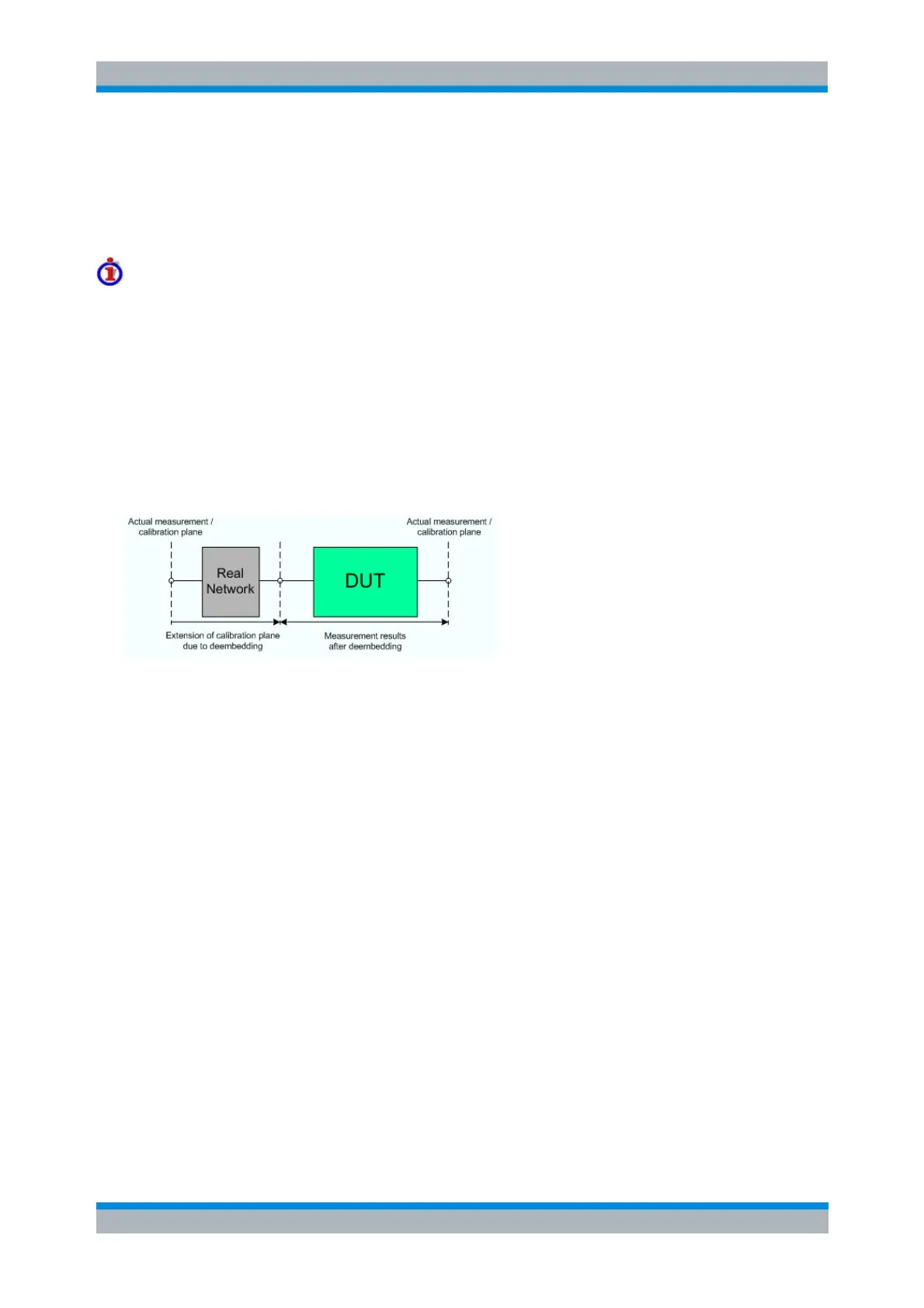
To be numerically removed, the real network must be described by a set of S-parameters or by an
equivalent circuit of lumped elements. Deembedding the DUT effectively extends the calibration plane
towards the DUT ports, enabling a realistic evaluation of the DUT without the distorting network.
Deembedding can be combined with length offset parameters.
The simplest case of single port deembedding can be depicted as follows:
The embedding/deembedding function in the Virtual Transform menu has the following characteristics:
Embedding and deembedding can be combined with balanced port conversion: the (de-
)embedding function is available for single ended and balanced ports.
A combination of four-port and two-port networks (not necessarily both) can be applied to
balanced ports; two-port networks can be applied to single ended ports.
A combination of four-port and two-port networks can be applied to any pair of single-ended ports.
Moreover it is possible to combine an several port pairs in an arbitrary order (port pair (de-
)embedding).
(De-)embedding at a single-ended and/or balanced port may be combined with ground loop (de-
)embedding. A ground loop models the effect of a non-ideal ground connection of the DUT.
Transformation networks can be defined by a set of S-parameters stored in a Touchstone file or
by an equivalent circuit with lumped elements.
The same networks are available for embedding and deembedding.


 To Next Page