R&S
®
ZVA / R&S
®
ZVB / R&S
®
ZVT GUI Reference
Channel Menu
Operating Manual 1145.1084.12 – 30 441
Frequency range for waveguide standards
For waveguide Line standards with a lower cutoff frequency f
c
, the formulas for the minimum and
maximum frequency are modified as follows:
f
min
= sqrt{1/[18*(d
Line
– d
Through
)]^2 + f
c
^2}
f
max
= sqrt{16/[9*(d
Line
– d
Through
)]^2 + f
c
^2}
TRL Calibration with Two or Three Lines
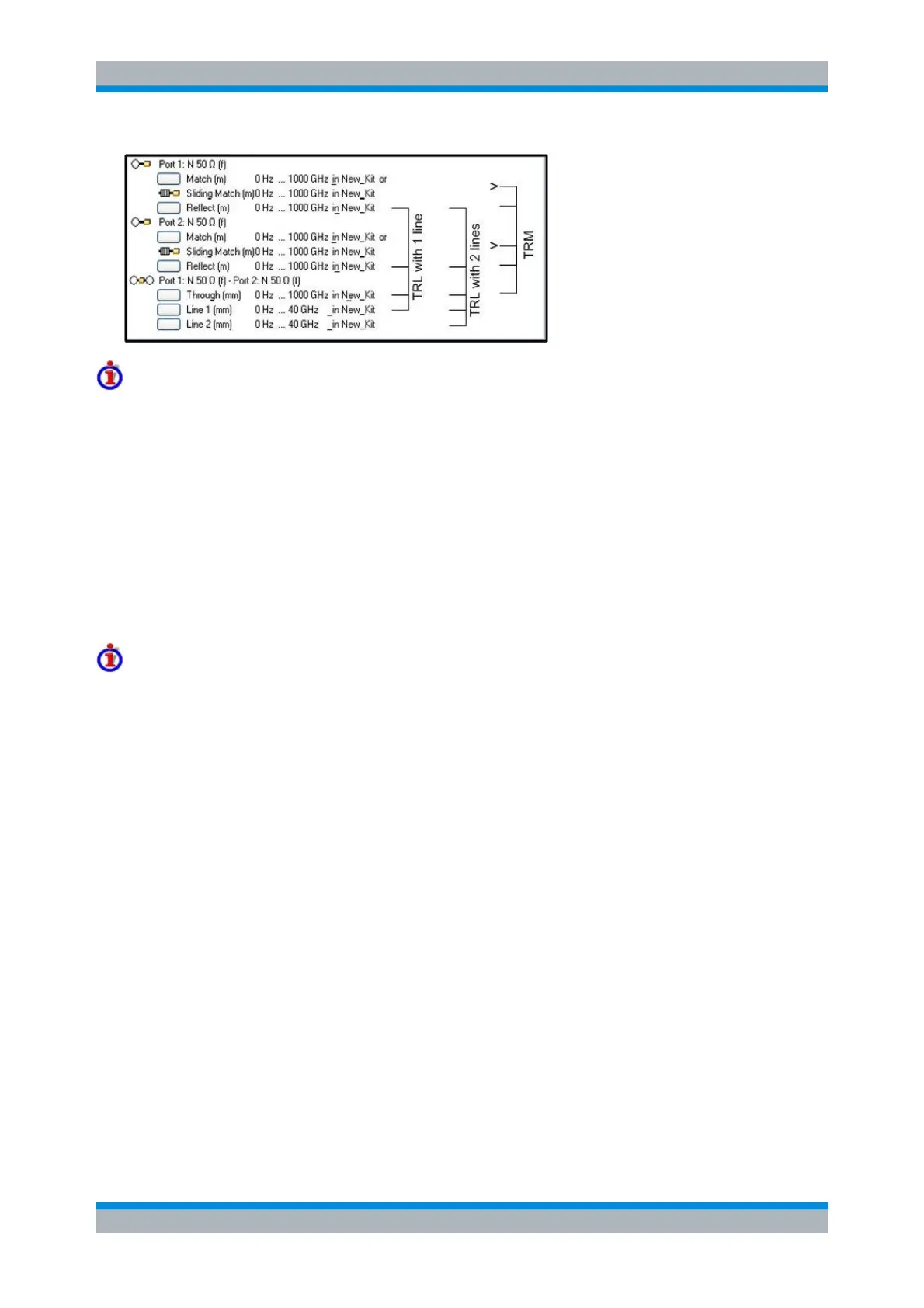
If several Lines with different lengths are measured, the analyzer automatically divides the calibrated
frequency range into sub-ranges; see background information below. The calibration data of the longest
Line is applied to the lowest sub-range, the calibration data of the shortest Line to the highest sub-range.
Calculation of sub-ranges
The transition frequency f
transition
between the calibration sweep sub-ranges for two Lines with delays d
long
and d
short
is obtained according to:
f
transition
= 1 / [2 (|d
long
– d
Through
| + |d
short
– d
Through
|)]
d
Through
denotes the delay of the Through standard. At f
transition
the phase difference between the longer
Line and the Through and the phase difference between the shorter Line and the Through are at an equal
distance from the ideal value of 90 deg. The delays d
long
, d
short
, and d
Through
are extracted from the cal kit
data.
For a TRL calibration using three Lines with different delays, the transition frequencies between adjacent
sweep ranges are calculated in an analogous manner.
Modifications of the transition frequency formula
The formula for f
transition
is modified in the following instances:
For waveguide standards with a lower cutoff frequency f
c
, f
transition
= sqrt{1/[2 (|d
long
– d
Through
| +
|d
short
– d
Through
|)]^2 + f
c
^2}.
If the frequency ranges of both Line standards overlap but the calculated transition frequency is
below (above) the minimum (maximum) frequency of the shorter (longer) Line, it is replaced by
the minimum (maximum) frequency of the shorter (longer) Line.
If the frequency ranges of both Line standards do not overlap, f
transition
is not modified, but a warning is
displayed before the calibration is applied.


 To Next Page