R&S
®
ZVA / R&S
®
ZVB / R&S
®
ZVT GUI Reference
Channel Menu
Operating Manual 1145.1084.12 – 30 440
appropriate, self-explanatory notice boxes.
[SENSe<Ch>:]CORRection:COLLect[:ACQuire]:RSAVe
[SENSe<Ch>:]CORRection:COLLect[:ACQUire]:SELected
[SENSe<Ch>:]CORRection:COLLect:DELete ["<cal_name>"]
[SENSe<Ch>:]CORRection:STIMulus?
TRL Extensions
The frequency range for a TRL calibration is restricted due to singularities in the system of equations to be
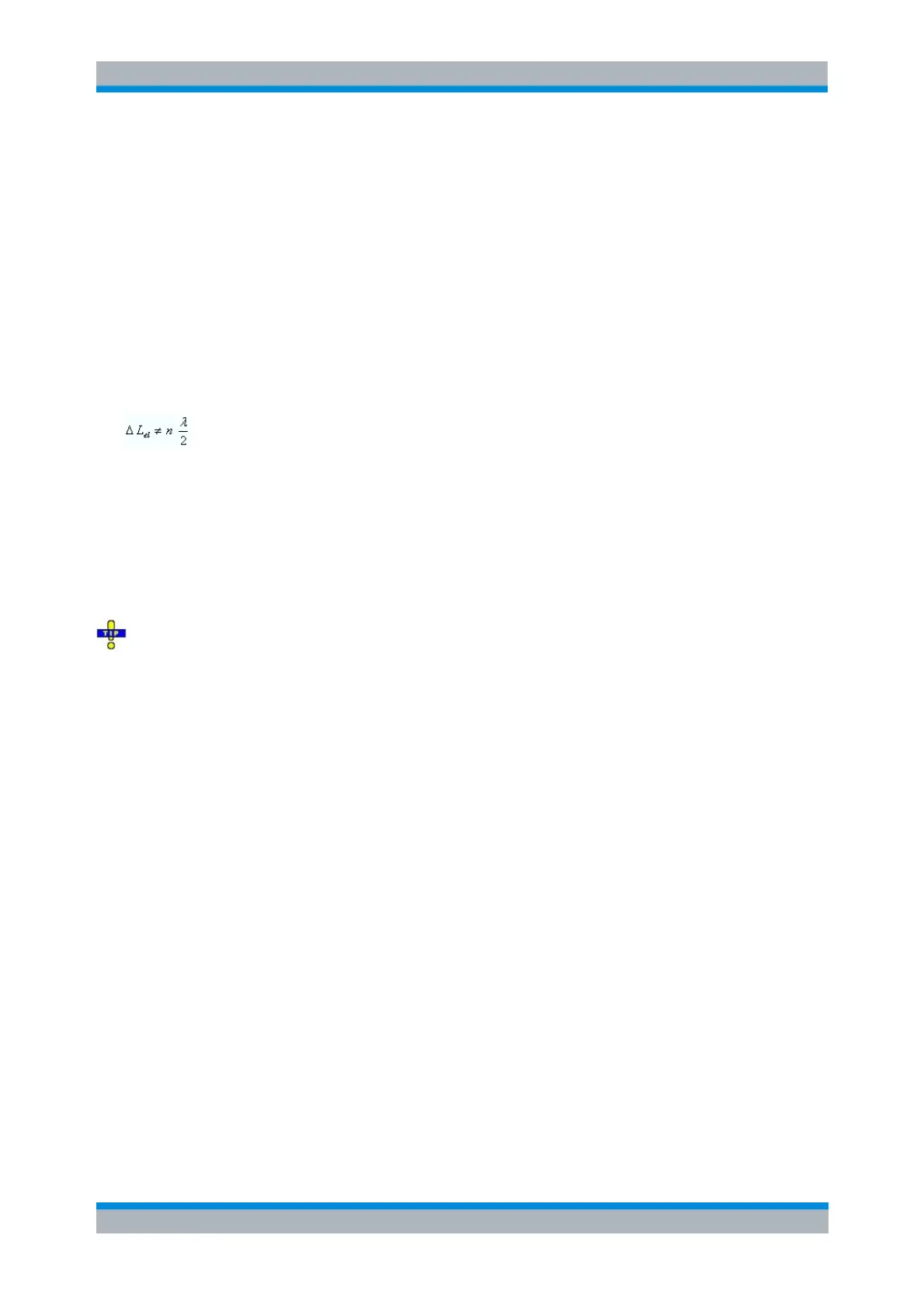
solved. Singularities occur whenever the electrical length difference
L
el
between the Through and the
Line is an integer multiple of half of the wave length:
As a rule, singularities are avoided with sufficient accuracy if the phase shift due to the (electrical) length
difference between the Through and the Line standard is between 20° and 160°. This corresponds to a
ratio of 1:8 for the start and stop frequency of the calibrated sweep range:
f
min
= 20°/360°*1/[d
Line
– d
Through
]; f
max
= 160°/360°*1/[d
Line
– d
Through
].
In the formula above, d denotes the delay, which is the electrical length divided by the velocity of light (d =
L
el
/ c).
To shift the calibrated sweep range to smaller or larger frequencies, you can use a longer or shorter
Line. To extend the calibrated range, use one of the following methods:
Perform TRL calibration with two or three different Line standards. With an appropriate length of
the Lines, the ratio for the start and stop frequency of the calibrated sweep range can increase to
approx. 1:64 (for 2 Lines) or 1:512 (for 3 Lines).
In the low-frequency domain where TRL becomes inaccurate, replace TRL by TRM calibration.
To check the frequency range of the Line standards, open the Channel – Calibration – Calibration
Kits – View/Modify Kit – View/Modify Standard dialog. The Optimize Line Freq Ranges button in
the Add Calibration Kit dialog re-adjusts the frequency ranges and transition frequencies between
the Line segments. You can also manually change the minimum and maximum frequency of each
Line standard and the adjusted transition frequencies.
The methods can be combined or used separately. The Measured Standards list for TRL calibration is
extended if the calibration kit in use contains the necessary standards:
A 2-Line (3-Line) calibration requires two (three) different Lines of matching gender. The Lines
must be measured between any combination of two ports.
A TRM extension at low frequencies requires either a Match or a sliding Match standard. The
standard must be measured at each port.
The complete Measured Standards list for a two-port calibration is shown below. The calibration is valid as
soon as the standards for TRL with 1 Line have been measured. The extensions are applied automatically
if the necessary standards have been measured.


 To Next Page