R&S
®
ZVA / R&S
®
ZVB / R&S
®
ZVT GUI Reference
Channel Menu
Operating Manual 1145.1084.12 – 30 451
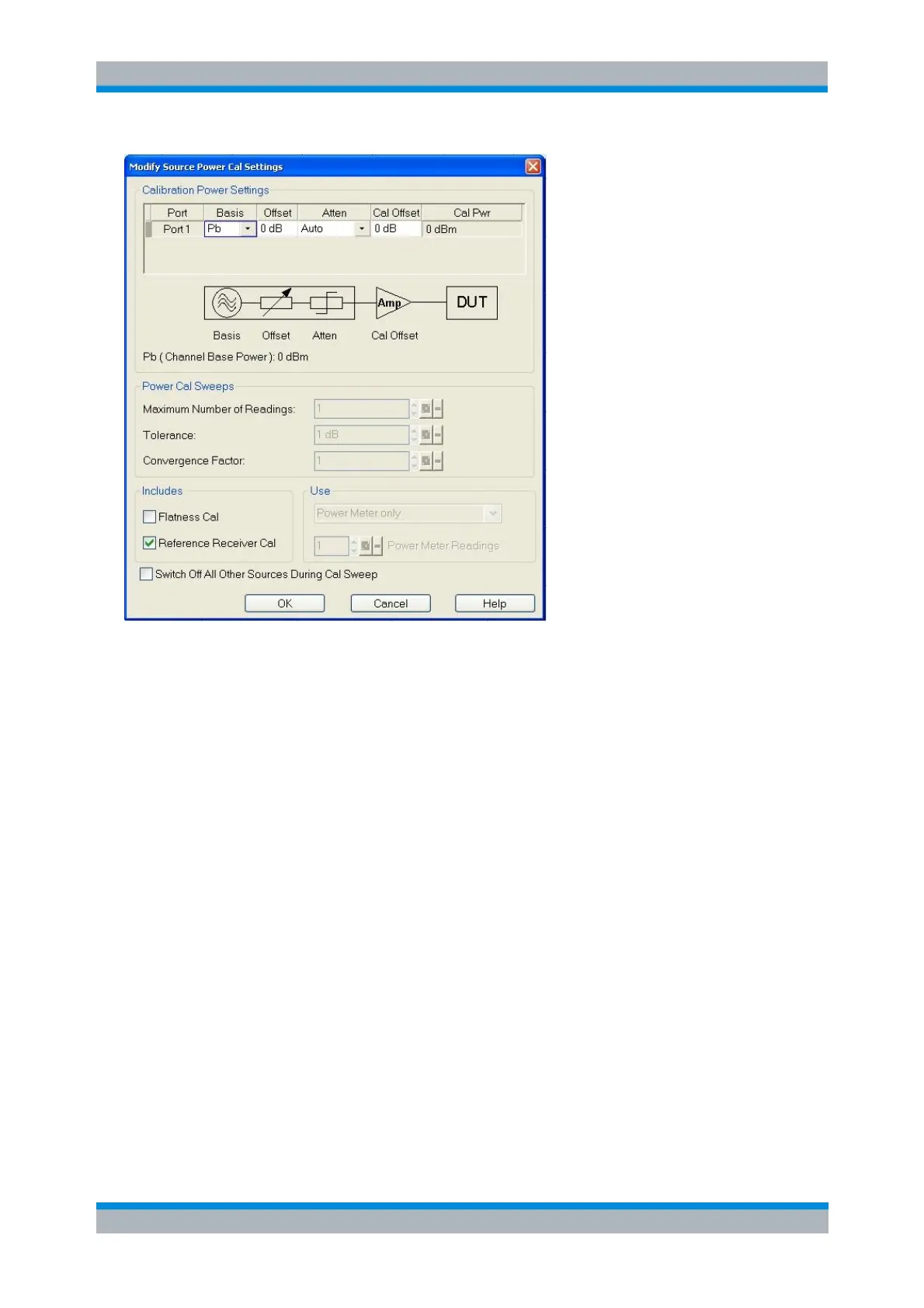
The dialog provides the following control elements:
Calibration Source Power Settings shows the calibrated Port(s), the Basis of the power
conversion formula, the port power Offset, the source step Attenuator setting, Cal (Power) Offset,
and the target power of the source power calibration at the calibration plane (Cal Pwr). The power
settings are analogous to the settings in the Port <n> Power dialog.
The parameters in the Power Cal Sweeps panel provide stop criteria for the calibration procedure:
Maximum Number of Readings is a limit for the number of calibration sweeps. Tolerance denotes
the maximum deviation of the measured power from the Cal Power. The calibration procedure is
stopped if the Maximum Number of Readings is reached or if the measured power is within the
Tolerance.
The Convergence Factor can be used to modify the amount of power correction after each
calibration sweep. The deviation from the desired power at the reference plane, as measured by
the external power meter or a-wave receiver, is multiplied by the selected convergence factor. The
variable attenuator setting is modified by the product of <power deviation> times <convergence
factor>. With a convergence factor larger (smaller) than 1, the source power correction after each
power calibration step is larger (smaller) than the measured deviation from the desired power.
Convergence factors different from 1 are indicated only if the test setup includes non-linear
components. External frequency converters may require convergence factors <1 at some source
power levels and frequencies. In general, it is recommendable to start the calibration with a
convergence factor 1 and choose smaller values (0.8 ... 0.4) in case that the iteration fails.
Inappropriate convergence factors can slow down the source power calibration or even prevent
convergence.
Includes – Flatness Cal enables the iterative source power calibration with the stop criteria
specified above. This corresponds to the normal source calibration procedure. If the Flatness Cal
is disabled, the analyzer performs a single calibration sweep in order to calibrate the reference
receiver (see below) but without overwriting the previous source power calibration data. The Port
n Cal Power and Power Meter Readings are disabled. A frequency extension with an external


 To Next Page