R&S
®
ZVA / R&S
®
ZVB / R&S
®
ZVT GUI Reference
Channel Menu
Operating Manual 1145.1084.12 – 30 296
SOURce<Ch>:FREQuency<Pt>:CONVersion:ARBitrary:CFRequency
Port <n> Power
The Port <n> Power dialog defines the port-specific source power. This is either a power range (for power
sweeps) or a fixed power (for frequency and CW sweeps). The general purpose of the port power settings
is to ensure a definite signal power at the input of the DUT, considering all possible sources of power
variations in the test setup.
The port-specific source power can be set to either the channel base power P
b
plus an offset or to a
constant value. The coefficients of the linear relation between P
b
and the actual source power are entered
in a dialog.
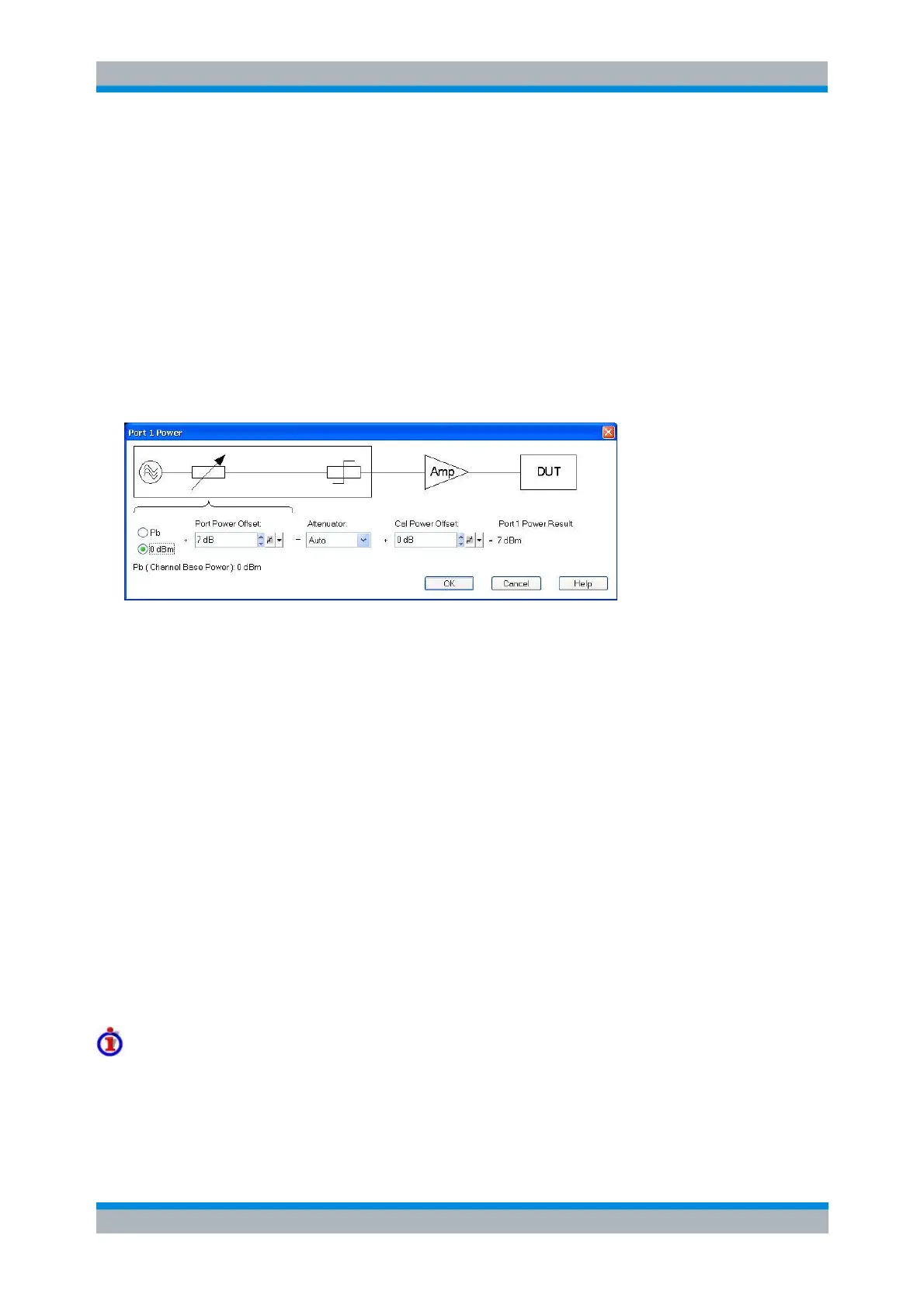
The Port <n> Power settings also appear in the Modify Source Power Cal Settings dialog:
Port Power Offset defines a port-specific offset to the channel power, to be added to the step
attenuator settings.
The actual output power at the port is equal to the channel power P
b
(Channel – Stimulus –
Power) plus the Port Power Offset minus the Attenuator setting. It is equal to the Port Power
Offset (in dBm) minus the Attenuator setting if 0 dBm is selected instead of P
b
. For power sweep
and the selection P
b
, the actual port power varies across the sweep, for other configurations the
port power is constant.
Attenuator defines the source step attenuator setting (with options R&S ZVABxx-B21); see Step
Attenuators. If Auto is selected, the step attenuator is set such that it doesn't have to be switched
over the entire sweep. The input field is unavailable and shows 0 dB if no generator step
attenuator is installed.
Cal Power Offset is relevant for source power calibrations; see background information below.
The parameter specifies a gain (positive values) or an attenuation (negative values) in the signal
path between the source port and the calibrated reference plane. With a Cal Power Offset of n dB,
the target power at the reference plane is equal to the actual output power at the port plus n dB.
The Cal Power Offset has no direct impact on the source power. It can be seen as a constant
power correction value.
Port <n> Power Result is the power at the reference plane of the power calibration (if available),
considering all dialog settings, including the Cal Power Offset.
Use of an amplifier in the signal path
Assume that a DUT requires a constant input power of +35 dBm, and that the measurement path contains
an amplifier with a 30 dB gain.
After a reset of the analyzer the channel power P
b
is zero dBm. With a Port Power Offset of +5 dB at the
calibrated source port and a Cal Power Offset of +30 dB, the source power calibration ensures that the


 To Next Page