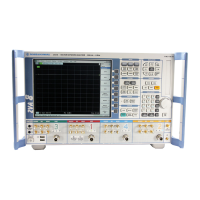
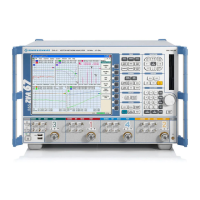
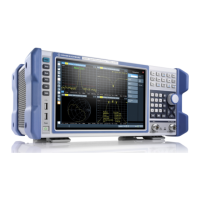
R&S
®
ZVA / R&S
®
ZVB / R&S
®
ZVT System Overview
Calibration Overview
Operating Manual 1145.1084.12 – 30 55
Reflect at all ports, Through
and
Line 1 [+ Line 2, Line 3
(optional)] between all
directed port pairs,
in combination with TRM
(optional)
Reflection
tracking,
Source match,
Directivity,
Load match,
Transmission
tracking
Reflection and transmission
measurements on DUTs with 2
or more ports, especially for
planar circuits. Limited
bandwidth.
NIST Multiline
TRL (2 or more
ports)
Reflect at all ports, Through
and
one or more Line standards
(number not limited)
between all directed port
pairs
Reflection
tracking,
Source match,
Directivity,
Load match,
Transmission
tracking
High, high
directivity
In general
higher accuracy
than TRL
Reflection and transmission
measurements on DUTs with 2
or more ports, especially for
planar circuits. Bandwidth
limited at low frequencies.
Through, Attenuation,
Symmetric network
Reflection
tracking,
Source match,
Directivity,
Load match,
Transmission
tracking
High, lowest
requirements on
standards
Reflection and transmission
measurements on DUTs with 2
or more ports, especially for
planar circuits.
1) Or any other 3 known one-port standards. To be used in a guided calibration, the known standards must be declared to be open,
short, and match irrespective of their properties .
2) Or any other known two-port standard. See remark above.
3) Via remote control it is possible to read the current error terms and to transfer user-defined error terms to the analyzer
The calibration type must be selected in accordance with the test setup. Select the calibration type for
which you can obtain or design the most accurate standards and for which you can measure the required
parameters with best accuracy.
Normalization
A normalization is the simplest calibration type since it requires the measurement of only one standard for
each calibrated S-parameter:
One-port (reflection) S-parameters (S
11
, S
22,
...) are calibrated with an open or a short standard
providing the reflection tracking error term.
Two-port (transmission) S-parameters (S
12
, S
21,
...) are calibrated with a through standard
providing the transmission tracking error term.
Normalization means that the measured S-parameter at each sweep point is divided by the corresponding
S-parameter of the standard. A normalization eliminates the frequency-dependent attenuation and phase
shift in the measurement path (reflection or transmission tracking error). It does not compensate for
directivity or mismatch errors. This limits the accuracy of a normalization.
Full One-Port Calibration
A full one-port calibration requires a short, an open and a match standard to be connected to a single test
port. The three standard measurements are used to derive all three reflection error terms:
The short and open standards are used to derive the source match and the reflection tracking
error terms.


 To Next Page