63 22 726 D3561
130 D3561.201.01.03.02 05.2012
4 Operation Sirona Dental Systems GmbH
4.6 Assistant element Operating Instructions SINIUS / SINIUS CS
4.6.6 Mini L.E.D. curing light
Mini L.E.D. curing light
The curing light is used to cure composite fillings with short-wave light.
4.6.6.1
Safety information
Safety information
Any condensation occurring in the handpiece of the Mini L.E.D. may
cause impairments (e.g. fogging of the L.E.D.). When moving the
handpiece from a cool environment to a warm room, always wait for it to
reach room temperature before putting it into operation.
Curing lights must not be used on persons who are suffering from or have
in the past been afflicted by photobiological reactions (including solar
urticaria and erythropoetic porphyria). Nor should they be used on
persons currently being treated with any medications which increase
one’s sensitivity to light (including methoxsalene and chlorotetracycline).
Any persons who have in the past suffered from retinal or eye lens
disorders or have undergone eye surgery, especially for gray cataracts,
must consult their medical eye specialist before using the light or
undergoing treatment with the Mini L.E.D. Caution is advisable even if the
patient gives his or her consent, since the light intensity can cause
accidents.
It is especially advisable to always wear appropriate protective goggles.
For the frequency range of the light, refer to “Technical data” [ → 133].
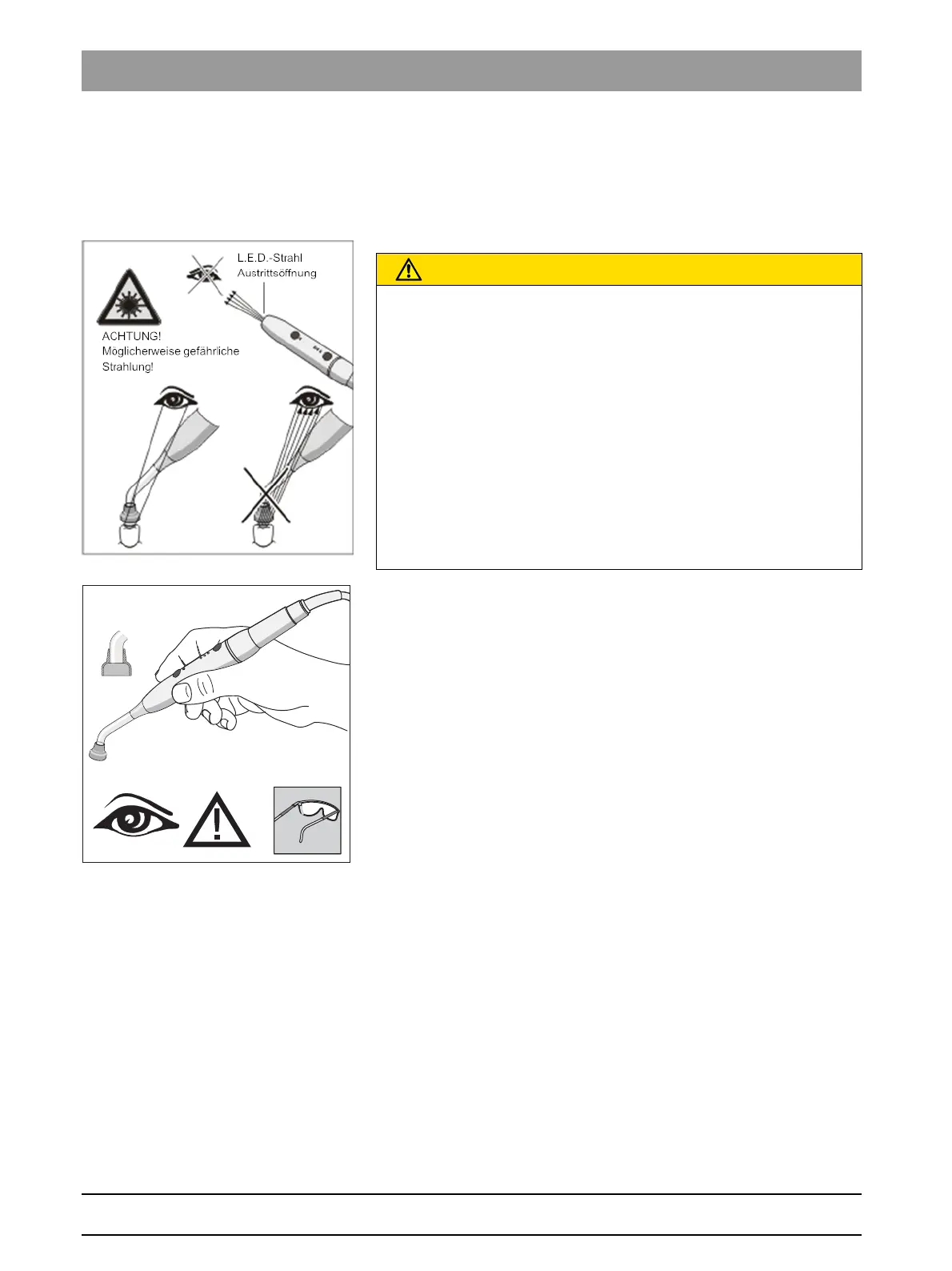
CAUTION
The curing light contains powerful LEDs. In accordance with IEC 62471,
they are classified in risk group 2 with the light bar removed.
➢ Do not stare into the beam path for longer periods, as this can
damage your eyes.
➢ Do not observe the light aperture with optical instruments which can
decrease the beam cross-section (e.g. magnifying lenses).
➢ Do not under any circumstances stare into the beam path when the
glass rod is removed.
➢ Never aim the laser beam at the user's or the patient's eyes, even if
he or she is wearing protective goggles.
➢ Never work without the glare shield.
➢ Never look into the light reflected by the tooth surface.
➢ Aim the light only at the treatment area in the oral cavity.




 To Next Page