63 22 726 D3561
20 D3561.201.01.03.02 05.2012
2 Safety instructions Sirona Dental Systems GmbH
2.16 Electrostatic discharge Operating Instructions SINIUS / SINIUS CS
● discharging the electrostatic charges from your own body through
contact with
– the metallic device casing
– a larger metallic object
– another grounded protective ground wire
● wearing an antistatic band that creates a connection between the
body and a protective ground wire.
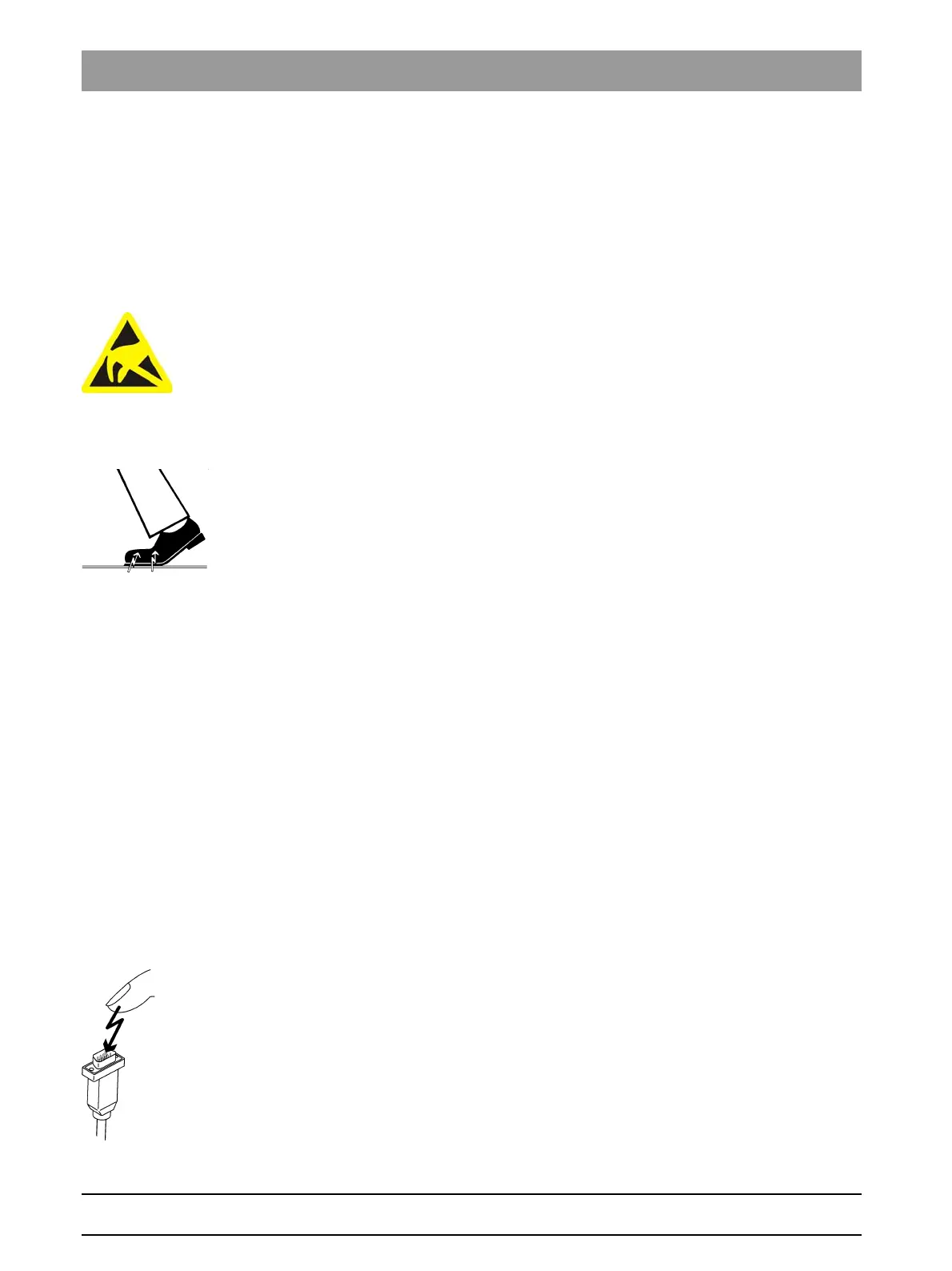
Areas at risk are indicated on the unit with the ESD warning label:
We recommend that all persons working with this system are made aware
of the significance of the ESD warning label. A training course should also
be held to inform users about the physics of electrostatic charges.
Physics of electrostatic charges
An electrostatic discharge requires prior electrostatic charging.
There is a danger of electrostatic charges building up whenever two
bodies rub against each other, e.g. when:
● walking (soles of shoes against the floor) or
● driving (tires against the road surface).
The amount of charge depends on several factors: The charge is:
● higher at low air humidity than at high air humidity, and
● higher with synthetic materials than with natural materials (clothing,
floor coverings).
The following rule of thumb can be applied to assess the transient
voltages resulting from an electrostatic discharge.
An electrostatic discharge is:
● perceptible at 3,000 V or higher
● audible at 5,000 V or higher (cracking, crackling)
● visible at 10,000 V or higher (spark-over)
The transient currents resulting from these discharges have a magnitude
of 10 amps. They are not hazardous for humans because they last for
only several nanoseconds.
Tip: 1 nanosecond = 1/1,000,000,000 second = 1 billionth of a second
Voltage differentials exceeding 30,000 volts per centimeter may lead to a
charge transfer (electrostatic discharge, lightning, spark-over).
Integrated circuits (logical circuits and microprocessors) are used in order
to implement a wide variety of functions in a device. The circuits must be
miniaturized to a very high degree in order to include as many functions
as possible on these chips. This leads to structure thicknesses as low as
a few ten thousandths of a millimeter. Integrated circuits that are
connected to wires leading externally are therefore particularly at risk
from electrostatic discharge.
Even voltages that are imperceptible to the user can cause breakdown of
the structures, thus leading to a discharge current that melts the chip in












 To Next Page