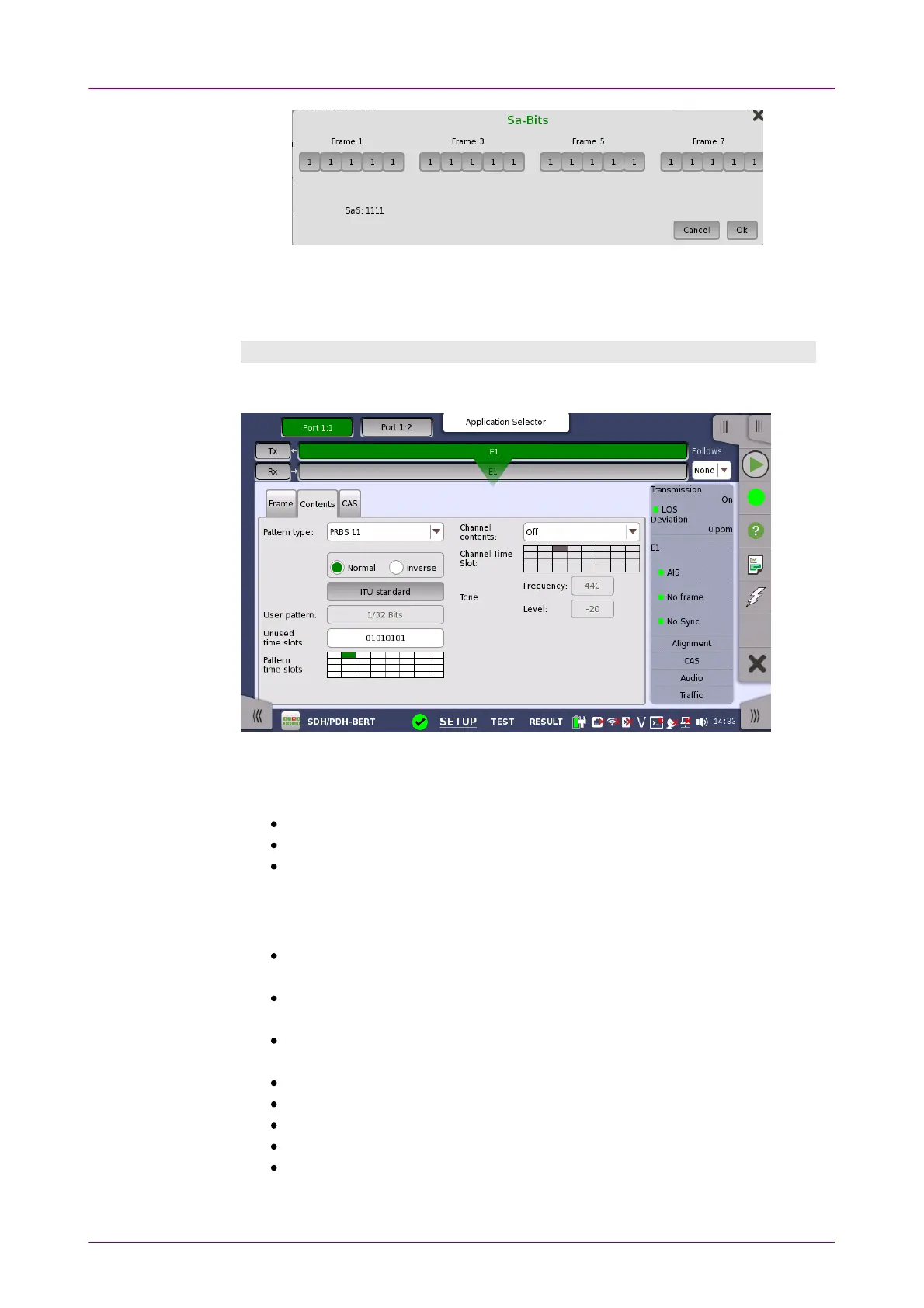
In the Sa-BitsSa-Bits dialog box, change the individual Sa-bits by touching on the
relevant bit keys - this will toggle the bit key's binary value from logic 1 to 0 or
vice versa. Touch OkOk to accept the changes and close the dialog.
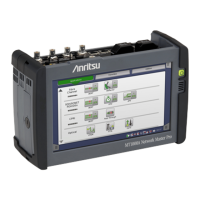
Content tab pageContent tab page
The ContentContent tab page contains the following parameters:
Pattern typePattern type
Select the pattern to be inserted in the transmitted signal.
OffOff: Does not insert the pattern.
User [32] bitUser [32] bit, User [2048] bitUser [2048] bit: 32 bits or 2048 bits length pattern.
PRBS 11PRBS 11 to PRBS 23PRBS 23: Pseudo-random bit sequence. The number indicates the
bit length of sequence.
For example, bit length of PRBS 9 is 2
9
-1=511.
Pattern LogicPattern Logic is enabled.
QRSS 11QRSS 11, QRSS 20QRSS 20: Quasi-random signal source.
The bit length of QRSS 11 is 2047, the length of QRSS 20 is 1 048 575.
Fox PatternFox Pattern 'THE QUICK BROWN FOX JUMPS OVER THE LAZY DOG
1234567890' in ASCII code
Fox (CMA3000)Fox (CMA3000) The 'fox pattern' using for the combined test with CMA3000
(the previous model of Network Master)
All 0'sAll 0's, All 1'sAll 1's: All bits are 0, all bits are 1.
Alternating 1:1Alternating 1:1: Bit pattern such as "010101..."
Alternating 1:3Alternating 1:3: Bit pattern such as "100010001000..."
Alternating 1:7Alternating 1:7: Bit pattern such as "1000000010000000..."
Alternating 3:24Alternating 3:24: A repeating 24-bit sequence that contains three ones, fifteen
consecutive zeros and 12.5% average ones density.





 To Next Page