Timing sourceTiming source
FollowsFollows
For the switching method between PDH Tx and DSn Tx, refer to Physical Setup
in "E1 Setup and Status". Touch E3E3 radio button. Touching OffOff radio button
disables the transmitter.
This screen allows you to make the physical setup of the PDH transmitter in E3
mode. It can also be used to inspect the current status of the selected port.
The configuration options available in the setup area of the screen are
described below. The status information is described in a separate section.
Select the clock source.
InternalInternal: Internal clock of the module
ExternalExternal: The clock provided from the Ext Clock connector
ReceivedReceived: The clock generated from the received signal
When ExternalExternal or ReceivedReceived is set, the right hand lamp indicates whether clock
is detected or not.
55..55..11..22 E3 Signal SetupE3 Signal Setup
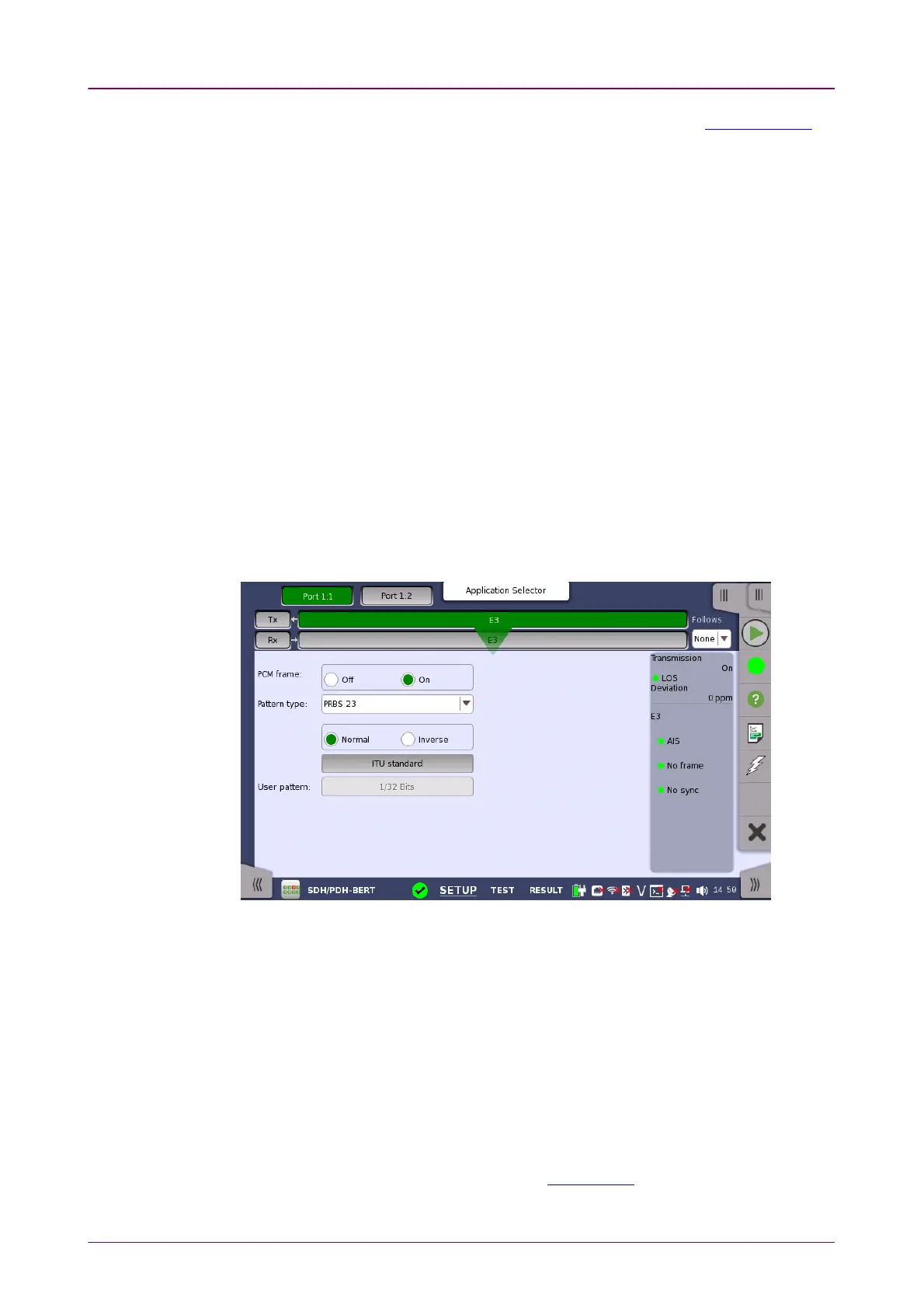
Touching the navigation area button which represents the transmitter's E3 layer
will display the screen shown below.
To make the Port 2 transmitter follow the Port 1 transmitter (i.e. copy its
settings) when using Port 1 and Port 2, touch the drop-down menu in the
navigation area and select the Tx1Tx1. The Port 2 settings continue to follow the
Port 1 transmitter change. The default setting is NoneNone. Note that the Port 1
transmitter cannot follow the Port 2 transmitter.
PCM framePCM frame
Use the PCM framePCM frame radio buttons to enable (OnOn) or disable (OffOff) insertion of
PCM frame in the transmitted signal.
Pattern typePattern type
Select the pattern to be inserted in the transmitted signal. Available patterns are
the same as the transmitter setup. Refer to Pattern type in "E1 Setup and
Status". Available patterns are:






 To Next Page