Instructions for use Primus Infinity Empowered SW 4.5n 81
Getting started
For Primus Infinity Empowered not configured with
an automatic detection for the Infinity ID CLIC ab-
sorber, the date and time indicating when the soda
lime was changed can only be logged by pressing
the soft key soda lime changed on the Check List
or the self test results screen. The label of the key
then changes to undo change. The key can be
pushed again to undo the soda lime change infor-
mation. Information on when the soda lime has
been changed will be logged in the system when
the automatic test is started.
The Infinity ID functionality for the Infinity ID CLIC
absorber can be enabled and disabled by
DrägerService. The factory default is enabled.
For diaphragm location and disassembly instruc-
tion see page 220.
Note the instructions for use of the
Drägersorb 800 Plus or Drägersorb FREE soda
lime.
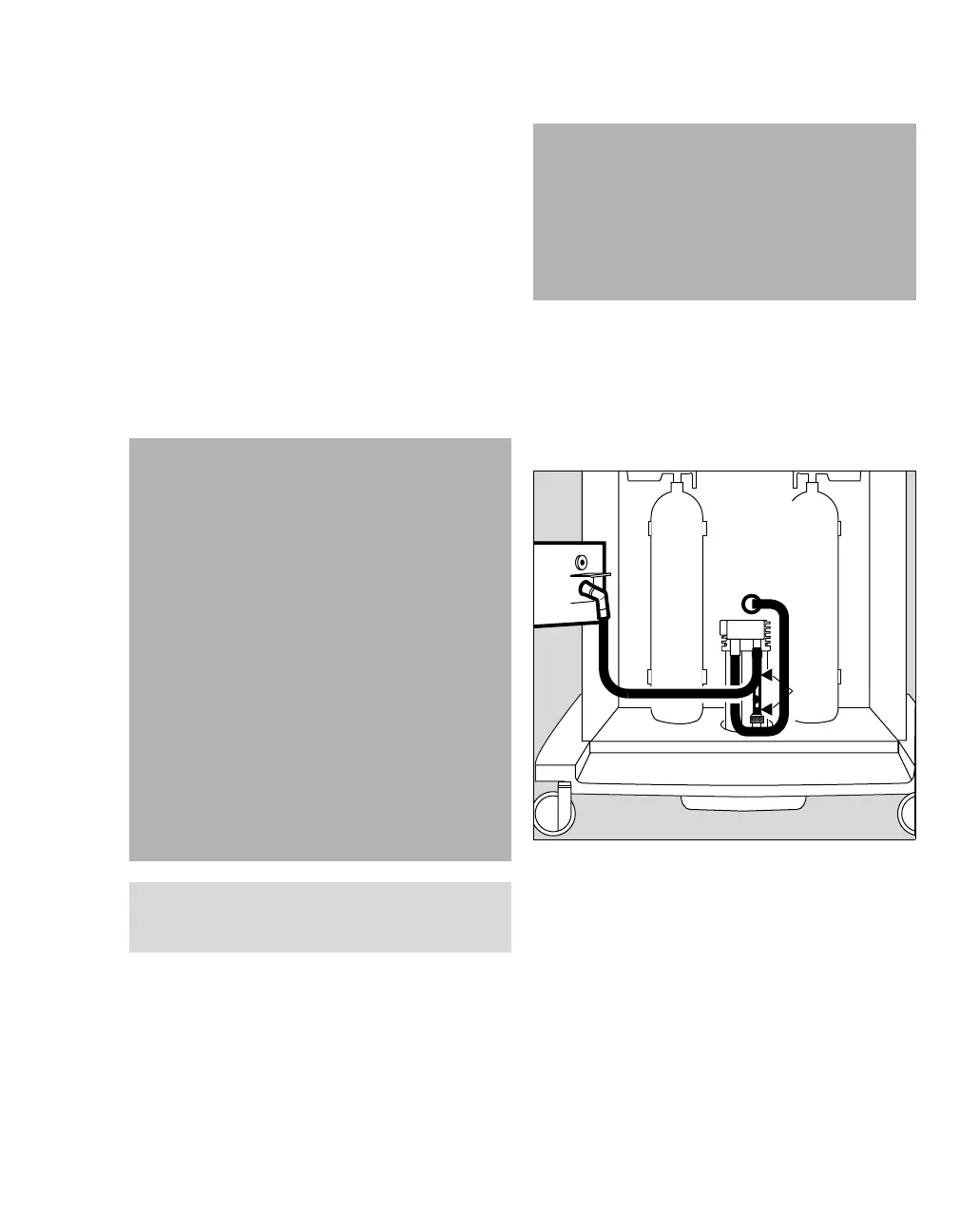
Anesthetic gas scavenging system AGS
1 The gray transfer hose (A) from the scavenging
nozzle must be connected.
2 Make sure that the AGS is connected to the ter-
minal unit of the disposal system via the scav-
enging hose (B). The operation indicator of the
terminal unit is green.
3 The AGS is functioning when the float in the
flow tube is between the two marks (C).
WARNING
Risk of patient injury
The soda lime loses humidity. Generally, if the
humidity falls below a minimum set point, un-
desirable reactions can occur, independent of
the type of lime and the inhalation anesthetic
being used:
–reduced CO2 absorption,
– increased heat build-up in the absorber
and thus, an increased breathing gas tem-
perature,
– formation of CO,
– absorption and/or decomposition of the
volatile anesthetic agent.
These reactions could pose a danger to the
patient.
When using dry gases, only flush the anesthe-
sia system briefly, and only if necessary!
NOTE
Drain any water which may have collected in the
ventilator diaphragm.
CAUTION
Risk of device failure
The correct operation of the anesthesia machine
will be impaired if condensation enters the breath-
ing system and/or the ventilator diaphragm.
If condensation is a frequent problem, install wa-
ter traps in the breathing hoses.
069
A
B
C



 To Next Page