Functional Description
Microsemi Proprietary and Confidential UG0677 User Guide Revision 9.0 49
• Global-Shared: These clocks are similar to Globals but have resources to allow sharing between
the TxPLLs. The sharing of lane clocking resources results in equal latency in the transmitter phase
compensation FIFO of all shared lanes.
Note: Global-Shared mode allows the global clock output from one lane to be used for other lanes. This
clocking mode is used when several lanes are part of the same protocol using the same clock.
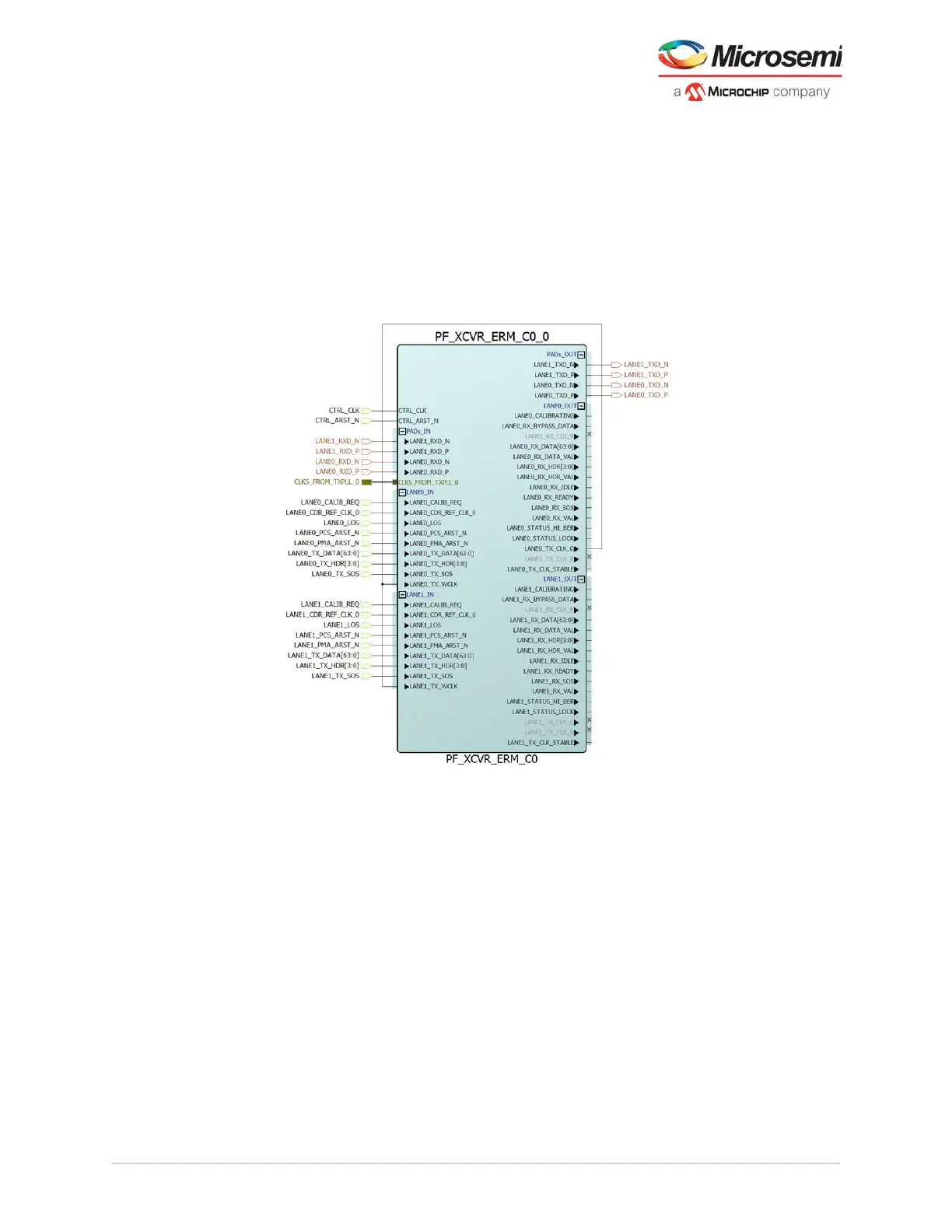
When Global-Shared mode is enabled, all the lanes include a global clock output port, but only one lane
can be used as the master port. All the lanes include a TX_WCLK input port. This port must be
connected to the global clock output of the master lane. The fly-wheel FIFO absorbs the phase difference
between the lanes and the master lane’s global clock. See the following SmartDesign figure for an
example.
Figure 30 • Global-shared Clocking Example
• Regional: These clocks use local resources to interconnect with the FPGA fabric with a FIFO in the
data path at the fabric boundary.
• Regional (Deterministic): These clocks use local resources to interconnect with the FPGA fabric
with zero-cycle data path at the fabric boundary providing low-latency.
Microsemi IP and solutions use these resources to optimize the FPGA architecture to provide robust use
cases. See Table 16, page 54.
3.4.1 Non-Deterministic Interface
The transceiver PMA to FPGA fabric/PCS data path includes a flywheel FIFO (FWF) interface, which is
used to transfer data between clock domains. This interface is included within the protocol-specific PCS
HDL modules or user FPGA fabric logic.
FWF is a simple form of FIFO where its write and read clocks are known to be at the same nominal
frequency, with some allowed phase difference and jitter that is compensated within the block.
The interface between the PMA and fabric cannot be throttled. However, the addition of the FWF block in
the data path handles the phase crossing of every PMA lane, ensuring that timing is met across this
interface. The received data, along with the recovered parallel clock, is passed to the FWF, which
synchronizes the data and clock for either regional or global clock routing.



 To Next Page