Functional Description
Microsemi Proprietary and Confidential UG0677 User Guide Revision 9.0 63
3.5.4.2 Jitter Attenuator
All transmit PLLs support a jitter-attenuator option. The jitter attenuator is used to track the data rate of
any noisy reference clock with a clean input reference clock to provide a 0 ppm offset from the noisy
reference clock while providing a jitter-cleaned output. It is used in designs requiring loop-timing where
the recovered clock is used as the transmit clock requiring low jitter performance. This is used in
applications such as Synchronous Ethernet (SyncE) providing low jitter synchronization to an Ethernet
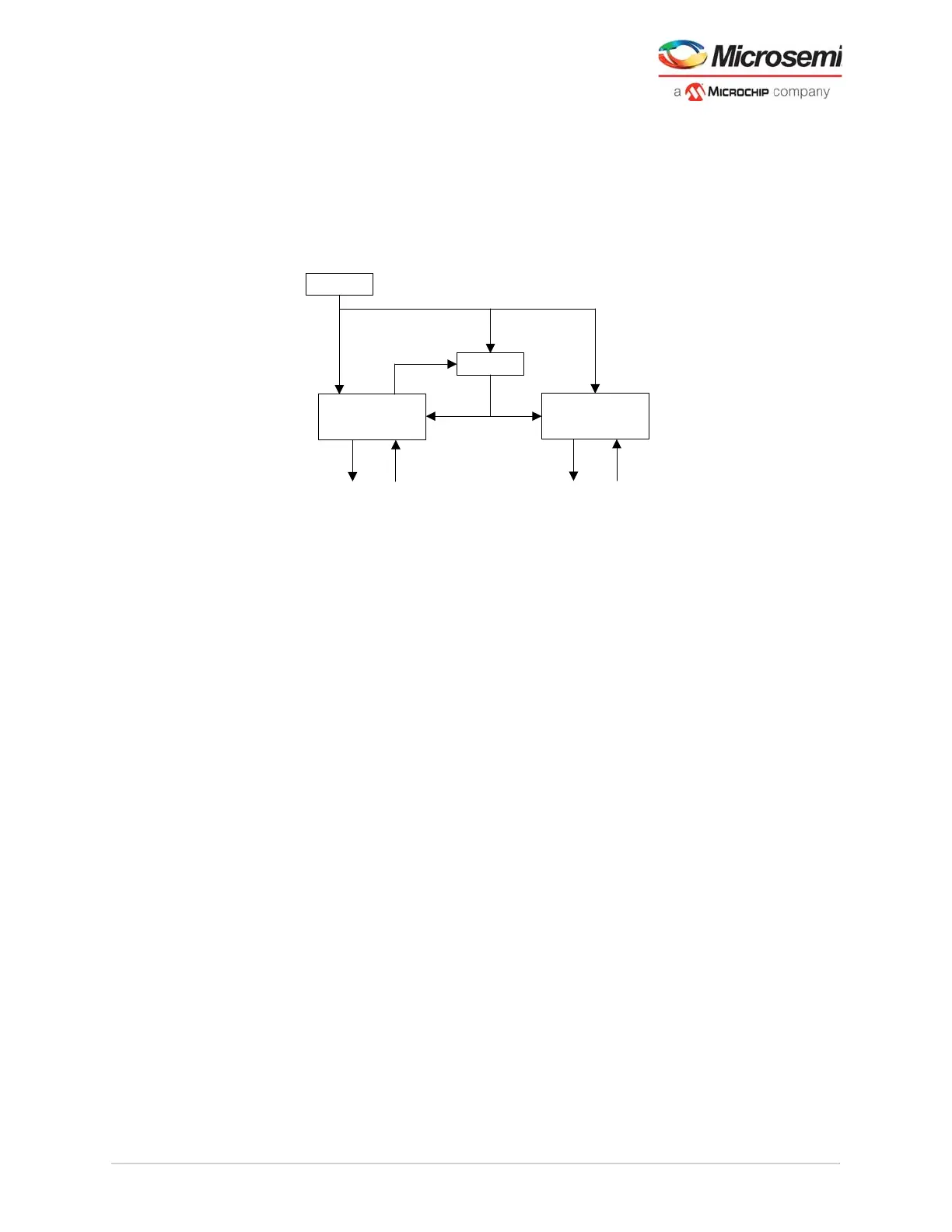
network. The following figure illustrates the application using jitter attenuation.
Figure 44 • Typical Jitter Attenuator Application Scheme
The TXPLL in the PolarFire transceiver can provide jitter attenuation. Its design attenuates input jitter by
using Libero configured settings to adjust the loop bandwidth and damping factors. The TXPLL input
from the recovered source of the RX_CLK is cleaned from jitter components in the JA_CLK input path of
the TXPLL. The TXPLL configurator allows pre-determined configurations of the attenuation feature
based on protocol including the following protocols.
• 10G SyncE (32-, 64-bit)
• 1G SyncE 10-bit
• CPRI Rate [1-8]
• SDI (3G, HD, SD)
JA_PLL demonstrates compliance with the 10G SyncE the ITU-T G.8261 and G.8262 standards. A 10G
SyncE Characterization Report and Libero Reference Design solution is available.
RX_CLK_R
Reference
Clock Osc
Lane0
TxPLL
Lane1
JA_CLK
REFCLK
TX_BIT_CLK



 To Next Page