R&S
®
ZVA / R&S
®
ZVB / R&S
®
ZVT GUI Reference
Channel Menu
Operating Manual 1145.1084.12 – 30 324
measurements also require option R&S ZVA-K5, Vector Mixer Calibration. Moreover, the hardware
options R&S ZVA<frequency>-B16, Direct Generator/Receiver Access, must be fitted.
Vector mixer measurements
In contrast to scalar mixer measurements, vector mixer measurements provide magnitude and phase
information, including group delay, about the mixer under test (MUT). To assess the phase information,
the IF signal at the mixer output is converted back to the original RF frequency using a second MEAS
mixer. A third REF mixer ensures that the reference wave is converted back to the RF frequency. The test
setup also requires a high or lowpass filter and a power splitter.
Vector mixer measurements are performed between the physical ports 1 and 2 of the network analyzer.
No balanced port configurations are supported. Port 1 is assigned to the RF port of the mixer under test,
port 2 to the IF port. Due to the two additional mixers, the frequencies of the measured waves a
1
, a
2
, b
1
,
and b
2
are all equal so that S-parameters and other quantities can be interpreted in the usual way, in
analogy to the parameters of a non frequency-converting network. The LO signals for the MUT and the
additional mixers can be provided by additional analyzer ports (port3, port 4, if available) or by external
generators.
With the extended test setup, calibration becomes an important issue: In addition to the power calibration
of the source signals, a complete two-port calibration at ports 1 and 2 (mixer vector calibration) is required
to compensate for the effects of the additional components and shift the reference plane towards the ports
of the mixer under test.
In the vector mixer mode the analyzer provides the following functionality:
Configuration of the RF and LO signals and measurement of the generated IF signal, see Define
Mixer Mode and Vector Mixer Test Setup.
Power calibration of all signal sources; see Mixer Power Calibration.
Full two-port calibration of the test setup including the two additional mixers; see Mixer Vector
Calibration.
The vector mixer mode can be used to test important performance parameters of RF mixers such
as frequency ranges, conversion loss, compression, and isolation.
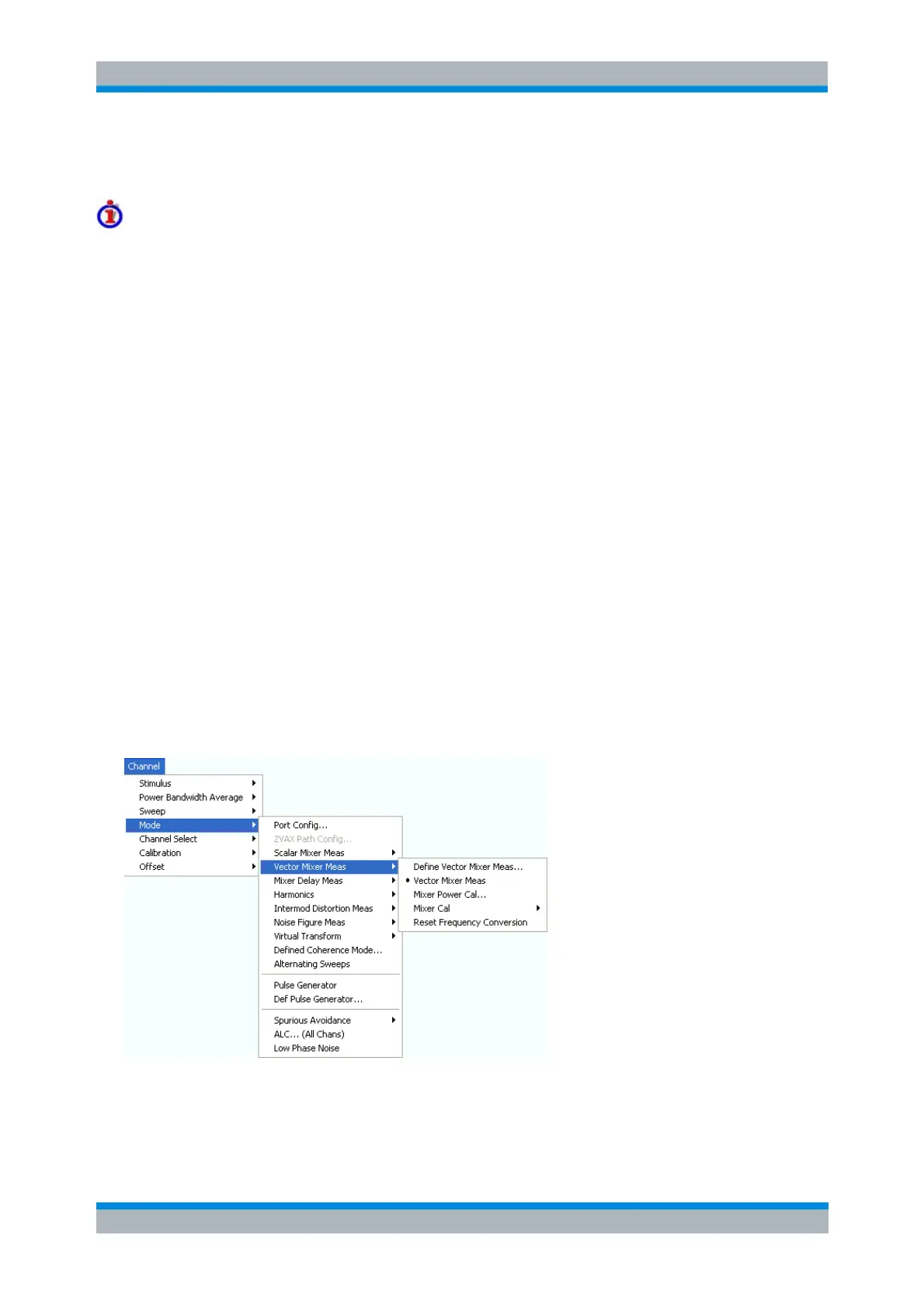
Define Vector Mixer Meas... opens a dialog to configure the mixer input signals.
Vector Mixer Meas and Reset Frequency Conversion toggle between the (frequency-converting)
vector mixer mode and normal (non frequency converting) operation.


 To Next Page