R&S
®
ZVA / R&S
®
ZVB / R&S
®
ZVT GUI Reference
Channel Menu
Operating Manual 1145.1084.12 – 30 383
it to a physical port and enables (de-)embedding. The two dialogs for deembedding and embedding are
identical except for their inverse effect. The dialogs are available only after a balanced port configuration
has been defined.
The dialogs contain the following control elements:
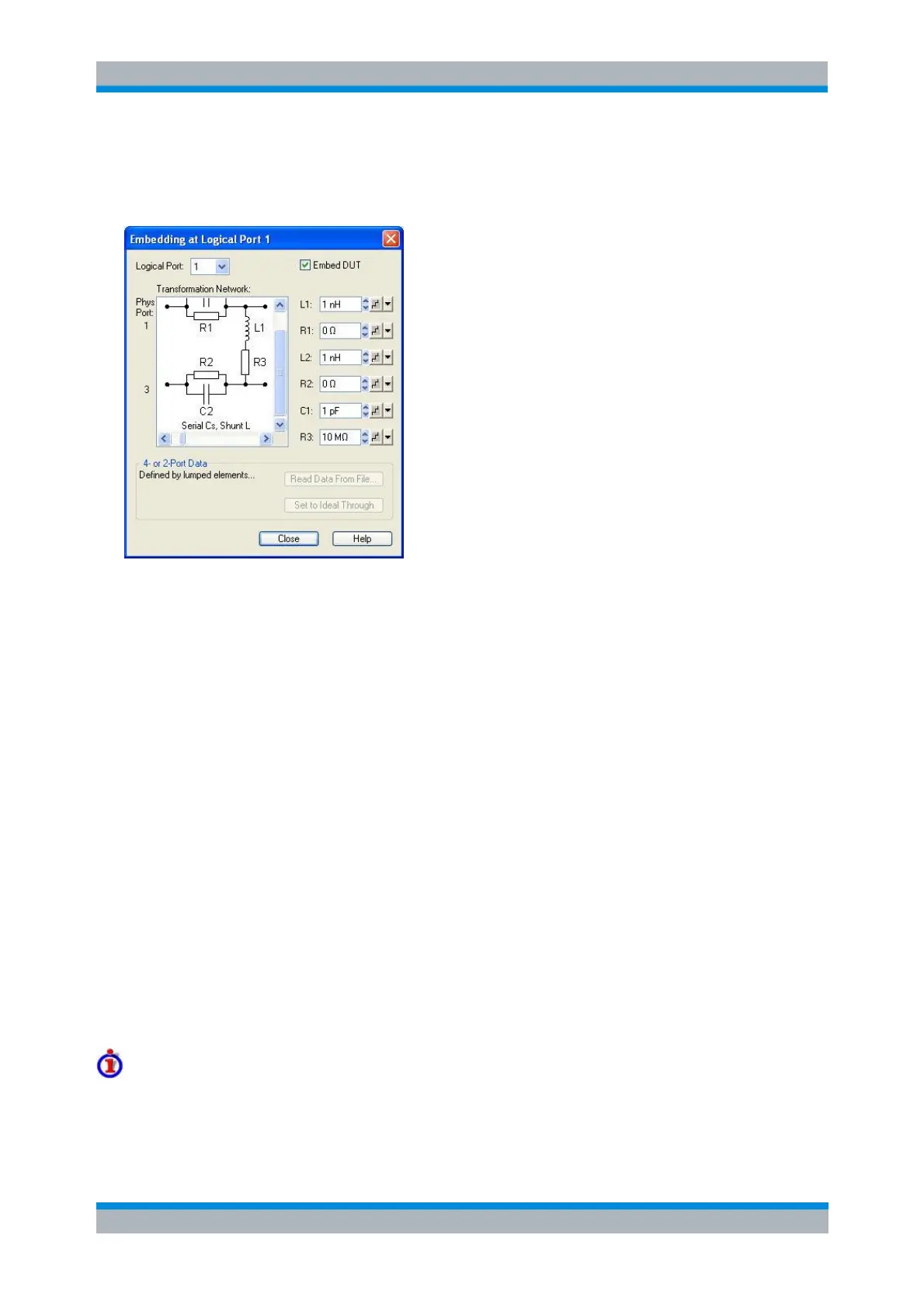
Physical Port is the physical analyzer port for the added or removed circuit. The transformation
networks are defined such that the physical analyzer test port is connected to the left of the circuit;
the DUT port is on the right side.
(De-)embed DUT enables or disables the (de-)embedding function.
Transformation Network contains all available 4-port networks (see below). Networks are defined
by lumped elements or by means of imported S-parameter data. The active network appears in
inverse colors. The element parameters (C, R, L) for the selected network are displayed on the
right side.
Read Data From File... is enabled as long as one of the networks involving two-port or four-port S-
parameter data is active. The S-parameters are read from two-port (*.s2p) or four-port (*.s4p)
Touchstone files. Each two-port file can be assigned to one of two different physical ports, to be
selected by means of the Phys. Port radio buttons.
S-parameter data are not renormalized during the import, however, they are renormalized to the
connector impedances of the associated ports before they are used for (de-)embedding. This
means that is still possible to change the connector impedances after S-parameter import. For
background information about renormalization see Reference Impedances.
In case the port number conventions of the loaded two-port Touchstone file differ from NWA
conventions (see description of Physical Port above), it is possible to Interchange Port Numbers
of s2p File.
Set to Ideal Through is enabled as long as one of the networks involving two-port or four-port S-
parameter data is active. An imported S-parameter set is replaced by the S-parameters of an ideal
through connection, which eliminates the transformation network.
Circuit models for 4-port networks
The lumped element 4-port transformation networks for (de-)embedding consist of the following two basic
circuit blocks:


 To Next Page