R&S
®
ZVA / R&S
®
ZVB / R&S
®
ZVT GUI Reference
Channel Menu
Operating Manual 1145.1084.12 – 30 410
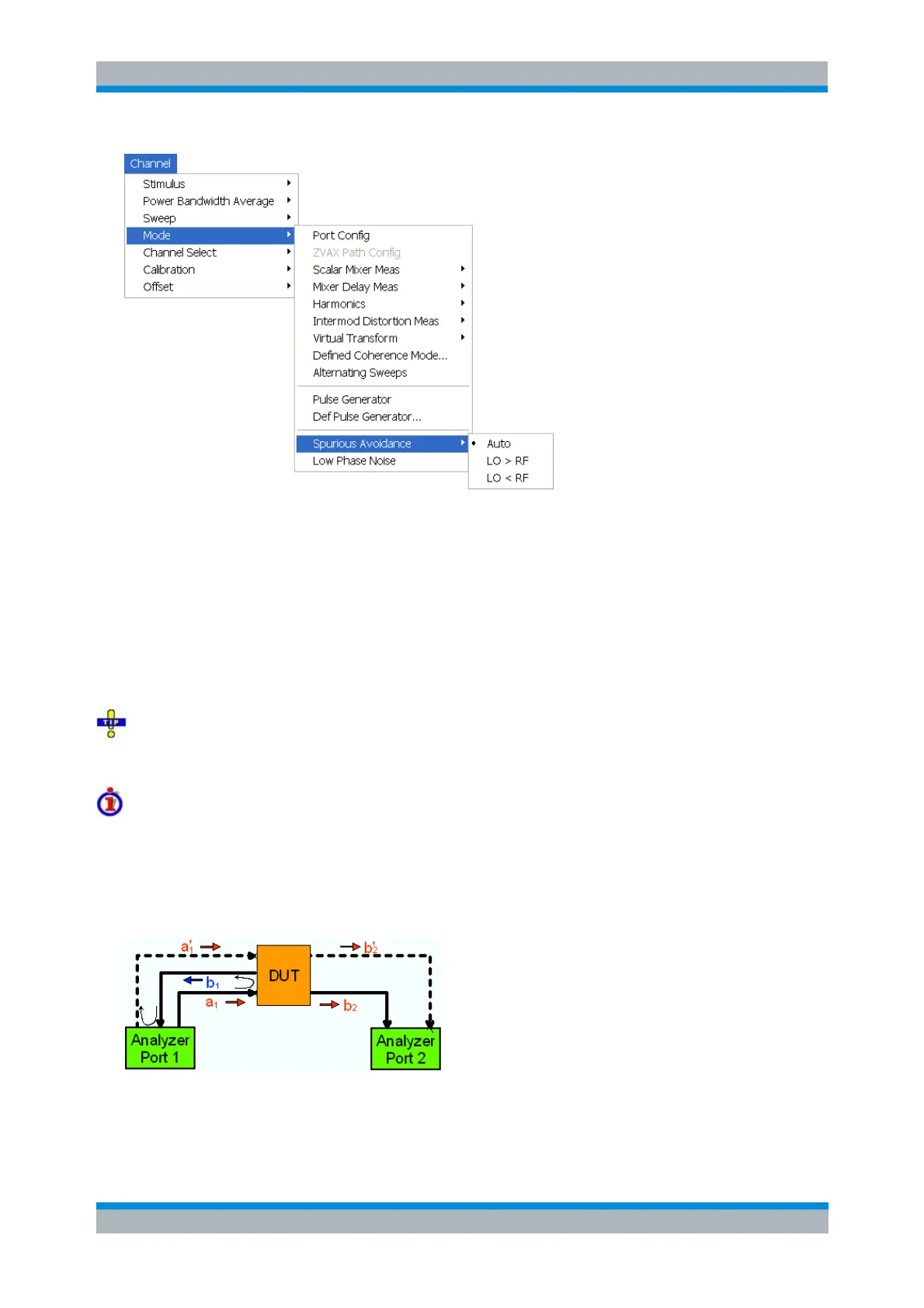
This feature can be used to eliminate known spurious components in the input signal that can distort the
measurement, especially in the low frequency range.
In Auto mode, the analyzer auto-selects the local oscillator frequency, depending on the receiver
(RF) frequency and the test port. This mode systematically avoids known spurious signals
provided that no frequency conversion occurs in the test setup.
LO > RF means that the LO frequency is always above the measured RF frequency. This mode is
appropriate for avoiding single, known spurious signals.
LO < RF means that the LO frequency is always below the measured RF frequency. This mode is
appropriate for avoiding single, known spurious signals.
In the presence of several spurious signals, setting the Spurious Avoidance parameter globally may
not be sufficient. To improve the result, perform a Segmented Frequency sweep and assign independent
LO frequencies to the individual sweep segments.
Application example
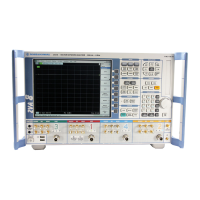
Consider the following test setup with strongly reflecting DUT (e.g. a bandpass in its stop band) that is
measured in transmission. a
1
is generated at a frequency RF. The reflected wave b
1
falls into the receiver
mixer of the analyzer port 1, where a small fraction of the mixer product RF + 2*IF can be reflected back
towards the DUT. If this spurious wave a'
1
passes the DUT, then it is received as b'
2
at port 2, together
with the wanted signal b
2
.
LO > RF implies that LO = RF + IF. The mixer at port 2 converts both the wanted signal b
2
and the
spurious signal b'
2
which is at the frequency RF' = IF + LO, to the same IF frequency. The response of an
ideal, infinitely steep bandpass filter with a pass band between B
-
and B
+
looks as follows:


 To Next Page