R&S
®
ZVA / R&S
®
ZVB / R&S
®
ZVT GUI Reference
Channel Menu
Operating Manual 1145.1084.12 – 30 411
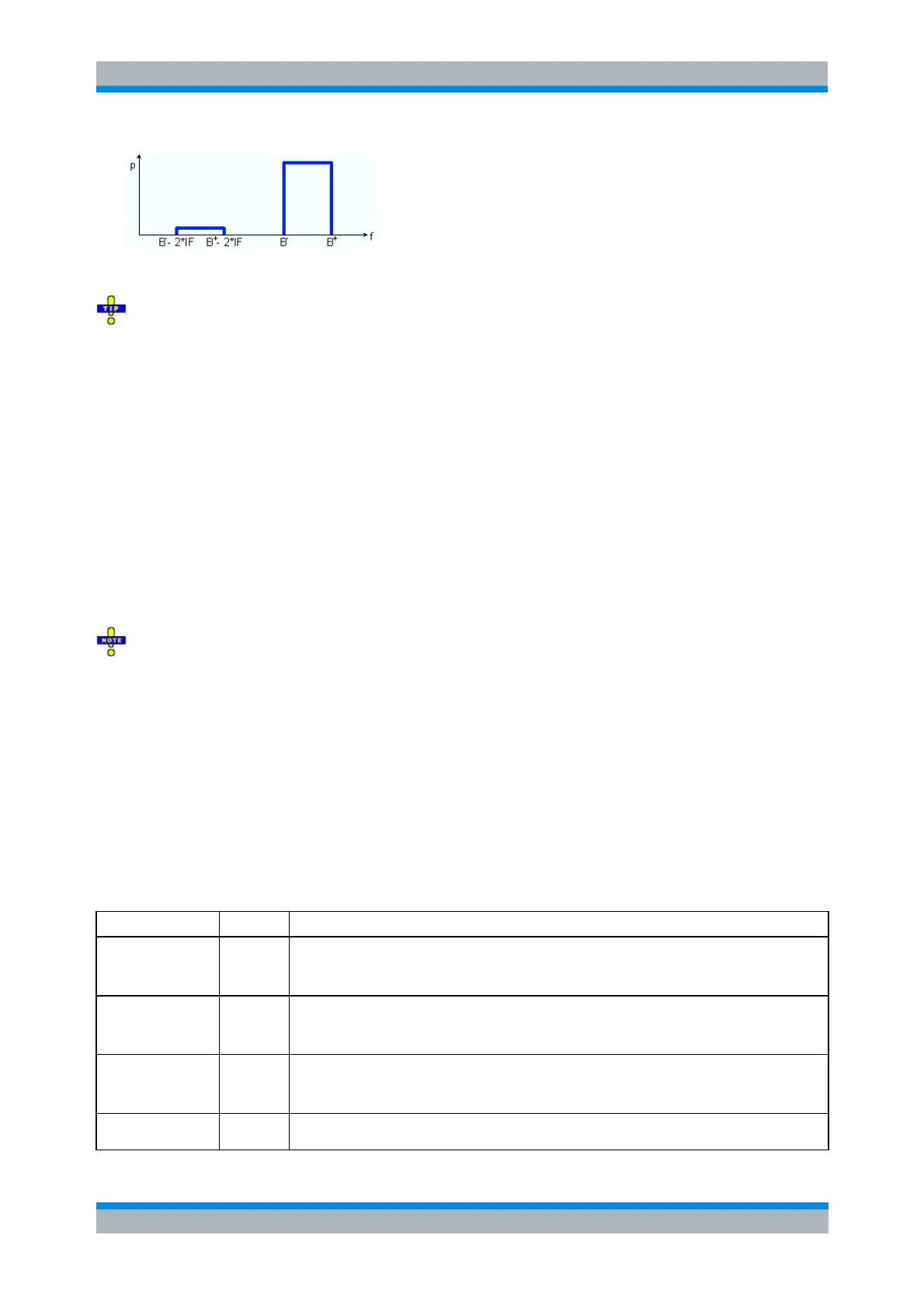
For a wide bandpass, the spurious response flattens the filter edges.
The spurious signal can be eliminated by dividing the sweep range into two segments with different
LO settings:
In the low-frequency segment, ranging up to the center frequency of the bandpass filter, the
frequency of the local oscillator is set to LO < RF. This ensures that the spurious signal b'
2
is not
measured at port 2.
In the high-frequency segment, starting at the center frequency of the bandpass filter, the
frequency of the local oscillator is set to LO > RF. If the center frequency is larger than B
+
– 2*IF,
then there is no distortion from b'
2
.
[SENSe<Ch>:]FREQuency:SBANd POSitive | NEGative | AUTO
Low Phase Noise
Reduces the phase noise of the source signals. The measurement speed is slightly reduced.
The "Low Phase Noise" setting is only available for older synthesizer generations with coupled test
ports.
The latest synthesizer generations of ZVA67 and of ZVA24/40 with 4 ports and 4 sources do not offer this
setting.
[SENSe<Ch>:]FREQuency<1>:LPNoise ON | OFF
Extension Unit R&S ZVAX24 (for R&S ZVA)
The extension unit R&S ZVAX24 is an accessory for vector network analyzers R&S ZVA24. The extension
unit can accommodate a variety of hardware options which extend the measurement functionality of the
network analyzer. The table below lists all options with possible applications. For an introduction to the
application unit and an application example refer to the Getting Started guide, stock no. 1312.7985.62.
Amplifies the input signal at port 2 of the network analyzer.
This reduces the noise figure of the NWA receiver and thus improves the accuracy of a noise
figure measurement with option R&S ZVAB-K30.
Port 2 Receiver
Monitor Output
The measured signal at port 2 is fed to the MONITOR connector on the R&S ZVAX24 front
panel.
An external device (e.g. a spectrum analyzer) can be connected to monitor the signal.
Combines the source signals from ports 1 and 3.
With different port frequencies, the combiner provides a two-tone signal, e.g. for intermodulation
measurements.
Provides an RF source signal with excellent harmonics suppression at port 1.


 To Next Page