R&S
®
ZVA / R&S
®
ZVB / R&S
®
ZVT GUI Reference
System Menu
Operating Manual 1145.1084.12 – 30 546
This power transfer model provides a maximum dynamic range while maintaining the spectral purity of the
converter output signal in the low-power range. The output power of converters without electronic
attenuator can additionally be set by the power adjustment knob. It is possible to adjust the knob to a
desired attenuation value and use this value as a correction factor for the port power.
The parameters configure a linear approximation of the relation between the input power P
RF IN
at the
converter's RF IN connector and the output power P
TP
at its test port:
P
TP
= Slope · P
RF IN
+ Offset - a
where a distinction is made between the waveguide attenuation a and an additional constant Offset,
indicating the output power at P
RF IN
= 0 dBm.
Output Power at Test Port defines the Slope and Offset parameters within this equation.
Waveguide Attenuator (Attenuation a) specifies the waveguide attenuation inside the converter
o Mechanical assumes a fixed, frequency-independent waveguide attenuation a the
analyzer will compensate for by increasing the RF In power. This attenuation is subtracted
from the offset as shown in the formula above.
This model is suitable for frequency converters without electronic attenuators but with an
output power adjustment knob; see background information below how to set a defined
attenuation. Increasing mechanical attenuation allows one to measure power-sensitive
DUTs while maintaining a sufficient input power at RF IN, which in turn provides a good
spectral purity of the mm-wave signal.
o Electronic is only available for converters with electronic attenuator. A piecewise linear
model is applied in this case.
The output power of frequency converters with electronic attenuators can be varied by
means of RF input power (i.e. the source power at the analyzer test port providing the
signal fed to RF IN) and/or by means of the electronic waveguide attenuators in the
converters. A combination of both methods will generally provide an RF output signal with
optimum characteristics; see Port<i> Power Control.
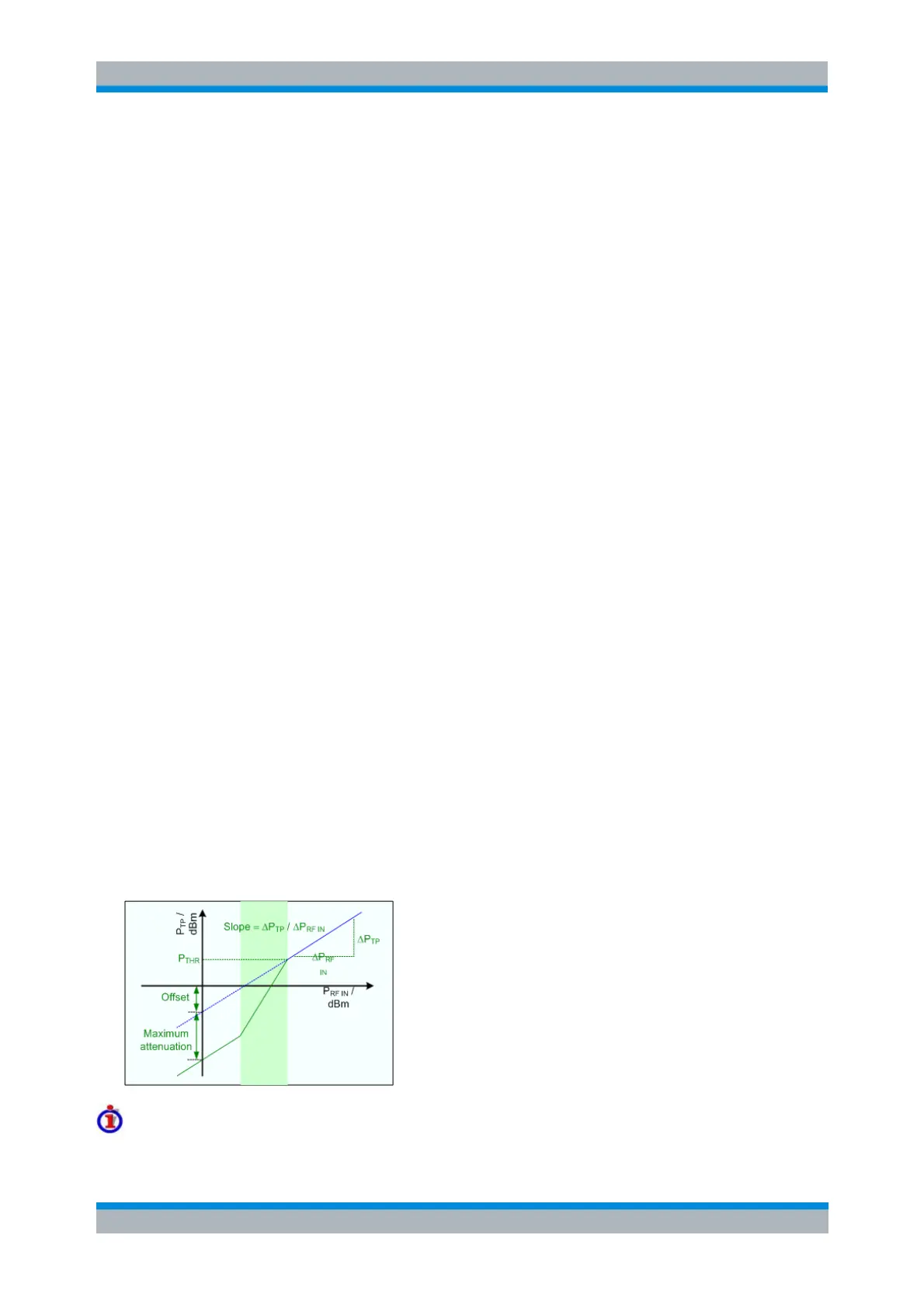
In the figure below, the green area corresponds to the test port power range where the
electronic attenuator is used. The output power threshold P
THR
("...output power at test
port is decreased below <P
THR
> dBm...") defines the right border of the area. The selected
percentage ("...% of power reduction...") due to the electronic attenuator defines the slope
of the green curve in the shaded area relative to the original slope (the larger the
percentage, the steeper the curve). The shaded area ends where the distance between
the green curve and the original blue curve has reached the selected "maximum
attenuation" of the electronic attenuator.
As a result of the combination between RF and waveguide attenuation, lower converter
output powers can be obtained at larger RF input powers. This improves the spectral
purity of the converter output signal in the low-power range.
Recommended procedure for setting a defined mechanical attenuation


 To Next Page