4.
Rinse the contaminated wells with deionized water (see “Detailed procedures for cleaning the
sample block” on page 160).
5.
Install the block and heated cover (see “Install a block” on page 156).
6.
Perform a background calibration to confirm that you have eliminated the contamination (see
“Perform calibrations” on page 91).
7.
If the contamination remains, clean the contaminated wells with a 95% ethanol solution.
Repeat step 2 to step 6 with a 95% ethanol solution (see “Detailed procedures for cleaning the
sample block” on page 160).
IMPORTANT! Always use deioniz
ed water to rinse wells after cleaning with bleach or ethanol
solution.
8.
If the contamination r
emains, clean the contaminated wells with a 10% bleach solution.
Repeat step 2 to step 6 with a 10% bleach solution (see “Detailed procedures for cleaning the
sample block” on page 160).
IMPORTANT! Always use deionized water to rinse wells after cleaning with bleach or ethanol
solution.
9.
Use Smar
t Help if the contamination remains (see “Request technical support with Smart Help” on
page 172).
Detailed procedures for cleaning the sample block
IMPORTANT! Use these cleaning procedures only in conjunction with the complete decontamination
procedure (see “Clean the sample block” on page 159).
•
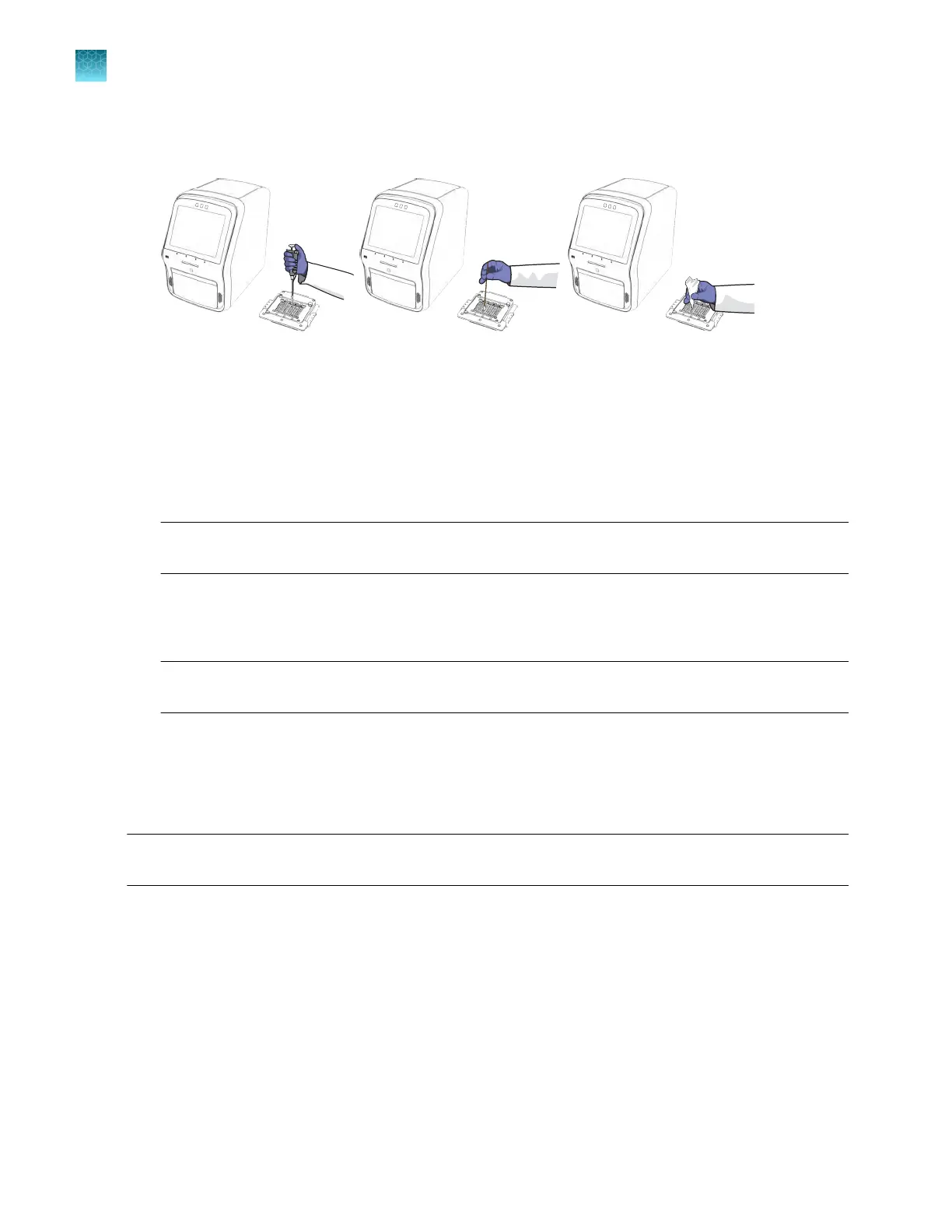
Rinse the sample block with deionized water.
a.
Pipet a small volume of deionized water into each contaminated well.
b.
In each well, pipet the water up and down several times to rinse the well.
c.
Pipet the water to a waste beaker.
d.
Use a cotton swab to scrub inside of each contaminated well.
e.
Use a lint-free cloth to absorb the excess deionized water.
Chapter 10 Maintain the instrument
Decontaminat
e the sample block
10
160
QuantStudio
™
6 Pro Real-Time PCR System and QuantStudio
™
7 Pro Real-Time PCR System User Guide




 To Next Page