Overview of data collection
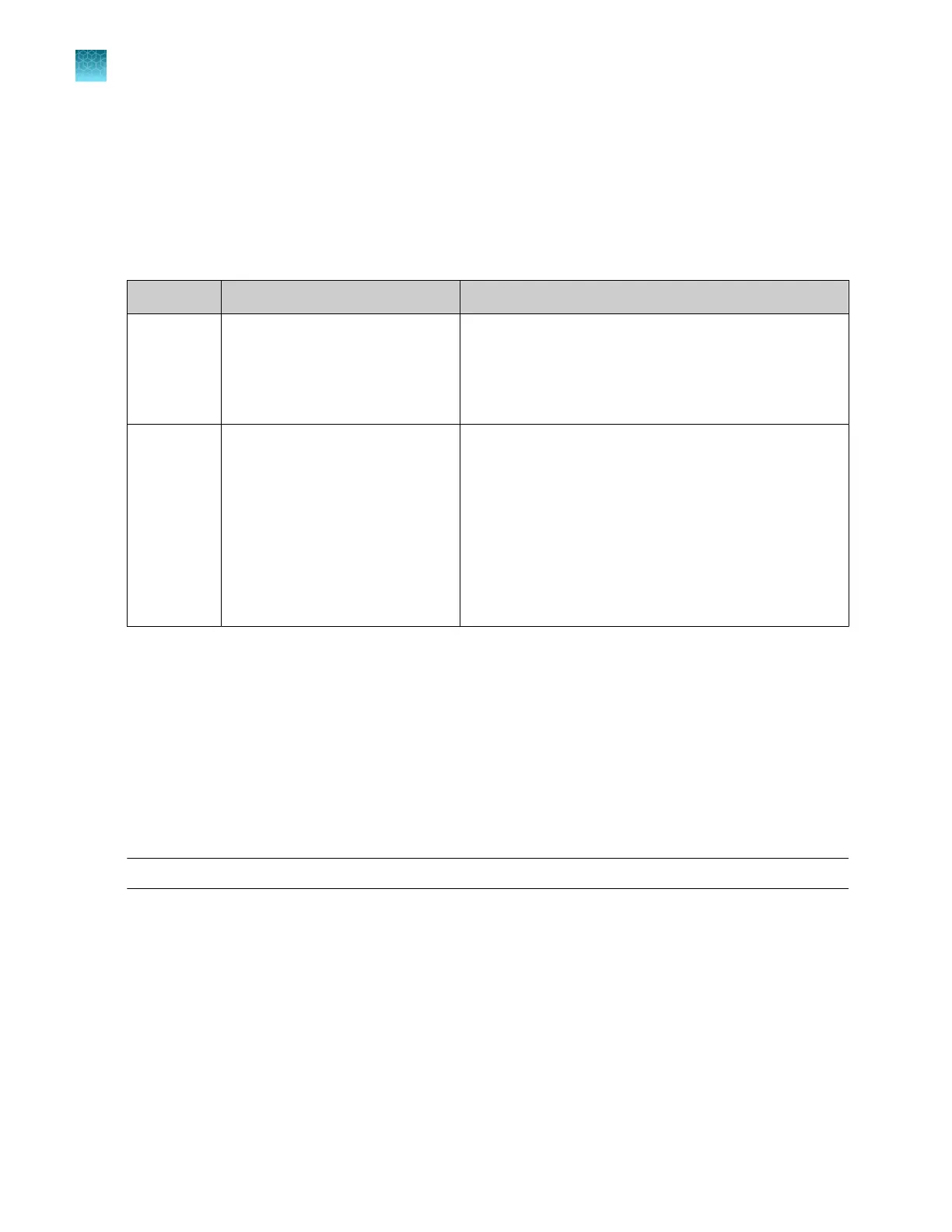
The instrument collects raw fluorescence data at dierent points during the PCR cycle, depending on
the type of run performed.
When you create a plate file, you can customize the optical filter channels through which the instrument
collects data. You can specify a filter channel set for all PCR thermal protocols and for melt curve
stages.
Run type Run type Data collection point
Real-time
•
Standard curve
•
Relative standard curve
•
Comparative C
t
(DDC
t
)
•
Melt curve
During the thermal cycling protocol.
Typical timing is to collect data at each cycle of a PCR
stage or continuously during a melt stage.
Post-PCR
(endpoint)
•
Genotyping
•
Presence/absence
•
After thermal cycling is completed.
For Presence/Absence and Genotyping analysis,
data collection before the PCR cycle is optional, but
recommended.
•
(Optional) During the thermal cycling protocol.
Collecting data during the run can confirm
genotyping results by viewing traces in allelic
discrimination plots or viewing genotyping calls at
earlier cycles.
VeriFlex
™
Zones
VeriFlex
™
Z
ones provide independent temperature zones that oer enhanced functionality and precise
control over your real-time PCR runs.
The independent zones are ideal for real-time PCR optimization. They also provide the ability to perform
multiple runs at the same time. Unlike standard gradients which give a sigmoidal temperature curve
across the columns, blocks with VeriFlex
™
Zones help deliver accurate temperatures across every zone.
The QuantStudio
™
6 Pro System has three VeriFlex
™
Zones (Figure 1 on page 19). The QuantStudio
™
7
Pro System has six VeriFlex
™
Zones (Figure 2 on page 19).
Note: VeriFlex
™
Zones are only applicable for the 96-well 0.2-mL block and the 96-well 0.1-mL block.
Chapter 1 Product information
Instrument hardware description
1
18
QuantStudio
™
6 Pro Real-Time PCR System and QuantStudio
™
7 Pro Real-Time PCR System User Guide




 To Next Page