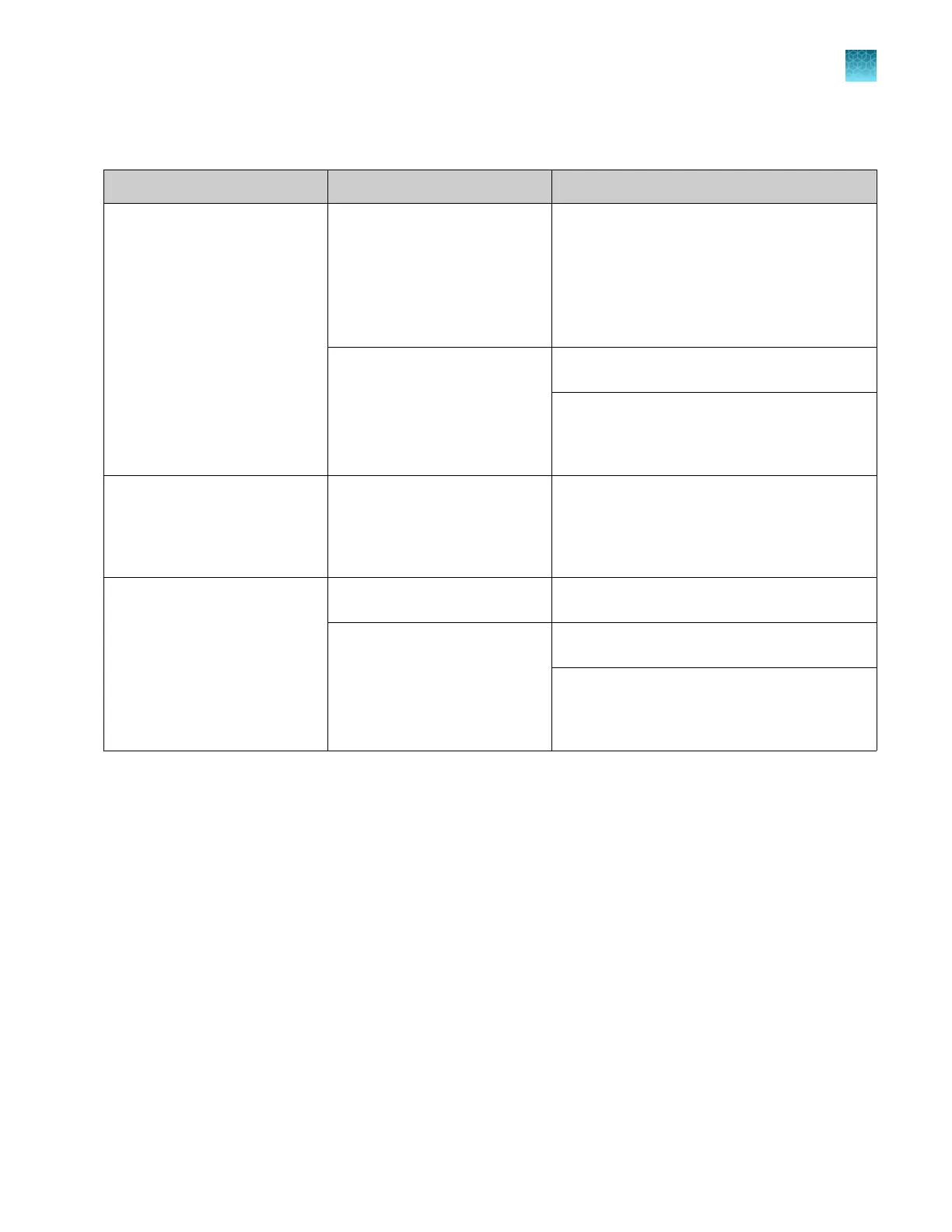
Troubleshoot calibration failure
Observation Possible cause Recommended action
Calibration failed
The plate was improperly
prepared.
Ensure the following:
•
The correct plate was used for the
calibration performed.
•
The plate was properly thawed.
•
The plate was properly centrifuged.
•
The plate was properly sealed.
The plate is damaged or
contaminated.
Check for damage, improper plate seal, or
contamination.
Order a replacement plate. Use Smart Help
if the replacement plate fails (see “Request
technical support with Smart Help” on
page 172).
High fluorescence signal in
individual wells
Signals that exceed the
limit of normal fluorescence
may indicate fluorescent
contaminants on the plate or the
sample block.
See “Identify contamination” on page 95.
Calibration failed but plate is
undamaged
The incorrect plate was used for
calibration performed.
Use the plate that matches the calibration
performed.
The plate was improperly
prepared.
Repeat the calibration with the plate properly
prepared.
If the calibration fails again, order a replacement
plate. Use Smart Help if the replacement plate
fails (see “Request technical support with Smart
Help” on page 172).
Identify contamination
Signals that exceed the limit of normal fluorescence may indicate fluorescent contaminants on the
calibration plate or the sample block. Common contaminants include ink residue from permanent pens,
powder from disposable gloves, and dust.
1.
View the calibration data and note the wells that failed the calibration.
2.
Remove the plate from the instrument, rotate the plate 180°, then perform the calibration again.
Chapter 7 Calibrate and verify instrument performance
Perform ROI/uniformity, background, and dye calibrations for plate blocks
7
QuantStudio
™
6 Pro Real-Time PCR System and QuantStudio
™
7 Pro Real-Time PCR System User Guide
95




 To Next Page