107
Smart Camera / Vision-Sensor / 1D-/2D-Code-Scanner / OCR Reader
Advantages for Digital Image Processing
This results in a decisive advantage for digital image processing. A hue can be de-
tected regardless of its brightness. For example, a shade of blue can be recognized
independent of ambient luminosity. This is not possible in RGB color space.
Application
The setting selected at the color filter determines which colors will be allowed to pass
through the filter and which will not.
If all shades of red need to be filtered out of a colorful image, the H value filter must be
utilized. The filter thresholds must be set above and below the desired shade of red. All
colors between the two thresholds are allowed to pass through the filter.
If all shades of red between the H thresholds should be allowed to pass through the
filter for this application regardless of saturation and brightness, the S and V filters can
be deactivated. However, if only the luminous shades of red should be allowed to pass
through the filter, the saturation filter must be activated and all colors beginning with
a given gray-scale value up to maximum saturation must be allowed to pass through.
If only the dark shades of red should be allowed to pass through the filter, the bright-
ness filter must be adjusted such that the upper threshold is set to the brightest desired
value and the lower threshold to 0 (black).
The hue and saturation filters cannot be used in applications for which a gray image
or a single-color imprint needs to be evaluated. An image which consists exclusively
of identical hues with varying brightness values can only be analyzed with the bright-
ness filter.
If a color image includes black, white or gray areas and certain shades of color must
be permitted to pass through the filter, the saturation filter has to be used and must be
set for colors with high saturation values. Black, white and gray tones do not have any
defined H values, and are thus allocated a color at random. These must be sorted out
by means of their characteristic saturation value (= 0).
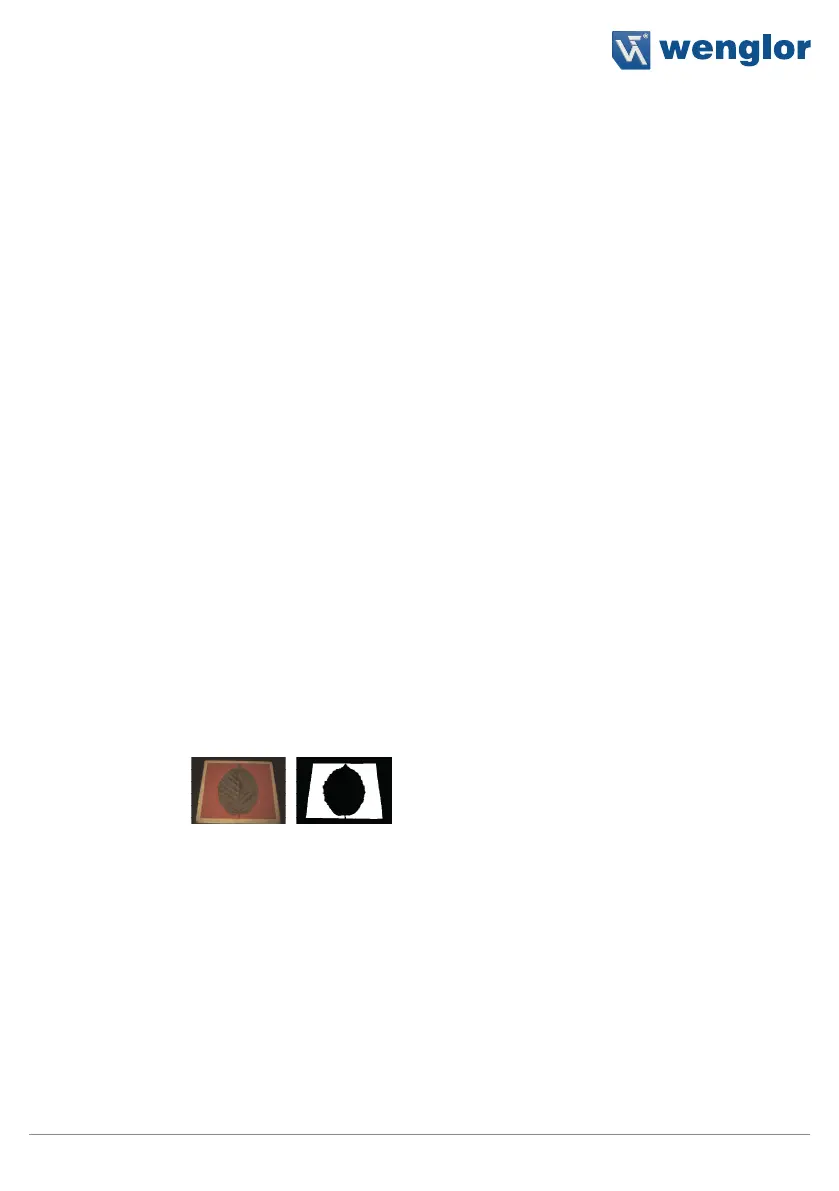
Example:
If the red area in this image needs to be detected (allowed to pass through the filter),
the H filter must be set so that all shades of red are allowed to pass. However, due to
that fact that white areas are included (white frame) which need to be suppressed, the
saturation filter must also be used.
The settings required for each individual filter are described in the following. One or
more filters can be selected in order to generate the digitized black and white image.
The histogram and the profile which display brightness values and distribution may
be helpful to this end (see sections 10.2.3.4 and 10.2.3.3).


 To Next Page