Need help?
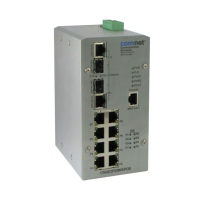
Do you have a question about the Comnet CNGE3FE8MSPOE and is the answer not in the manual?
Steps for mounting the switch on a DIN-rail using the included kit.
Steps for mounting the switch on a wall using provided panels and screws.
Instructions for accessing the switch's web interface using default IP, username, and password.
Configuration for IP stack mode, DNS server settings, and DNS proxy functionality.
Settings for managing IP interfaces, including DHCP client, fallback timeout, and current lease.
Defines the IPv4 address and network mask for the interface, including fallback options.
Configuration for enabling the DHCPv6 client for IPv6 address assignment.
Settings for configuring IPv6 addresses and network masks for interfaces.
Specifies the IP address of the default gateway for network routing.
Manages IP routes, including adding, deleting, and specifying network, gateway, and next hop VLAN.
Provides general traffic statistics for all switch ports, including received/transmitted packets, bytes, errors, drops, and filtered frames.
Configures global and per-VLAN modes to enable or disable the DHCP server.
Displays DHCP server database counters and statistics for messages sent and received.
Manages DHCP pools, allowing creation, deletion, and configuration of pool settings like type, IP, and lease time.
Manages switch security, focusing on user accounts, passwords, and privilege levels.
Displays statistics for access management, showing received, allowed, and discarded packets per interface.
Shows the status of Port Security module, indicating user module enablement and port security state.
Configures authentication methods (local, RADIUS, TACACS+) for management client interfaces.
Configures Port Security Limit Control system to limit the number of users per port.
Configures the IEEE 802.1X and MAC-based authentication system and port settings.
Configures global NAS settings like mode, reauthentication period, and EAPOL timeout.
Controls reauthentication of authenticated supplicants/clients after a specified interval.
Determines the interval in seconds for client reauthentication.
Configures Access Control List (ACL) parameters for each switch port, affecting received frames.
Defines the logical port for ACL settings.
Selects the policy to apply to a port for ACL configuration.
Selects whether to permit or deny frame forwarding based on ACE matches.
Specifies the rate limiter to apply to a port for traffic control.
Displays and manages Access Control List (ACL) entries, defining rules for traffic filtering.
Configures ARP inspection settings per port and VLAN, including log types.
Displays dynamic ARP inspection entries, showing port, VLAN ID, MAC address, and IP address.
Configures RADIUS server settings for authentication and accounting, including timeouts and keys.
Configures static aggregation hash modes and groups, defining which ports contribute to aggregation.
Configures Link Aggregation Control Protocol (LACP) settings per port, including key, role, timeout, and priority.
Configures STP system settings like protocol version, bridge priority, forward delay, and max age.
Displays STP CIST port status for physical ports, showing role and state.
Manages IPMC profiles, allowing creation of up to 64 profiles with 128 rules each for IP multicast access control.
Defines filtering rule settings for IPMC profiles, specifying action and logging preferences.
Specifies address ranges used in IPMC profiles, allowing up to 128 address entries.
Configures Multicast VLAN Registration (MVR) mode, VLAN IDs, and channel profiles for multicast traffic.
Configures IGMP Snooping globally and per port, including unregistered flooding and SSM range.
Configures MLD Snooping globally and per port, including unregistered flooding and SSM range.
Configures LLDP parameters like transmit interval, hold time, delay, and reinitialization time.
Manages LLDP port settings, including mode, CDP awareness, and optional TLVs for transmission.
Configures PoE mode for ports (Disable, PoE, PoE+, PoE++, Forced) and port priority.
Configures Ethernet Protection Switch (EPS) instances, including EPS ID, domain, architecture, and flows.
Configures Maintenance Entity Points (MEPs) for OAM and traffic monitoring, including domain, mode, direction, and level.
Configures Ethernet Ring Protection Switching (ERPS) instances, including ERPS ID, port settings, and ring type.
Provides ERPS instance data like ID, port information, MEPs, and ring type.
Provides steps to verify ERPS configuration by checking CCM rates and ERPS status.
Configures ERPS instance parameters such as guard time, WTR time, and hold-off time.
Guides on adding and editing Maintenance Entity Points (MEPs) on switch 1 for ERPS configuration.
Details adding and editing MEPs on Switch 2 as part of ERPS configuration.
Guides on adding and configuring MEPs on Switch 3 for ERPS setup.
Details steps for configuring ERPS on Switch 1, including adding protection groups and editing VLANs.
Guides on configuring ERPS on Switch 2 as an RPL neighbor, including protection groups and VLAN editing.
Details configuring ERPS on Switch 3, noting minimal action required for the RPL owner.
Provides initial CLI commands to configure ERPS by disabling STP/LLDP and enabling C-Port.
Details CLI commands for configuring MEP and ERPS on Switch 1, setting up the RPL owner.
Provides CLI commands for configuring MEP and ERPS on Switch 2 as an RPL neighbor.
Details CLI commands for configuring MEP and ERPS on Switch 3, including setting CCM rates.
Configures MAC address table settings, including aging, learning, and static MAC entries.
Configures global VLAN settings, including allowed access VLANs and Ethertype for custom ports.
Manages VLAN membership, allowing configuration of VLAN users and port memberships.
Configures port VLAN settings, including port mode, VLAN ID, and port type.
Configures Voice VLAN settings, including mode, VLAN ID, aging time, and traffic class.
Configures Voice VLAN port modes (Disabled, Auto, Forced) for controlling VoIP phone integration.
Configures QoS Ingress Classification settings for ports, defining CoS, DPL, PCP, and DEI values.
Sets the classification mode for tagged frames on a port.
Enables DSCP-based QoS Ingress Port Classification for mapping DSCP values.
Controls tag remarking mode and mapping of PCP/DEI to QoS class/DP level for tagged frames.
Configures policer settings for switch ports, defining enabled status, rate, and unit.
Configures queue policer settings for switch ports, enabling rate and unit for each queue.
Provides an overview of QoS Egress Port Schedulers, showing port mode and queue weights.
Configures scheduler and shaper settings for specific ports, including queue shapers and weights.
Provides an overview of QoS Egress Port Shapers, showing port and queue shaper rates.
Configures DSCP ingress and egress settings for switch ports, including translation and classification.
Configures DSCP-based QoS ingress classification settings, including trust and QoS class mapping.
Configures DSCP translation settings for ingress and egress, allowing remapping of DP levels.
Configures the mapping of QoS class and Drop Precedence Level to DSCP values.
Defines key parameters for QoS Control Entries (QCEs), including MAC, VLAN ID, frame type, and IP address matching.
Specifies action parameters for QCEs, such as CoS, DPL, and DSCP classification.
Configures mirroring and remote mirroring features for switched port analysis.
Manages QoS Control List (QCL) entries, defining actions like CoS, DPL, DSCP, PCP, DEI, and Policy.
Provides a legend for user modules requesting Port Security services and their abbreviations.
Shows secured MAC addresses and their status (blocked/forwarding) on a specific port.
Displays detailed NAS statistics for a specific port, including port state, QoS class, and VLAN ID.
Provides an overview of current Network Access Server (NAS) port states, including admin state and QoS class.
 General
| PoE Standard | IEEE 802.3af/at |
|---|---|
| Power Budget per port | 30W |
| MAC Address Table | 8K |
| Jumbo Frame | 9K |
| Weight | 2.2 kg |
| PoE Support | Yes |
| Operating Temperature | -40°C to 75°C |
| Enclosure | IP40 |
| Installation | DIN Rail |
| Standards | IEEE 802.3, 802.3u, 802.3ab, 802.3z, 802.3x, 802.3af, 802.3at |

 To Next Page