OPERATION
3.15.5 Condit
ioning: Roll Type
Rolls condition the crop by crimping and crushing th e stem in s ev eral plac es allowing the r elease of m ois ture
resulting in faster drying times. Both steel and polyureth ane conditione r rolls are ava ilable.
3.15.6 Roll Gap
The degree to which the crop is conditioned as it passes through the rolls is controlled by the roll gap which is
factory-set at 1/4 in. (6 mm) for steel rolls and approximately 1/8 in. (3 mm) for polyurethane rolls.
Correct conditioning of alfalfa, clover, and other legumes is achieved when 90% of the stems show cracking, but
no more than 5% of the leaves are damaged. Set enough roll gap to produce these results. Polyurethane rolls are
better suited for crushing stems while providing less crimping and are recommended for these types of crops.
A larger gap (up to 1 in. [25 mm]) may be desirable in thick stemmed cane-type crops; however, too large a gap
may cause feeding problems. Steel rolls are recommended for these types of situations.
Grass type crops may require less gap for proper feeding and conditioning.
IMPORTAN
T:
If u sing s
ettings below the factory setting, visually inspect the roll gap.
Checking Roll Gap: Polyurethane Rolls
DANGER
To avoid bodily injury or death from unexpected startup of machine, always stop engine and remove key
from ignition before leaving operator's seat for any reason.
1. Lower mower conditioner fully.
2. Stop engine and remove key.
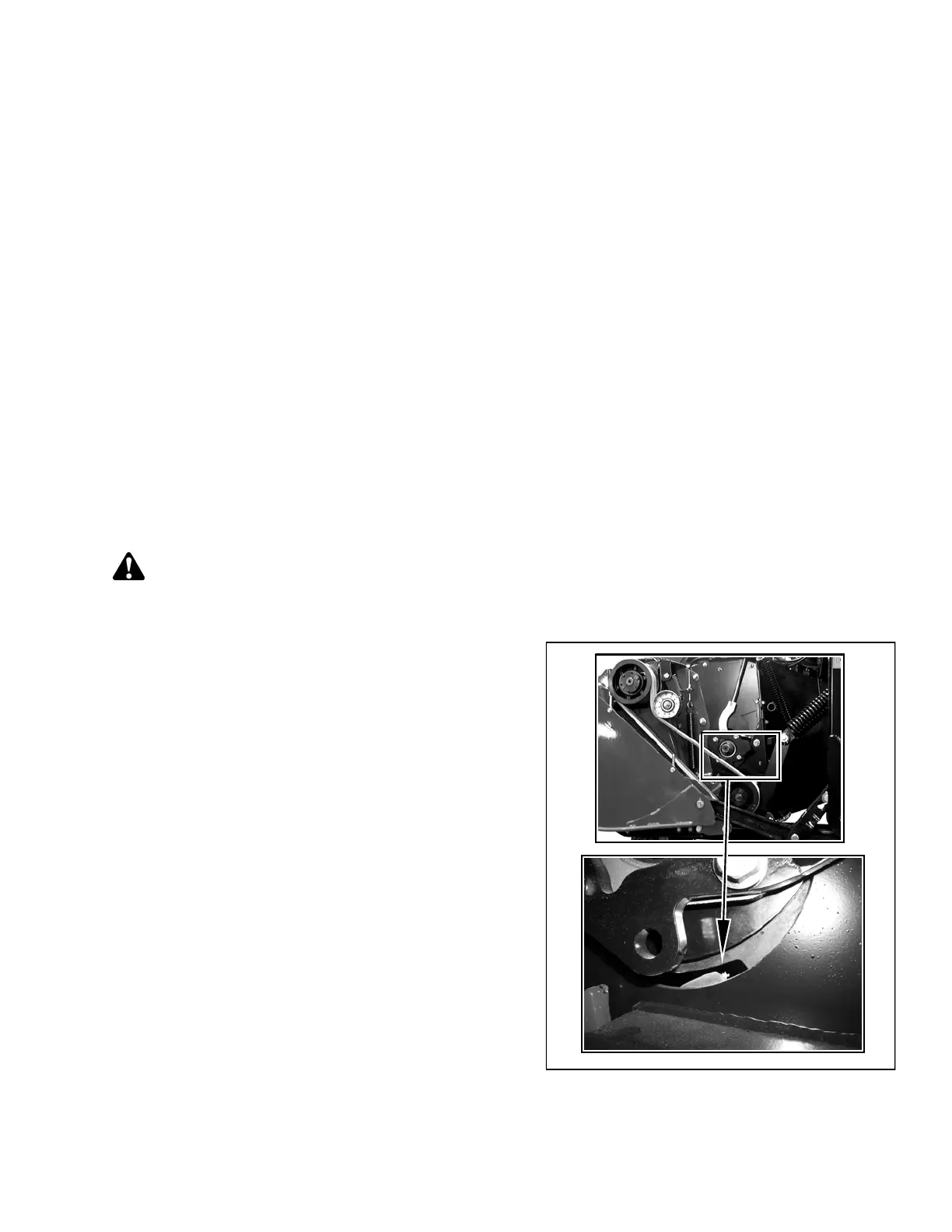
3. Insert a feeler gauge through the inspection hole
in the conditioner endsheet to check roll gap on
polyurethane roll conditioners.
NOTE:
For information about roll gap on steel roll
conditioners, refer to Adjusting Roll Gap: S te el Rolls,
page 86.
Figure 3.99: Polyurethane Roll Conditioner
147910 85 Revision A



 To Next Page