TROUBLESHOOTING
K2–193
K2
End Of Sie
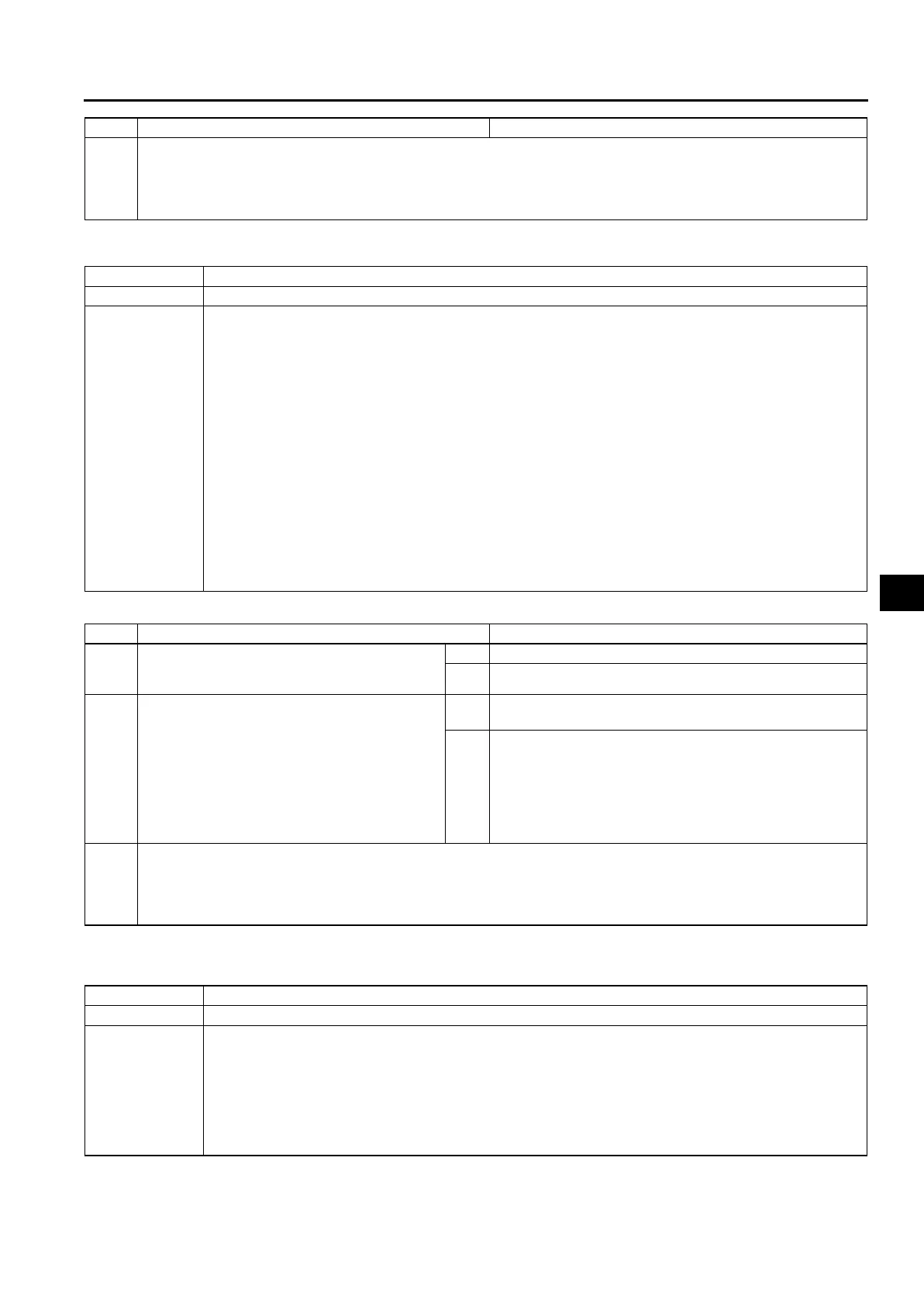
NO.9 ABNORMAL SHIFTING
A6E578001030212
Diagnostic procedure
End Of Sie
NO.10 FREQUENT SHIFTING
A6E578001030213
End Of Sie
5 • Verify test results.
— If okay, return to diagnostic index to service any additional symptoms.
— If malfunction remains, inspect related Service Informations and perform repair or diagnosis.
— If vehicle repaired, troubleshooting completed.
— If vehicle not repaired or additional diagnostic information not available, replace TCM.
STEP INSPECTION ACTION
9 Abnormal shifting
DESCRIPTION • Shift incorrectly (incorrect shift pattern).
POSSIBLE
CAUSE
• There is a malfunction in signal circuit which controls shifting (Throttle position signal, input/turbine
speed sensor, VSS), control valve is stuck, or clutch circuit is stuck.
— Clutch slipped, burned
• Line pressure low
• Incorrect throttle position signal
• Malfunction of VSS
• Malfunction of input/turbine speed sensor
• Malfunction of sensor ground
• Malfunction of shift solenoid A, B, or C
• Malfunction of TCC solenoid valve
• Malfunction of body ground
• Misadjustment of accelerator cable
• Malfunction of control valve body
• Malfunction or misadjustment of TR switch
Note
• Before following troubleshooting steps, make sure that Automatic Transaxle On-Board Diagnostic
and Automatic Transaxle Basic Inspection are conducted.
STEP INSPECTION ACTION
1 • Inspect continuity between TCM connector
terminals C and Y and transaxle case.
• Is there continuity?
Yes Go to next step.
No Repair or replace ground circuit.
2 • Stop engine.
• Inspect shift solenoid A, B, or C circuit.
• Are they okay?
Yes Inspect TCM connector terminal for bend, damage,
corrosion or poor contact.
No • Inspect connection of shift solenoid A, B, or C terminal
on ATX for bend, damage, corrosion or looseness.
• Inspect for shift solenoid mechanical stuck.
(See K2–88 SOLENOID VALVE INSPECTION.)
— If shift solenoids okay, inspect for open or short circuit
between TCM connector terminals 2W, 2T, 2X and
coupler component terminals I, G, or F.
3 • Verify test results.
— If okay, return to diagnostic index to service any additional symptoms.
— If malfunction remains, inspect related Service Informations and perform repair or diagnosis.
— If vehicle repaired, troubleshooting completed.
— If vehicle not repaired or additional diagnostic information not available, replace TCM.
10 Frequent shifting
DESCRIPTION • Downshifting occurs immediately even when accelerator pedal depressed slightly in D range.
POSSIBLE
CAUSE
• The circuit which is the cause is basically the same as for No.9 “Abnormal shifting”. However, a
malfunction of input signal to TP sensor, input/turbine speed sensor, VSS (including the sensor ground,
sensor harness and connector), or clutch slippage (clutch stuck, low pressure in line) may also be the
cause.
Note
• Before following troubleshooting steps, make sure that the Automatic Transaxle On-Board
Diagnostic and Automatic Transaxle Basic Inspection are conducted.












 To Next Page