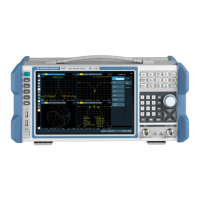
R&S
®
ZVA / R&S
®
ZVB / R&S
®
ZVT Command Reference
SCPI Command Reference
Operating Manual 1145.1084.12 – 30 1027
SOUR:POW:CORR:IMOD:LTON
Start source power calibration for the lower tone at the previously selected source
port 1.
SOUR:POW:CORR:IMOD:UTON
Start source power calibration for the upper tone at the previously selected source
port 3.
CORR:POW:IMOD:ACQ
Start receiver power calibration at the previously selected receive port 2.
CALC:PAR:SDEF 'IM_Meas', 'IP3UI'
Create a new trace named 'IM_Meas'. Select the upper 3
rd
-order intercept point at
the DUT input as a measured quantity.
DISPlay:WINDow1:TRACe2:FEED 'IM_Meas'
Display the newly created trace in diagram area no. 1
SOURce<Ch>:POWer<Pt>:CORRection:IMODulation:RPORt[:ACQuire]
Starts a source power calibration for the receive port of the intermodulation measurement (2nd power
calibration step for intermodulation measurements), stores and applies the calibration data. The external
power meter used is selected via SOURce<Ch>:POWer<Pt>:CORRection:PMETer:ID.
A source power calibration of the receive port is usually done as preparation for an enhanced wave
correction. Make sure that the Prepare Enhanced Wave Corr
([SENSe<Ch>:]FREQuency:IMODulation:PEWCorr[:STATe]) flag is set before calling this
command. To perform a receiver power calibration of the receive port use command
[SENSe<Ch>:]CORRection:POWer<port_no>:IMODulation:RPORt:ACQuire.
This calibration encompasses the lower and upper tone frequency range as well as the frequency range
for all lower and upper intermodulation products which have been selected via
[SENSe<Ch>:]FREQuency:IMODulation:ORDer<Im>:STATe. If in addition to the intermodulation
measurement a mixer measurement is set up as well, only the IF frequency ranges will be measured.
Port number. This suffix is ignored; the analyzer calibrates the port that is selected as
receive port for the intermodulation measurement
([SENSe<Ch>:]FREQuency:IMODulation:RECeiver).
Device-specific, no query
*RST; FREQ:IMOD:LTON PORT,1; UTON PORT, 3
Reset the instrument to create the default channel no. 1. Select port 1 as a source
port for the lower tone, port 3 as a source port for the upper tone.
FREQ:IMOD:REC 2
Select port 2 as a receiver port.
FREQ:STAR 1GHZ; STOP 2GHz
Define a suitable sweep range to ensure that the analyzer can measure all


 To Next Page