R&S
®
ZVA / R&S
®
ZVB / R&S
®
ZVT GUI Reference
Channel Menu
Operating Manual 1145.1084.12 – 30 353
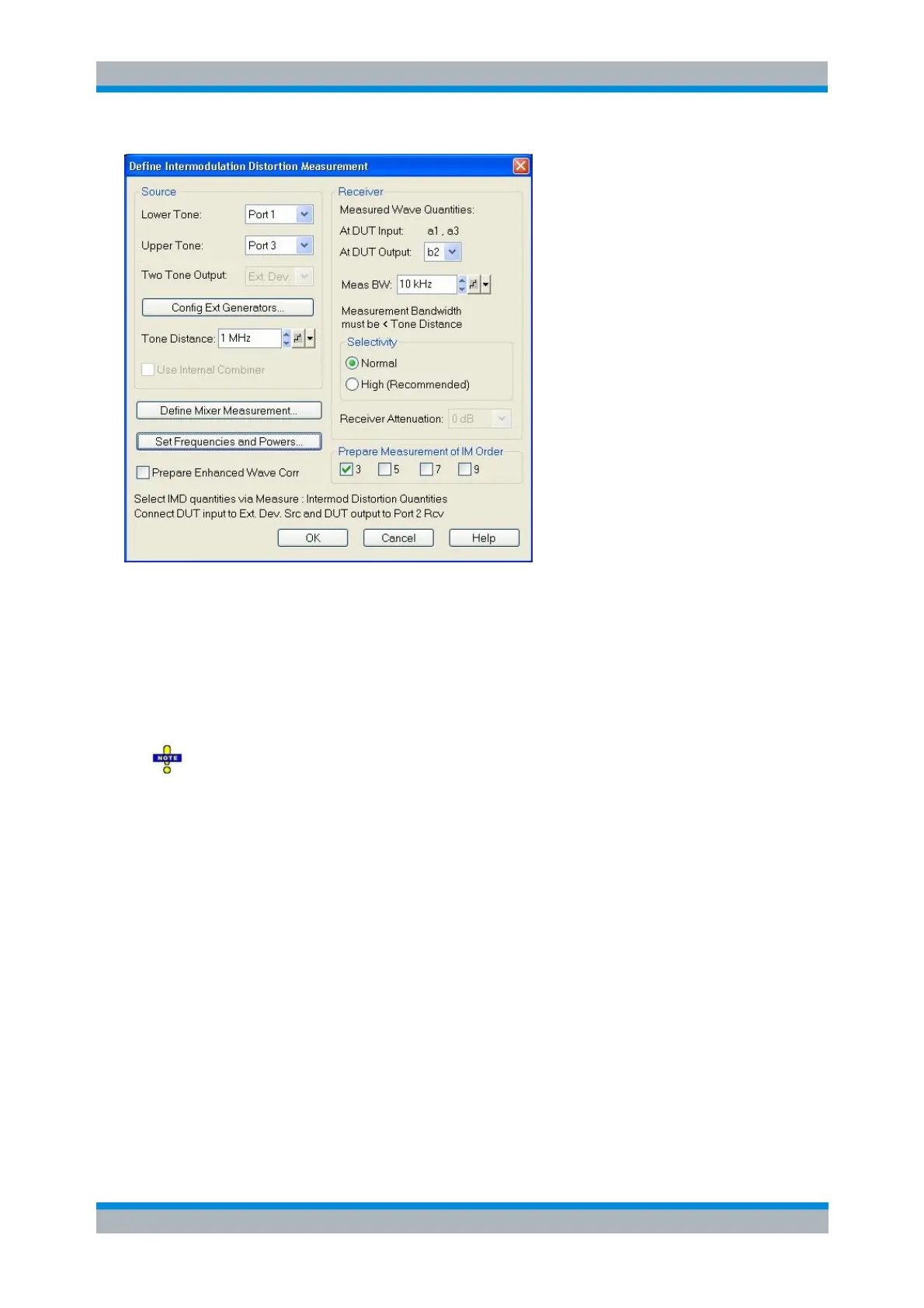
Lower Tone selects an analyzer port as a source of the lower tone signal. If Port 1 is selected as
the Two Tone Output, then Port 1 must also provide the lower tone. This condition ensures a
consistent receiver power calibration for the intermodulation products at the DUT output port (e.g.
Port 2, for details refer to the description of the power calibration procedure in section
Intermodulation Distortion Measurement Power Calibration).
Upper Tone selects an analyzer port or external generator as a source of the upper tone signal.
The source must be different from the lower tone source and - if an internal source is used - the
generators of the source ports must not be coupled.
An external generator driving the upper tone must not be used in the same channel for other
measurements requiring a driving frequency differing from the upper tone frequency. Also the
power settings must not differ.
Two Tone Output defines the source of the two tone signal which is fed to the input of the DUT.
For analyzers without option R&S ZVA<frequency>-B16, Direct Generator/Receiver Access, and
without an internal combiner (see Use Internal Combiner below), the setting Ext. Dev. (external
device) is fixed: The analyzer assumes that the lower tone and the upper tone signals are
combined by external means. If one of the options above is available, the lower tone source Port 1
may be selected alternatively. The two basic test setups are described above; see Intermodulation
measurement, test setups.
The Two Tone Output setting affects the fast power calibration method (see Modify Source
Power Cal Settings dialog, Use Reference Receiver After First Cal Sweep: On): If Ext. Dev. is
selected, the actual source power is derived from the reference waves (a waves) of the lower and
upper tone ports, respectively. If Port 1 is selected, the source power is derived from the lower
tone reference wave a
1
. Select the Two Tone Output in accordance with the test setup to ensure
an accurate fast power calibration.
The Two Tone Output setting also affects the availability of an Enhanced Wave Correction: If Ext.
Dev. is selected, an Enhanced Wave Correction is only possible at the DUT output. If Port 1 is
selected, an Enhanced Wave Correction is possible both at the DUT output and input. For details
see section Intermod Dist Meas Cal.
Furthermore, the Two Tone Output setting affects the possibility of performing Automatic Level


 To Next Page