R&S
®
ZVA / R&S
®
ZVB / R&S
®
ZVT GUI Reference
Channel Menu
Operating Manual 1145.1084.12 – 30 473
Load parameters are used to describe all types of standards except a Through, a Sliding Match, a Line
and an Attenuation.
The Through standard is a through-connection between two ports with minimum loss which is
taken into account by the Offset Parameters.
The Sliding Match is a one-port standard with variable load parameters (sliding load), so there is
no fixed load model.
The Line standard is a line of variable length with minimum loss which is taken into account by the
Offset Parameters.
The Attenuation is a two-port standard which is fully matched in both directions (the reflection
factor at both ports is zero). No load and offset parameters need to be set.
[SENSe<Ch>:]CORRection:CKIT:<conn_type>:<std_type>
Calibration Standard Types
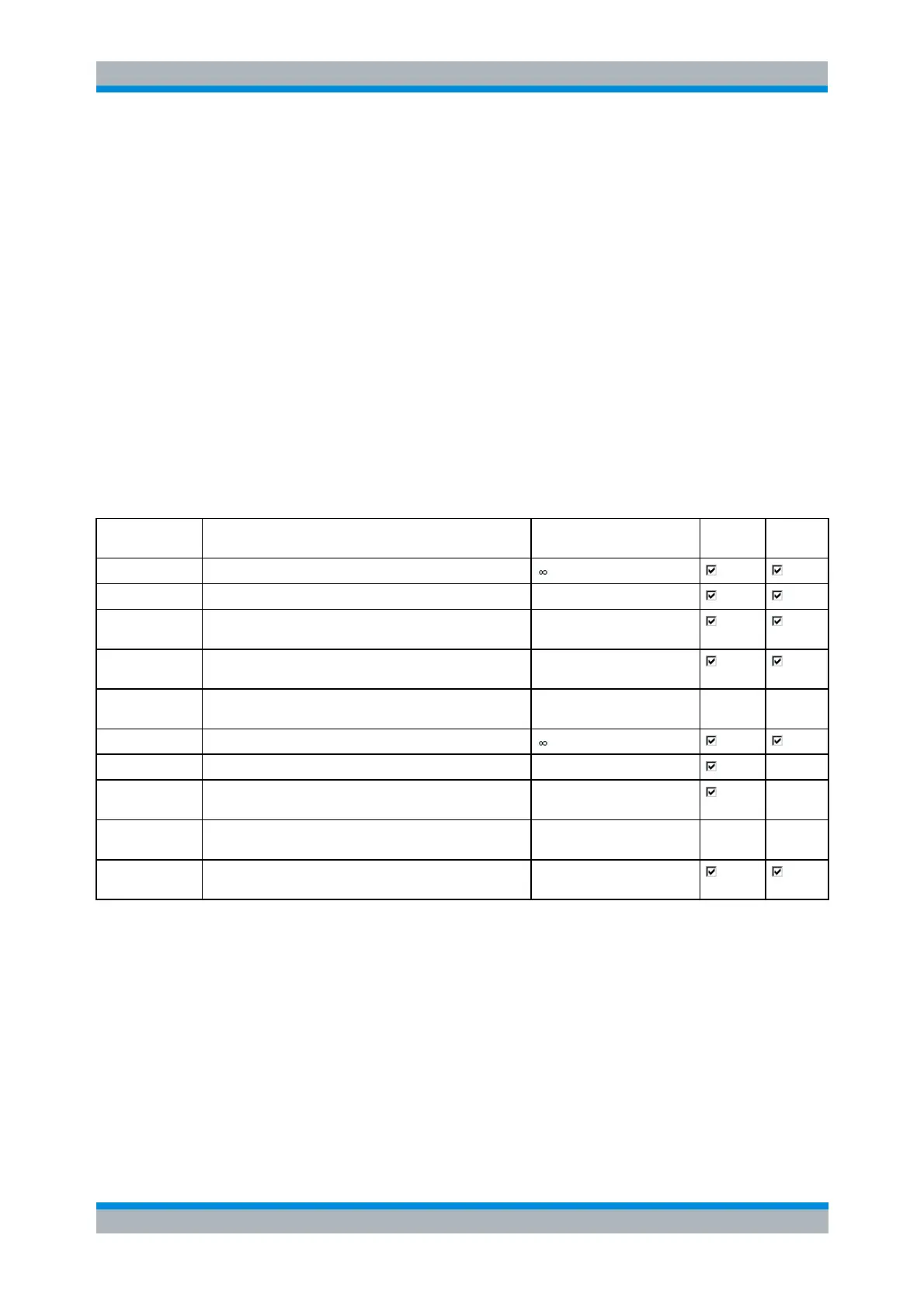
The following table gives an overview of the different standards and their offset and load models:
Short circuit with added electrical length offset, for
waveguide calibration (one-port)
Matched broadband termination (one-port)
Z
0
(reference impedance of
the connector type)
One-port standard consisting of an air line with a
movable, low-reflection load element (sliding load). .
Unknown mismatched standard (one-port)
Through-connection with minimum loss (two-port)
Line1, Line 2,
Line 3, ...
Line(s) for TRL calibration with minimum loss (two-port)
and NIST Multiline TRL calibration
Fully matched standard in both directions (two-port; the
reflection factor at both ports is zero).
Unknown mismatched reflection-symmetric standard
(two-port)
The calibration of rectangular waveguides at very high frequencies requires a special set of standards;
see Frequency Extension – Calibration.
For an overview of standard parameters see also
[SENSe<Ch>:]CORRection:CKIT:<conn_type>:<std_type>
Waveguide Calibration Kits
Rohde & Schwarz offers special waveguide calibration kits for test setups involving frequency converters.
Calibration Kit R&S ZV-WR10 is suited for the frequency converter R&S ZVA-Z110(E) (frequency
range: 75 GHz to 110 GHz)


 To Next Page