4.86
SEL-751A Relay Instruction Manual Date Code 20100129
Protection and Logic Functions
Logic Settings (SET L Command)
In a Math SELOGIC control equation, use the NOT operator with any Relay
Word bits. This allows a simple if/else type equation, as shown in the example
below.
MV01 := 12 * IN101 + (MV01 + 1) * NOT IN101
The equation above sets MV01 to 12 whenever IN101 asserts, otherwise it
increments MV01 by 1 each time the equation is executed.
Boolean Rising-Edge Operator (R_TRIG)
Apply the rising-edge operator, R_TRIG, to individual Relay Word bits only;
you cannot apply R_TRIG to groups of elements within parentheses. When
any Relay Word bit asserts (going from logical 0 to logical 1), R_TRIG
interprets this logical 0 to logical 1 transition as a “rising edge” and asserts to
logical 1 for one processing interval.
For example, the Boolean SEL
OGIC control equation event report generation
setting uses rising-edge operators:
ER := R_TRIG IN101 OR R_TRIG IN102
The rising-edge operators detect a logical 0 to logical 1 transition each time
one of IN101 or IN102 asserts. Using these settings, the device triggers a new
event report each time IN101 or IN102 asserts anew, if the device is not
already recording an event report. You can use the rising-edge operator with
the NOT operator as long as the NOT operator precedes the R_TRIG operator.
The NOT R_TRIG combination produces a logical 0 for one processing
interval when it detects a rising edge on the specified element.
Boolean Falling-Edge Operator (F_TRIG)
Apply the falling-edge operator, F_TRIG, to individual Relay Word bits only;
you cannot apply F_TRIG to groups of elements within parentheses. The
falling-edge operator, F_TRIG, operates similarly to the rising-edge operator,
but operates on Relay Word bit deassertion (elements going from logical 1 to
logical 0) instead of Relay Word bit assertion. When the Relay Word bit
deasserts, F_TRIG interprets this logical 1 to logical 0 transition as a “falling
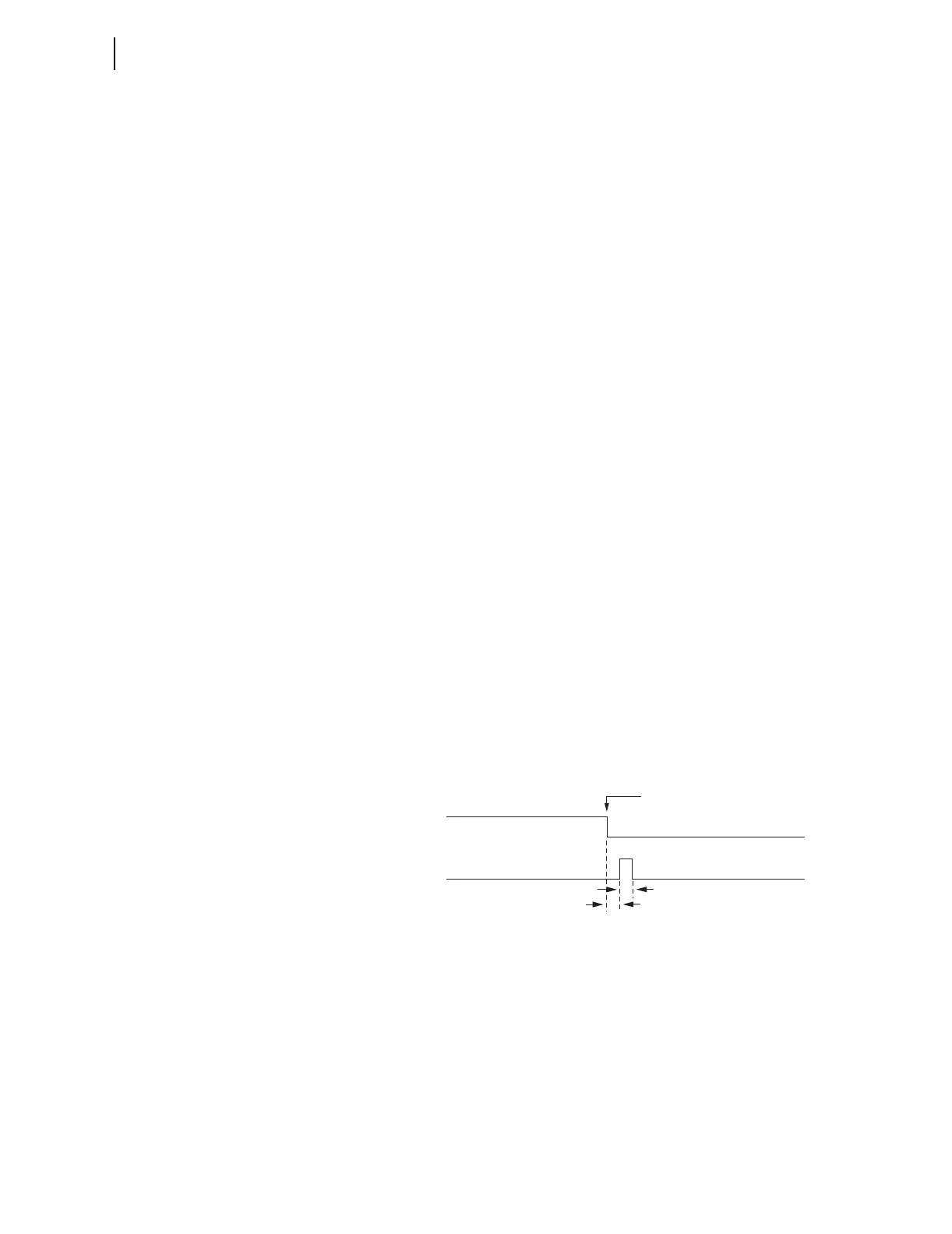
edge” and asserts to logical 1 for one processing interval, as shown in
Figure 4.46.
Figure 4.46 Result of Falling-Edge Operator on a Deasserting Input
You can use the falling-edge operator with the NOT operator as long as the
NOT operator precedes the F_TRIG operator. The NOT F_TRIG combination
produces a logical 0 for one processing interval when it detects a falling edge
on the specified element.
Math Arithmetic Operators (*, /, +, and –)
If Relay Word bits (which are effectively Boolean resultants, equal to logical 1
or logical 0) are used in mathematical operations, they are treated as
numerical values 0 and 1, depending on if the Relay Word bit is equal to
logical 0 or logical 1, respectively.
F_TRIG IN101
IN101
Falling Edge
One Processing Interval
One Processin
Interval



 To Next Page