72A-1589 Rev. C 02/01 E-1
D
DD
D
R
RR
R
A
AA
A
F
FF
F
T
TT
T
2
22
2
/
//
/
2
22
2
1
11
1
/
//
/
0
00
0
1
11
1
Appendix E. Timing Between State Changes
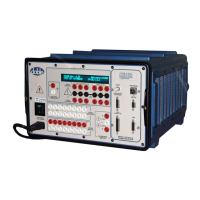
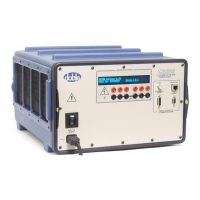
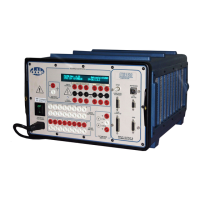
The F6150 builds waveforms based on a 10 kHz sample rate. Its
waveforms are assembled with data every 100 microseconds or
0.1 milliseconds. When the instrument generates a waveform, it rounds
the total time for the required number of cycles to the nearest
0.1 millisecond.
In a 60 Hz waveform, for example, one cycle is completed over
16.66666... milliseconds. Under the rounding function, the cycle
actually completes at 16.7 milliseconds. For two cycles at 60 Hz, the
time is 33.33333... milliseconds, rounded to 33.3 milliseconds.
The rounding function may cause a discrepancy between expected and
actual times for state simulations where a timer is started in one state and
stopped after one or several states with a long duration time. A
workaround for this discrepancy is to have state durations in factors of
time that negate the rounding factor.
For example, 60 Hz durations in factors of three cycles per state (3, 6,
9..., 63...) equate to an even 50 milliseconds per three-cycle duration. In
this case, no discrepancy appears because no rounding is used to
generate the waveform.
N
OTE
50 Hz systems do not use the rounding function at all, as their base time
unit per cycle is 20 milliseconds.


 To Next Page