R&S
®
ZVA / R&S
®
ZVB / R&S
®
ZVT GUI Reference
Channel Menu
Operating Manual 1145.1084.12 – 30 447
calibration is possible.
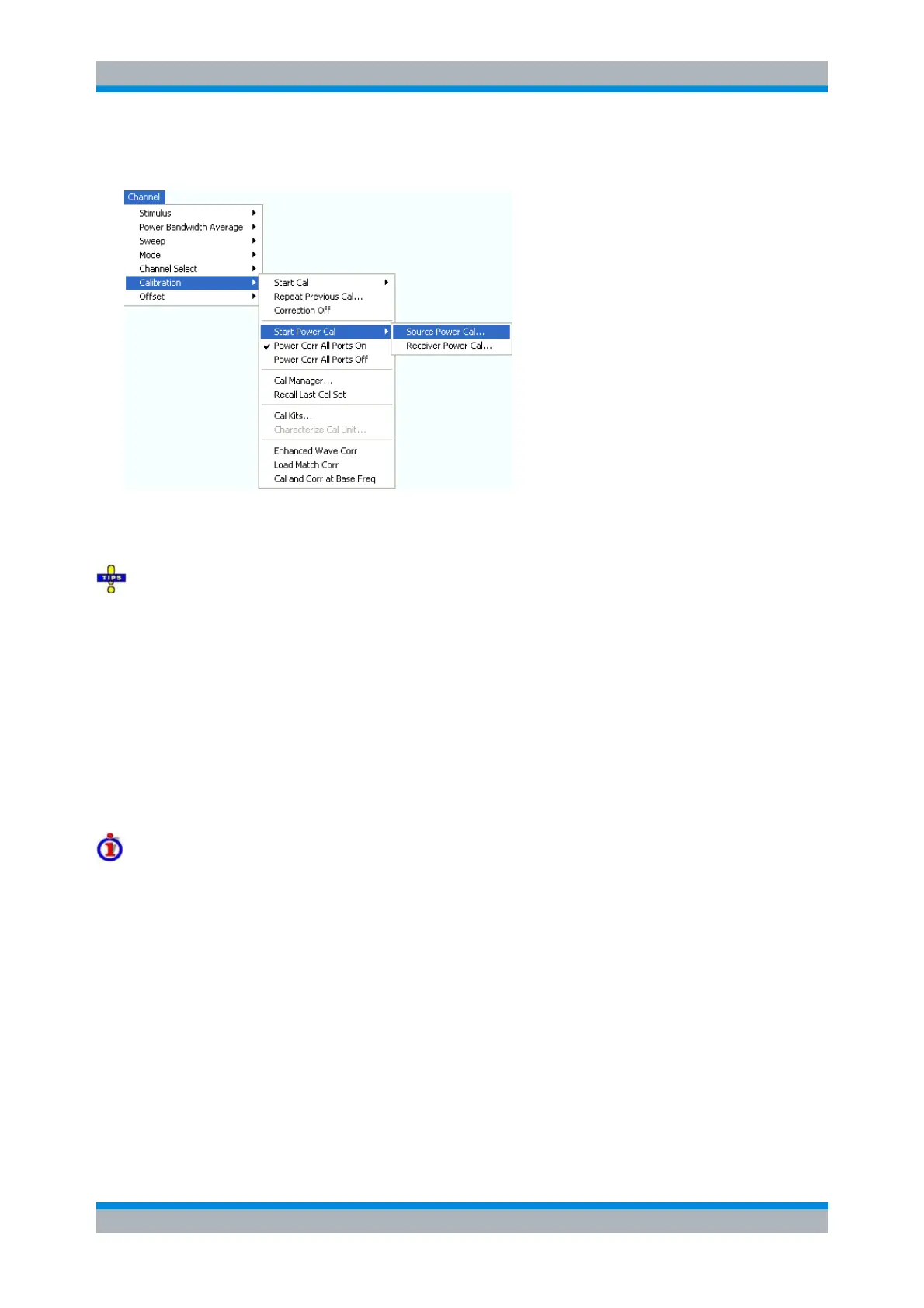
Source Power Cal... opens the configuration dialog for a source power calibration.
Receiver Power Cal... opens the configuration dialog for a receiver power calibration.
Power correction data can be stored to a cal group and applied to several channels; see description of
the Calibration Manager.
In remote control it is possible to read, modify and reload power calibration data. Refer to the description
of the commands SOURce<Ch>:POWer<Pt>:CORRection:DATA and
[SENSe<Ch>:]CORRection:POWer<port_no>:DATA.
SOURce<Ch>:POWer:CORRection...
[SENSe<Ch>:]CORRection:POWer...
Source Power Cal...
Opens the configuration dialog for a source power calibration.
Purpose of a source power calibration
A source power calibration ensures accurate power levels of the generated wave at an arbitrary reference
plane in the measurement path. The calibrated reference plane is typically the input of the DUT.
In a frequency sweep, the power at the reference plane is maintained at a constant Cal Power value. The
source power calibration eliminates frequency response errors in the signal path between the source and
the reference plane. It is possible to introduce an arbitrary attenuation or gain into the signal path so that
the Cal Power is not restricted to the power range of the source. A typical application for a power
calibration in a frequency sweep is the measurement of the gain of an amplifier across a frequency range
but at a fixed input power.
In a power sweep, the power calibration ensures that the power at the reference plane is either constant
or a linear function of the stimulus power. A typical application for a power calibration in a power sweep is
the measurement of the gain of an amplifier across a power range but at a fixed frequency.
The correction data acquired in a frequency or power sweep is re-used if a Time or CW Mode sweep is
activated.


 To Next Page