Vision Operator’s Manual (v12.0 MD) Switcher Basics • Ops 4–37
Using the Positioner
The Positioner Module (Figure 4.21) allows you to manipulate wipes, patterns, flying keys, and
interface with some external equipment, such as a robotic camera. The module automatically
follows what is currently selected on the crosspoint buses and menu. For example, if you select a
robotic camera that is controlled by the switcher on a crosspoint bus, the Positioner Module is
assigned to the camera automatically. Similarly, if you are on the Squeeze & Tease Menus, you
can use the positioner to manipulate the key, instead of entering X, Y, and Z values manually.
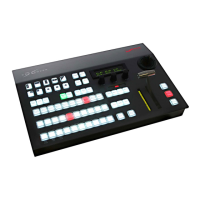
Figure 4.21 Vision 4 Positioner Module
Positioner Module Display
The display on the Positioner Module shows you where the positioner is assigned, and what it is
controlling. The first line of the display shows where the Positioner Module is assigned. In this
example (Figure 4.22), the positioner is assigned to Channel 1, on Key 1 of MLE 2. The second
line of the display shows you what the positioner is controlling. In this example, the positioner is
controlling the Position of a flying key.
Figure 4.22 Positioner Module Display
Positioner Control
The 3-axis positioner (Figure 4.23), or joystick, allows you to manipulate the position and
orientation of on-screen elements and external devices.
Figure 4.23 Positioner Control
LINK
CLEAR
HOLD
P
OSITIONER
MLE1 Key2
Pos/Rotation
MLE2 Key1 3D C1
Pos/Rotation
Up/Down
(Y-Axis) Movement:
Vertical Position Control
Clockwise/
Counter-Clockwise
(Z-Axis) Movement:
Size Control
Left/Right
(X-Axis) Movement:
Horizontal Position Control



 To Next Page