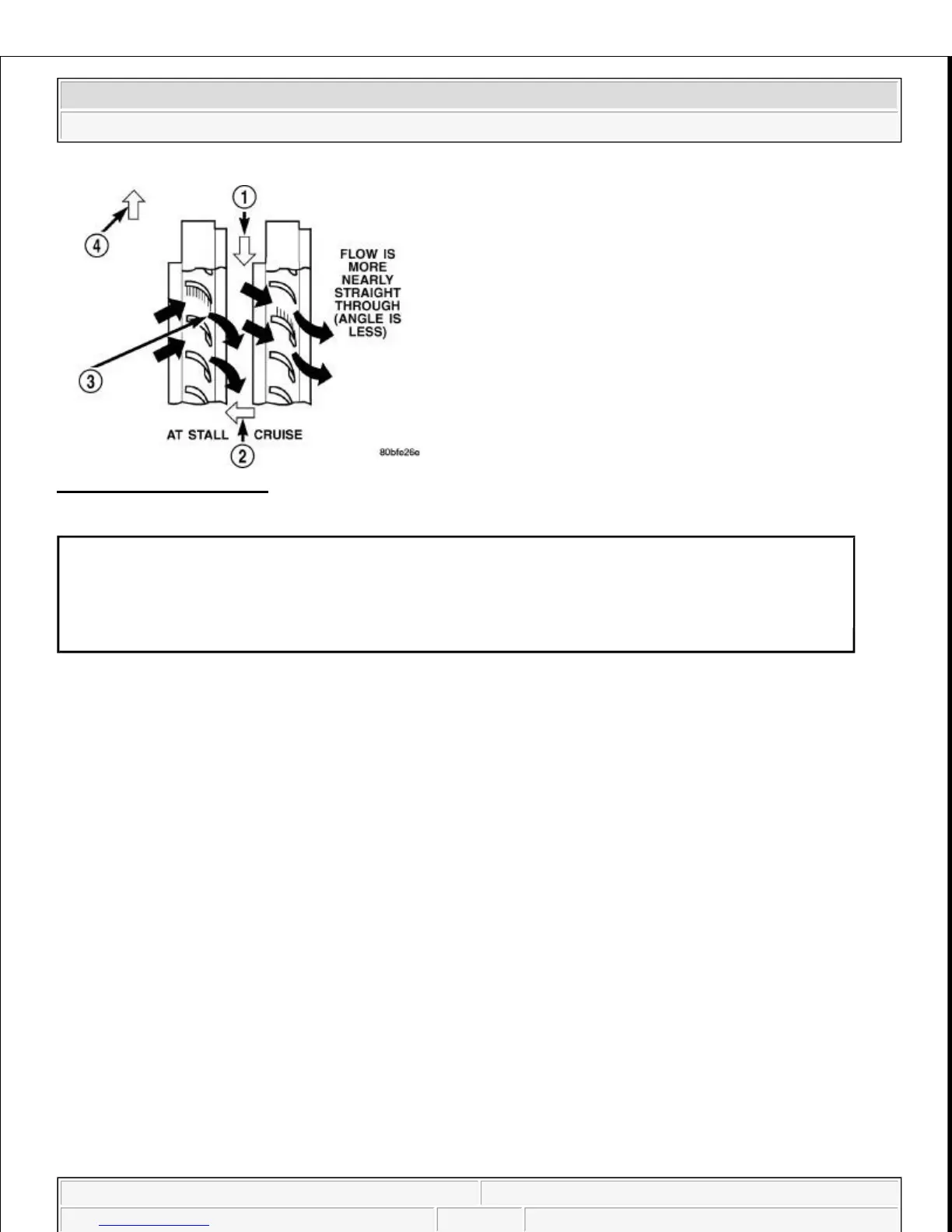
Fig. 578: Stator Operation
Courtesy of CHRYSLER LLC
Torque multiplication is achieved by locking the stator's over-running clutch to its shaft. Under stall conditions
(the turbine is stationary), the oil leaving the turbine blades strikes the face of the stator blades and tries to rotate
them in a counterclockwise direction. When this happens the over-running clutch of the stator locks and holds
the stator from rotating. With the stator locked, the oil strikes the stator blades and is redirected into a "helping"
direction before it enters the impeller. This circulation of oil from impeller to turbine, turbine to stator, and
stator to impeller, can produce a maximum torque multiplication of about 2.4:1. As the turbine begins to match
the speed of the impeller, the fluid that was hitting the stator in such as way as to cause it to lock-up is no longer
doing so. In this condition of operation, the stator begins to free wheel and the converter acts as a fluid
coupling.
TORQUE CONVERTER CLUTCH (TCC)
In a standard torque converter, the impeller and turbine are rotating at about the same speed and the stator is
freewheeling, providing no torque multiplication. By applying the turbine's piston to the front cover's friction
material, a total converter engagement can be obtained. The result of this engagement is a direct 1:1 mechanical
link between the engine and the transmission.
The engagement and disengagement of the TCC are automatic and controlled by the Powertrain Control
Module (PCM). The engagement cannot be activated in the lower gears because it eliminates the torque
multiplication effect of the torque converter necessary for acceleration. Inputs that determine clutch engagement
are: coolant temperature, vehicle speed and throttle position. The torque converter clutch is engaged by the
clutch solenoid on the valve body. The clutch will engage at approximately 56 km/h (35 mph) with light
throttle, after the shift to third gear.
1 - DIRECTION STATOR WILL FREE WHEEL DUE TO OIL PUSHING ON BACKSIDE OF
VANES
2 - FRONT OF ENGINE
3 - INCREASED ANGLE AS OIL STRIKES VANES
4 - DIRECTION STATOR IS LOCKED UP DUE TO OIL PUSHING AGAINST STATOR VANES
2009 Chrysler Town & Country LX
2009 AUTOMATIC TRANSMISSION 62TE - Service Information - Grand Caravan, Town & Country
steve
Monday, May 23, 2011 1:26:12 PM Page 358 © 2006 Mitchell Repair Information Company, LLC.


 To Next Page