MD-11 Flight Crew Operations Manual
k
Aircraft General Chapter Agen
Description and Operation Section 10
Agen.10.1
+Agen.10 Aircraft General-Description and Operation
General
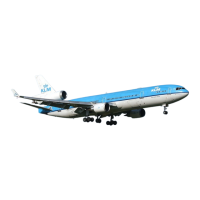
The MD-11 is powered by three interchangeable high bypass ratio turbofan
engines. It has a fully retractable tricycle landing gear with a load bearing center
gear.
The fuselage is of semimonocoque metal construction. All areas are pressurized
except nose radome, wheelwells, wing center section, and aft fuselage. The
fuselage is divided lengthwise into an upper floor level and a lower floor level.
The cantilevered wing consists of a primary box structure with a leading and
trailing edge secondary structure. The primary box contains integral fuel tanks,
main landing gear supporting structure, engine pylons, full span leading edge
slats, spoilers, trailing edge ailerons, and flaps. The winglets are installed at the
wingtips to reduce drag and improve fuel efficiency.
The tail consists of an adjustable horizontal stabilizer with integral fuel tank, right
and left two-section elevators, tail-engine pylon, fixed vertical stabilizer, and
two-section (four-segment) rudder.
Some parts of the wing and tail are made of lightweight composite materials.
Most MD-11 systems are automated with manual backup operation provided.
Avionics and Controllers
Six Display Units (DU) in the instrument panel show the following:
• DUs 1 and 6 are Primary Flight Displays (PFD).
• DUs 2 and 5 are Navigation Displays (ND).
• DU3 is Engine and Alert Display (EAD).
• DU4 is System Display (SD) (secondary engine data and aircraft system
data).
Three (1, 2, and aux) Display Electronic Units (DEU) in the avionics compartment
drive the DUs. Normally, DEU1 drives the 3 left side DUs, DEU2 drives the 3
right side DUs, and the aux DEU is a spare. The glareshield control panel consists
of a Flight Control Panel (FCP) and two EIS Control Panels (ECP) on both ends
of the FCP. The ECPs control data display on the PFDs and NDs. SD data is
controlled from the Systems Display Control Panel (SDCP) on the aft pedestal.
The Air Data System (ADS) consists of two Central Air Data Computers (CADC)
in the avionics compartment. The CADCs send airspeed, pressure altitude, and
total air temperature to various aircraft systems.
October 02, 2006


 To Next Page