R&S
®
ZVA / R&S
®
ZVB / R&S
®
ZVT GUI Reference
Trace Menu
Operating Manual 1145.1084.12 – 30 175
frequency sweep (Channel – Sweep – Sweep Type – Lin. Frequency) is active. The analyzer
automatically quits time domain representation as soon as a different sweep type is selected.
In time domain representation the diagram shows the measurement results as a function of time. The
results are obtained by transforming the measured frequency sweep data into the time domain using an
appropriate mathematical transformation type and frequency window (Define Transform...). The sweep
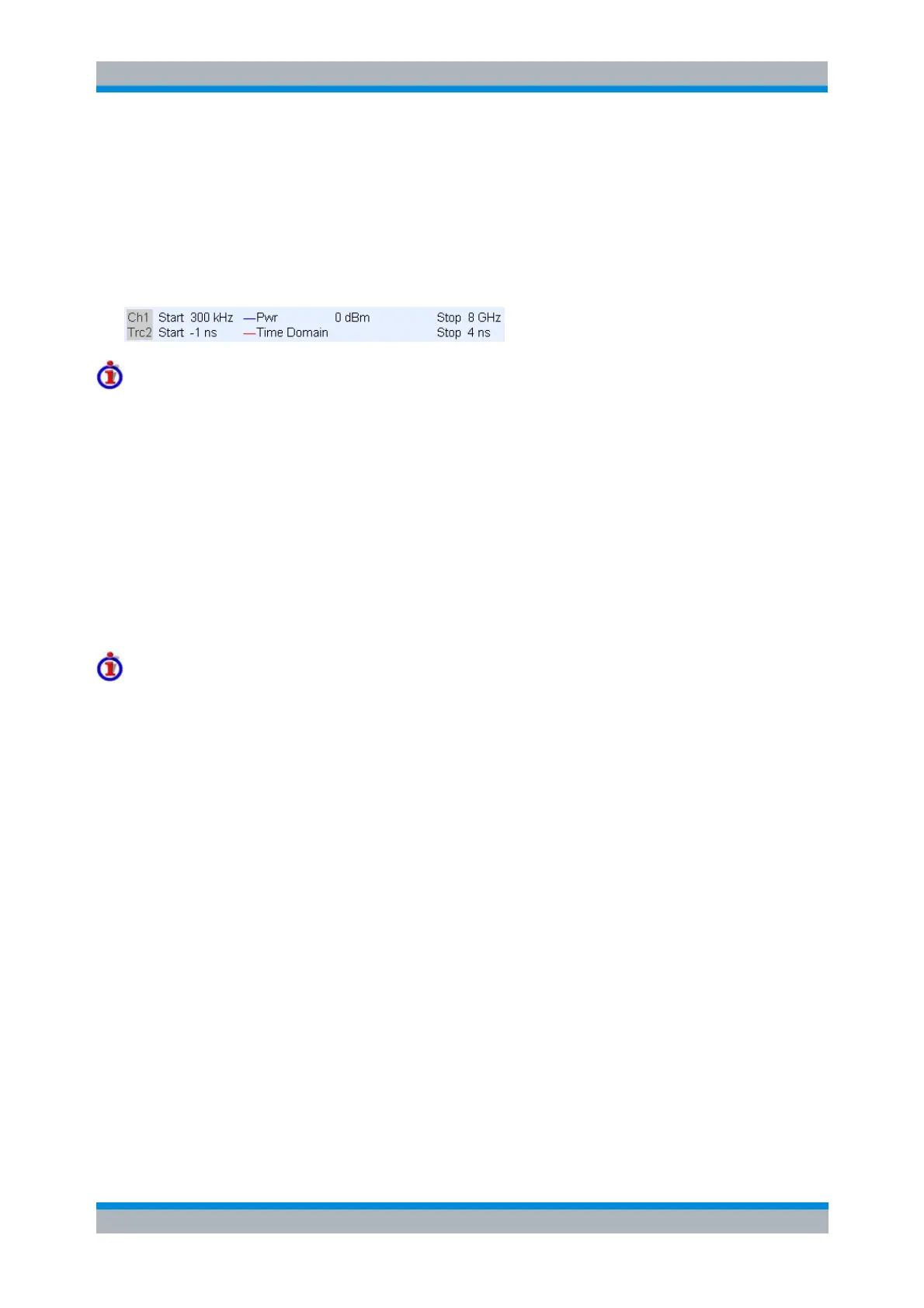
range and the output power for the active channel is still displayed below the diagram; the displayed time
interval is shown in a second line:
Trace settings in time domain representation
While the time domain representation is active the trace settings behave as follows:
The settings in the Time Domain Stimulus Axis submenu configure the time axis.
All Trace Formats including the circular diagrams are available.
Limit lines can be defined like the limit lines for time sweeps.
The bandfilter search functions are available for the transformed trace.
If marker coupling is active, then the markers in the time domain and in the frequency domain are
coupled with each other.
The analyzer places no restriction on the measured quantities to be transformed into the time domain.
Impedances and admittances are first converted back into the equivalent S-parameter, transformed, and
restored after the transformation.
Properties of the Chirp z-transformation
The Chirp z-transformation that the analyzer uses to compute the time domain response is an extension of
the (inverse) Fast Fourier Transform (FFT). Compared to the FFT, the number of sweep points is arbitrary
(not necessarily an integer power of 2), but the computation time is increased by approx. a factor of 2.
This increased computation time is usually negligible compared to the sweep times of the analyzer.
Furthermore, the Chirp z-transformation allows zooming in and out in the time axis which is not possible
using a FFT.
The following properties of the Chirp z-transformation are relevant for the analyzer settings:
The frequency points must be equidistant.
The time domain response is repeated after a time interval which is equal to Δt = 1/Δf, where Δf is
the spacing between two consecutive sweep points in the frequency domain. For a sweep span of
4 GHz and 201 equidistant sweep points, Δf = 4 GHz/200 = 2 * 10
7
Hz, so that Δt = 50 ns. Δt is
termed measurement range (in time domain) or unambiguous range.
For a lowpass transformation the frequency points must lie on a harmonic grid.
CALCulate<Chn>:TRANsform:TIME:STATe ON
Time Domain Stimulus Axis
Opens a submenu to define the stimulus axis range for time domain representation.


 To Next Page