Vision Operator’s Manual (v12.0 MD) Control Panel Introduction • Ops 2–9
8. Global Memory Module
The Global Memory Module allows you to store and recall memory registers within any, or all,
MLEs on the switcher, or load clips or stills. Unlike the Effects Memory Module, the Global
Memory Module can be used to load clips and stills to the internal Still-Store (Global-Store or
MLE-Store) and external VTRs, Video Servers, and Still Stores.
In addition to memory registers functions, you can assign MLE transition rates and key transition
rates for the MLE. The display above the keypad on the Global Memory Module can show the
current auto transition rate, key transition rate, and current memory register. The content of the
display depends on the mode you are currently in.
For More Information...
• on storing and recalling memories, refer to the section “Storing and Recalling
Memories” on page Ops 8-6.
9. Positioner Module
The Positioner Module allows you to use a positioner, or joystick, to control various aspects of
the switcher, including wipe position, as well as external devices, such as robotic cameras.
The display at the top of the module shows you where the Positioner Module is assigned,
including the MLE, key and channel, as well as what the positioner is controlling, such as
position or rotation of a Fly Key.
For More Information...
• on the Positioner Module, refer to the section “Using the Positioner with the Menu
System” on page Ops 3-8.
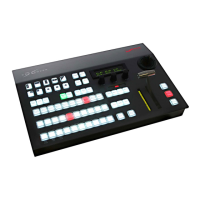
10. Crosspoint Group
A Crosspoint Group is composed of three buses, or rows, of crosspoint buttons. These buses are
the Key Bus, the Background Bus and the Preset Bus.
• Key Bus — This bus is used to select key sources that can be electronically cut, or keyed,
into the background video. The Key Bus is shared between all keyers on the MLE, and
the Utility Buses. The Key Bus can also be assigned to an Aux Bus.
• Background Bus — This bus is used to select the source that is used as the background
video that the keys will appear on top of. The background video is the basis for the
Program output of each MLE, or AuxKey.
• Preset Bus — This bus is used to select the source that you want to transition to with the
next Background transition. The transition can be a Cut, Dissolve, Wipe, or DVE
transition.
Depending on how the Crosspoint Group is assigned, these buses could be for an MLE, Aux
Bus, AuxKey, or an extension of another MLE. An MLE can be thought of as an individual video
layer that can be combined with other video signals, keys, and MLEs to form the composite
switcher output.
In addition to the crosspoint buses, each Crosspoint Group has a module display and a SEL, or
select, button. The display is used to show which MLE, Aux Bus, or AuxKey the Crosspoint
Group is assigned to, and what the Key Bus is currently assigned to. The SEL button is used to
cycle through which key the Key Bus is assigned to on an MLE, default the group, or assign the
group to another MLE.
Pressing the SEL button displays a menu that allows you to assign the Key Bus to a Keyer, Aux
Bus, or a Utility Bus, or the entire Crosspoint Group of MLE 1 to an AuxKey, or another MLE.
For More Information...
• on the Crosspoint Group, refer to the section “Panel Row” on page Ops 4-5.



 To Next Page