11. Cue and Cuelists 223
11.7 Working with Tracking
Hog 4 OS uses tracking, which gives it some very powerful abilities. Tracking can also add
extra complexity, but Hog 4 OS has several functions that make working with tracking
straightforward. For a detailed discussion about the fundamentals of tracking, see Tracking.
11.7.1 Tracking Values Backwards When Recording
You can use the Track Backwards feature when you record a cue to assign the parameter
values to the last cue they appeared in, rather than the cue being recorded. For example,
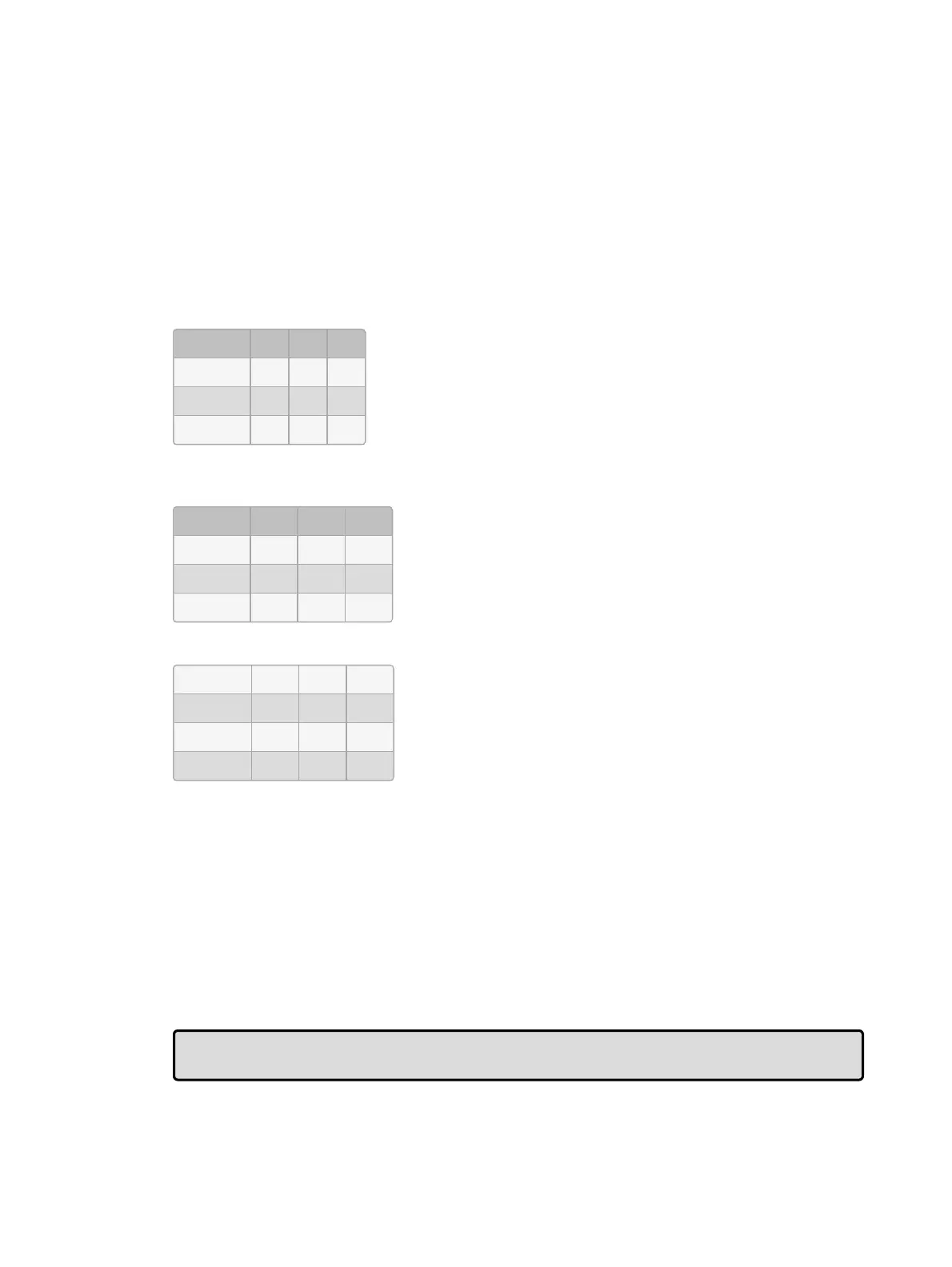
suppose that you have a series of cues with intensity values for three fixtures:
Fixture: 1 2 3
Cue 1 50 50 50
Cue 2 60 60
Cue 3 70
If you assign all three fixtures to 100% and record with merge into Cue 3 (see Insert, Merge
and Replace for recording with merging), you would get these values:
Fixture: 1 2 3
Cue 1 50 50 50
Cue 2 60 60
Cue 3 100 100 100
However, if you did the same thing with Track Backwards, you would get:
Fixture: 1 2 3
Cue 1 50 50 100
Cue 2 60 100
Cue 3 100
The value of 100% has been applied to the last cue that the intensity parameter had a value
in.
If you Track Backwards a parameter that hasn't been given a value since the start of the
cuelist, the value is added to the first cue in the cuelist.
To record a cue with Track Backwards, select the Track Backward button on the Re cord
Option s Toolbar that appears after you press the Re cord key:
1. Fixture 1 Thru 3 @ 1 0 0 Enter .
2. Re cord Cue 3
3. Select Track Backwa rds on the Record Options Toolbar.
4. Ente r
Tip: You can also Track Backwards when you update cues using Auto Update; see Auto
Update.



 To Next Page