4.48
SEL-351A Relay Instruction Manual Date Code 20080213
Loss-of-Potential, Load Encroachment, and Directional Element Logic
Directional Control Settings (Not in SEL-351A-1)
50NFP—Forward Directional Neutral-Ground Current Pickup
50NRP—Reverse Directional Neutral-Ground Current Pickup
Setting Range:
0.005–5.00 A secondary (0.2 A nominal neutral channel input, IN)
If preceding setting ORDER does not contain S or U (zero-sequence voltage-
polarized directional elements: low-impedance or ungrounded/high-
impedance grounded, are not enabled) or the model does not have a 0.2 A
nominal neutral channel (IN), then settings 50NFP and 50NRP are not made or
displayed.
The 50NFP setting (I
N
current value) is the pickup for the forward fault
detector 50NF of the zero-sequence voltage-polarized directional elements:
low-impedance or ungrounded/high-impedance grounded (see Figure 4.8).
Ideally, this setting is above normal load unbalance and below the lowest
expected zero-sequence current magnitude for unbalanced forward faults.
The 50NRP setting (I
N
current value) is the pickup for the reverse fault
detector 50NR of the zero-sequence voltage-polarized directional elements:
low-impedance or ungrounded/high-impedance grounded (see Figure 4.8).
Ideally, this setting is above normal load/system unbalance and below the
lowest expected zero-sequence current magnitude for unbalanced reverse
faults.
a0N—Positive-Sequence Current Restraint Factor, I
N
/I
1
Setting Range:
0.001–0.500 (unitless)
If preceding setting ORDER does not contain S or U (zero-sequence voltage-
polarized directional elements: low-impedance grounded or ungrounded/high-
impedance grounded, are not enabled) or the model does not have a 0.2 A
nominal neutral channel (IN), then setting a0N is not made or displayed.
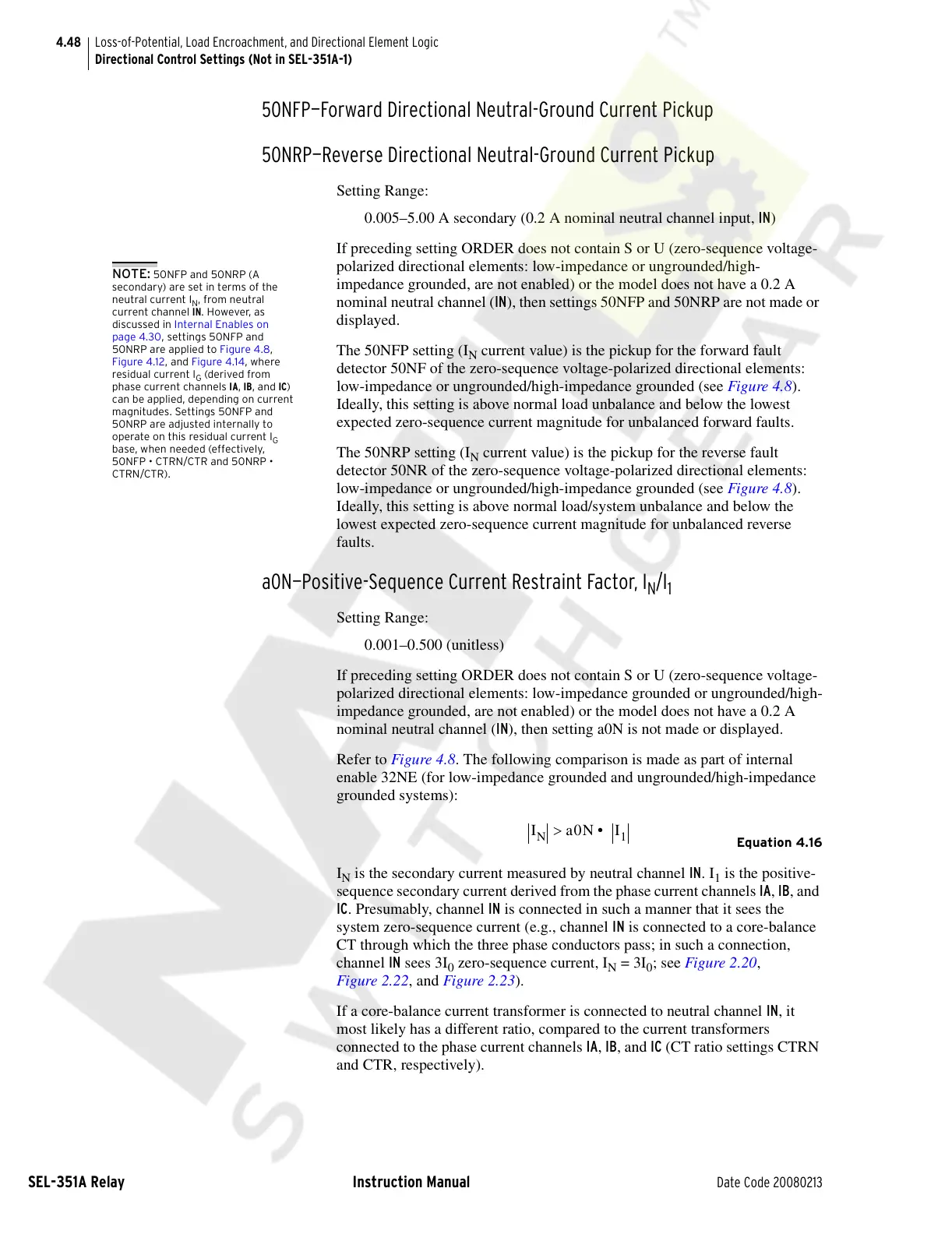
Refer to Figure 4.8. The following comparison is made as part of internal
enable 32NE (for low-impedance grounded and ungrounded/high-impedance
grounded systems):
Equation 4.16
I
N
is the secondary current measured by neutral channel IN. I
1
is the positive-
sequence secondary current derived from the phase current channels IA, IB, and
IC. Presumably, channel IN is connected in such a manner that it sees the
system zero-sequence current (e.g., channel IN is connected to a core-balance
CT through which the three phase conductors pass; in such a connection,
channel IN sees 3I
0
zero-sequence current, I
N
= 3I
0
; see Figure 2.20,
Figure 2.22, and Figure 2.23).
If a core-balance current transformer is connected to neutral channel IN, it
most likely has a different ratio, compared to the current transformers
connected to the phase current channels IA, IB, and IC (CT ratio settings CTRN
and CTR, respectively).
NOTE: 50NFP and 50NRP (A
secondary) are set in terms of the
neutral current I
N
, from neutral
current channel IN. However, as
discussed in Internal Enables on
page 4.30, settings 50NFP and
50NRP are applied to Figure 4.8,
Figure 4.12, and Figure 4.14, where
residual current I
G
(derived from
phase current channels IA, IB, and IC)
can be applied, depending on current
magnitudes. Settings 50NFP and
50NRP are adjusted internally to
operate on this residual current I
G
base, when needed (effectively,
50NFP • CTRN/CTR and 50NRP •
CTRN/CTR).
I
N
a0N I
1
• >
Courtesy of NationalSwitchgear.com


 To Next Page