1.3
Date Code 20080213 Instruction Manual SEL-351A Relay
Introduction and Specifications
SEL-351A Models
Throughout this instruction manual, differences in settings or procedures for
SEL-351A relays that are ordered without an LCD are identified. For
example, all of Section 11: Front-Panel Interface (Only on Models With LCD)
can be disregarded if your relay does not have an LCD.
What’s the Difference
Between the
SEL-351A, SEL-351A-1
and the SEL-351?
The SEL-351A is based on the SEL-351 “family.” It has been created to offer
a lower-cost product and includes some specific features that provide an easy
migration path from the SEL-200 series relays (specifically the SEL-251 and
SEL-267 relays—see “Wire-Alike” Rear Panel Terminal Marking on page 1.4
for more information).
The SEL-351A firmware is based on the SEL-351-5 firmware.
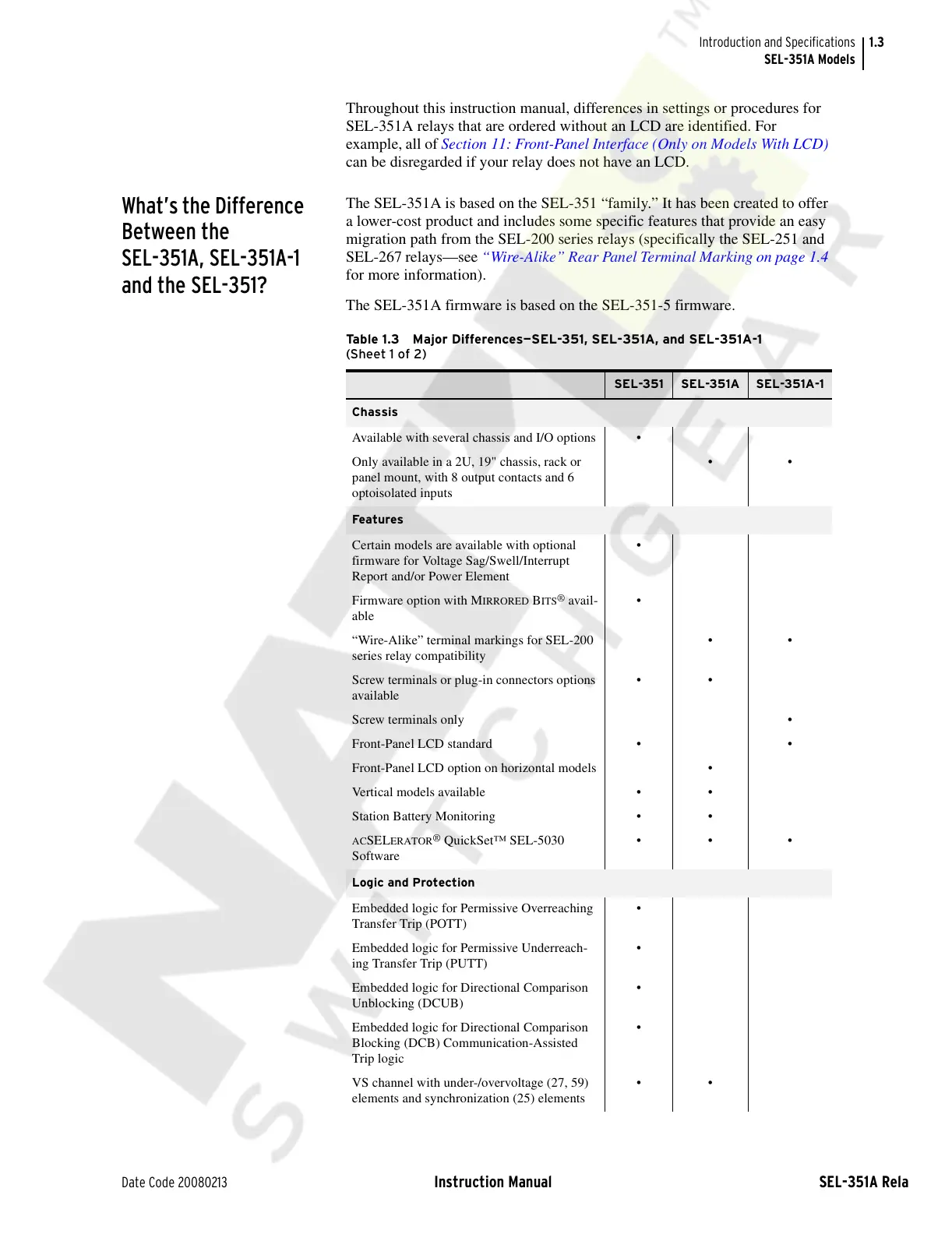
Table 1.3 Major Differences—SEL-351, SEL-351A, and SEL-351A-1
(Sheet 1 of 2)
SEL-351 SEL-351A SEL-351A-1
Chassis
Available with several chassis and I/O options •
Only available in a 2U, 19" chassis, rack or
panel mount, with 8 output contacts and 6
optoisolated inputs
••
Features
Certain models are available with optional
firmware for Voltage Sag/Swell/Interrupt
Report and/or Power Element
•
Firmware option with M
IRRORED BITS
®
avail-
able
•
“Wire-Alike” terminal markings for SEL-200
series relay compatibility
••
Screw terminals or plug-in connectors options
available
••
Screw terminals only •
Front-Panel LCD standard • •
Front-Panel LCD option on horizontal models •
Vertical models available • •
Station Battery Monitoring • •
ACSELERATOR
®
QuickSet™ SEL-5030
Software
•• •
Logic and Protection
Embedded logic for Permissive Overreaching
Transfer Trip (POTT)
•
Embedded logic for Permissive Underreach-
ing Transfer Trip (PUTT)
•
Embedded logic for Directional Comparison
Unblocking (DCUB)
•
Embedded logic for Directional Comparison
Blocking (DCB) Communication-Assisted
Trip logic
•
VS channel with under-/overvoltage (27, 59)
elements and synchronization (25) elements
••
Courtesy of NationalSwitchgear.com


 To Next Page