F.2
SEL-351A Relay Instruction Manual Date Code 20080213
Setting Negative-Sequence Overcurrent Elements
Setting Negative-Sequence Time-Overcurrent Elements
Setting Negative-Sequence Time-Overcurrent
Elements
Negative-sequence time-overcurrent element 51QT should not be set to trip
directly when it is set with a low time-dial setting 51QTD, that results in curve
times below 3 cycles (see curves in Figure 9.1–Figure 9.10). This is because
negative-sequence current can transiently appear when a circuit breaker is
closed and balanced load current suddenly appears. Refer to Figure 3.21 for
more information on negative-sequence time-overcurrent element 51QT.
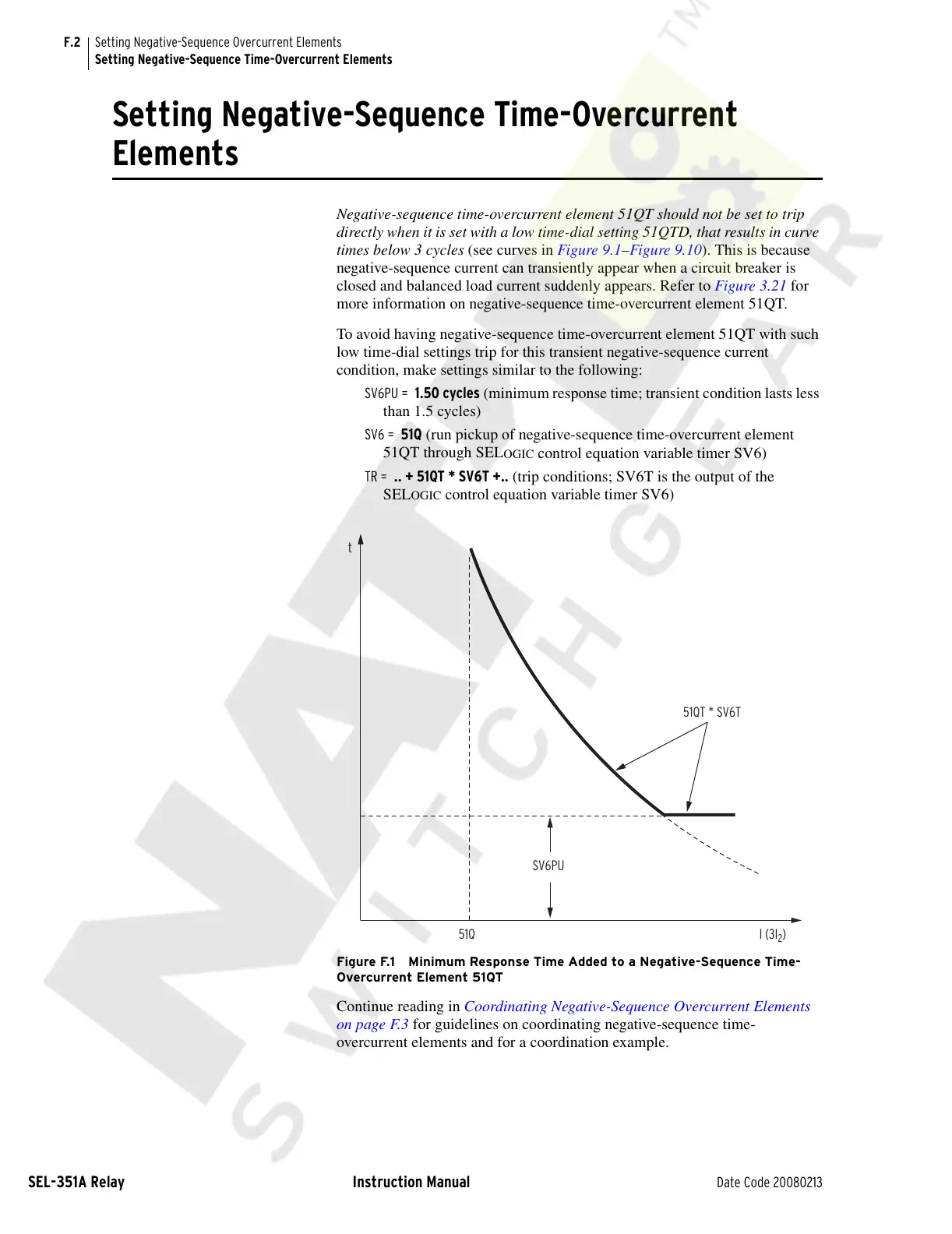
To avoid having negative-sequence time-overcurrent element 51QT with such
low time-dial settings trip for this transient negative-sequence current
condition, make settings similar to the following:
SV6PU = 1.50 cycles (minimum response time; transient condition lasts less
than 1.5 cycles)
SV6 = 51Q (run pickup of negative-sequence time-overcurrent element
51QT through SEL
OGIC control equation variable timer SV6)
TR = .. + 51QT * SV6T +.. (trip conditions; SV6T is the output of the
SEL
OGIC control equation variable timer SV6)
Figure F.1 Minimum Response Time Added to a Negative-Sequence Time-
Overcurrent Element 51QT
Continue reading in Coordinating Negative-Sequence Overcurrent Elements
on page F.3 for guidelines on coordinating negative-sequence time-
overcurrent elements and for a coordination example.
51QT * SV6T
I (3I
2
)51Q
SV6PU
t
Courtesy of NationalSwitchgear.com


 To Next Page