5.7
Date Code 20080213 Instruction Manual SEL-351A Relay
Trip and Target Logic
Switch-Onto-Fault (SOTF) Trip Logic
Switch-Onto-Fault (SOTF) Trip Logic
Switch-Onto-Fault (SOTF) trip logic provides a programmable time window
for selected elements to trip right after the circuit breaker closes. “Switch-
onto-fault” implies that a circuit breaker is closed into an existing fault
condition. For example, suppose safety grounds are accidentally left attached
to a line after a clearance. If the circuit breaker is closed into such a condition,
the resulting fault needs to be cleared right away and reclosing blocked. An
instantaneous overcurrent element is usually set to trip in the three-pole open
(3PO) logic and the SOTF trip logic.
Refer to the switch-onto-fault trip logic in Figure 5.1 (top of figure). The
SOTF trip logic permits tripping if both the following occur:
➤ An element asserts in SELOGIC control equation trip setting
TRSOTF
➤ Relay Word bit SOTFE is asserted to logical 1
Relay Word bit SOTFE (the output of the SOTF logic) provides the effective
time window for an element in trip setting TRSOTF (e.g., TRSOTF = 50P2) to
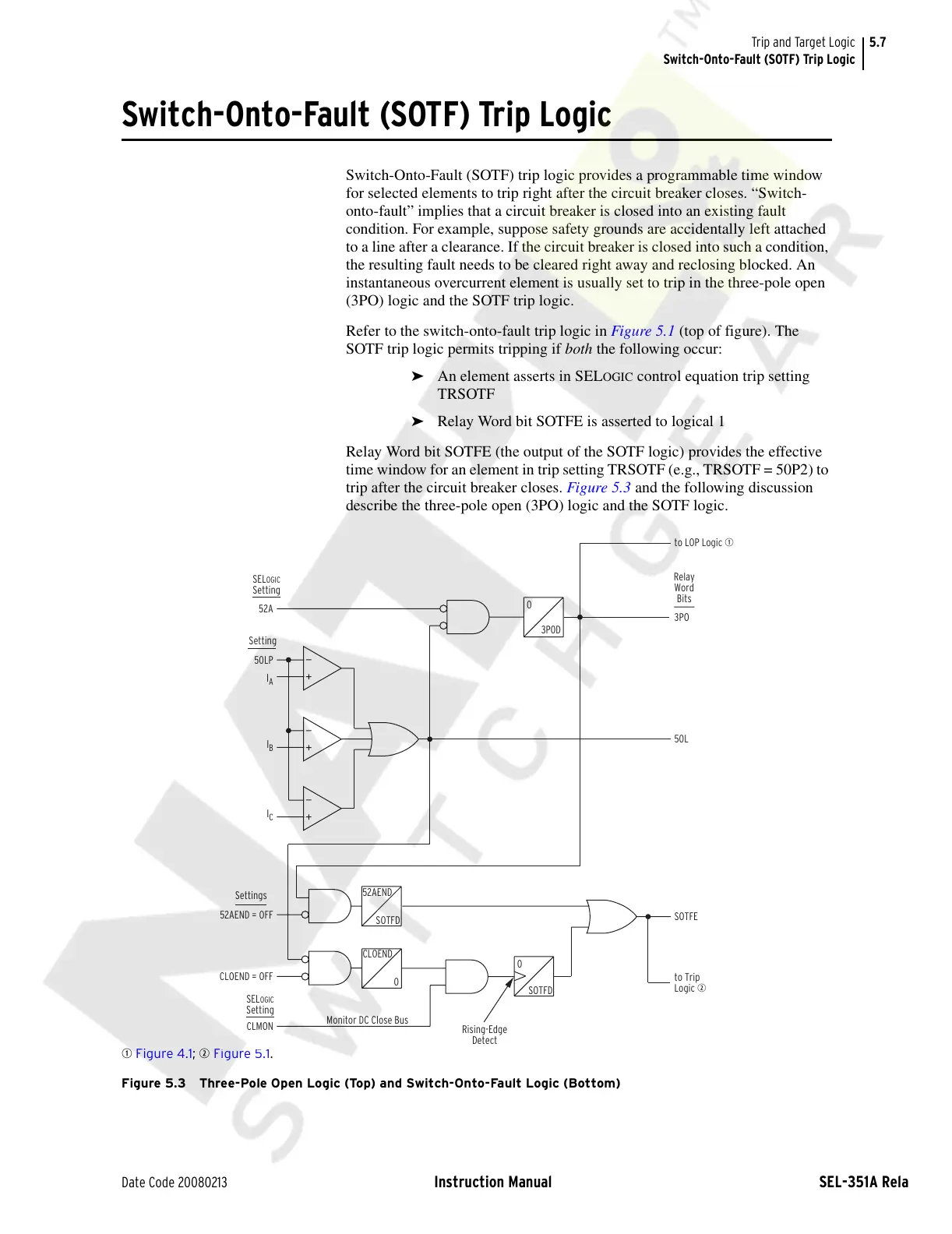
trip after the circuit breaker closes. Figure 5.3 and the following discussion
describe the three-pole open (3PO) logic and the SOTF logic.
q Figure 4.1; w Figure 5.1.
Figure 5.3 Three-Pole Open Logic (Top) and Switch-Onto-Fault Logic (Bottom)
Setting
52A
to LOP Logic
q
3PO
50L
50LP
Monitor DC Close Bus
Rising-Edge
Detect
to Trip
Logic w
SOTFE
Settings
52AEND = OFF
CLMON
CLOEND = OFF
52AEND
SOTFD
CLOEND
0
0
3P0D
0
SOTFD
SEL
OGIC
Setting
SEL
OGIC
Setting
I
A
I
B
I
C
Relay
Word
Bits
Courtesy of NationalSwitchgear.com


 To Next Page