100-412-234 REV. 06 17
2.1.1 Overview of the Welding system
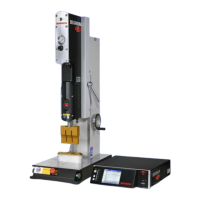
The welding system consists of a power supply, an actuator, and a converter-booster-horn
stack. The system can perform a variety of ultrasonic welding operations, including:
inserting, staking, spot welding, swaging, degating, and continuous operations. It is
designed for use in automated, semi-automated, and/or manual production systems.
2.1.2 Principle of Operation
Thermoplastic parts are welded ultrasonically by applying high-frequency vibrations to the
parts being assembled. The vibrations, through surface and intermolecular friction,
produce a sharp rise in temperature at the welding interface.
When the temperature is high enough to melt the plastic, there is a flow of material
between the parts. When the vibrations stop, the material solidifies under pressure and a
weld results.
Most plastics welders operate at a frequency above the range of human hearing (18 kHz)
and are thus called ultrasonic.
2.1.3 The 2000Xc Power Supply
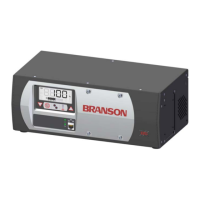
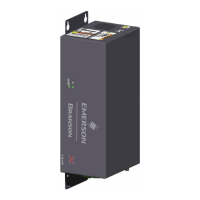
The power supply consists of an ultrasonic power supply module and a system controller.
The ultrasonic power supply module converts conventional 50/60 Hz line current to 20
kHz, 30kHz or 40 kHz electrical energy. The system controller monitors and controls the
welding system.
The power supply is configured with a digital UPS. The digital supply has a library of up to
1000 locked presets which are accessible for various process parameter modifications that
are unique to the power supply itself. These modifications can be named to reflect specific
applications, and are loaded into memory prior to shipment from the Branson factory. The
parameters of the individual presets can be modified by a Branson representative.
Initially, one preset is set to factory default. They are accessed via an RS232 link to the
system controller.
The power supply provides the following features:
• AutoTune with Memory (AT/M): Allows the power supply to track and store the horn
frequency of the last weld.
• Auto Seek: Tracks and starts the horn on the correct frequency. It does this by running the horn
at a low-level amplitude (5%) to find and lock on to the horn operating frequency.
• Line Regulation: Maintains converter amplitude by regulating for variances in the line voltages.
• S-Beam Load Cell: Provides an indication of the force on a part during a weld. This indication
can be used to determine when to trigger ultrasonics and also to produce a force/distance graph
of the operating cycle.
• Load Regulation: Maintains converter amplitude over the full range of rated power.
• System Protection: Protects the power supply by providing five levels of protection.
Voltage
Current
Phase
Temperature
Power
• Frequency Offset: Provides for applying an external frequency offset to the operating
frequency.



 To Next Page