100-412-234 REV. 06 21
2.3 Features of the System
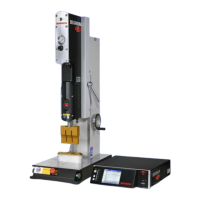
Listed below are many features of the Branson 2000Xc ultrasonic welding system.
• 1 Millisecond Control and Sampling Rate: This feature provides sampling and control of the
weld process 1000 times each second.
• 1000 Presets: User-configurable setups that can be preset allowing you to simply recall a weld
setup to start production.
• 19” Rack Mount Enclosure: Compatible with industry standard 19” rack enclosure systems.
• Adjust While Running: The 2000Xc Power Supply allows you to modify the weld parameters
while the welder is running.
• Afterburst: This feature allows you to set the system weld controls to turn the ultrasonics on
after the weld and hold steps to release parts from the horn.
• Alarms, Process: These are set values used for part quality monitoring.
• Amplitude Stepping: A process controlled by the power supply. At a specified time, energy,
peak power, distance, or by external signal you can change the amplitude during the weld to
control the flow of plastic. This feature helps ensure part consistency, higher strength parts and
control of flash.
• Automatic Preset Naming: If you choose not to name your preset, the power supply will give it
a name that describes the weld mode and main parameter setting.
• Autotuning: Ensures that the welder is running at peak efficiency.
• Collapse Limits in the Collapse Mode: Plus and minus Suspect and Reject limits can be set in
the Collapse Mode.
• Control Limits: With some power supply models, these secondary controls are used in
conjunction with the main parameters of the weld. These user-programmed limits provide for
adaptive control of the weld process.
• Cycle Aborts: These are user programmed conditions (missing part and ground detect) at which
the cycle is terminated. These can be used as safety limits to save wear and tear on the system
and your tooling.
• Cycle Time and Date Stamp: The power supply provides each cycle with a time and date stamp
for production and quality control purposes.
• Digital Amplitude Setting: This feature allows you to set the exact amplitude necessary for
your application, affording increased range and setting repeatability over analog systems.
• Digital Horn Test Diagnostics: In Test mode of the power supply, you can view the Horn Test
results in digital form, using digital readouts and bar graphs on the power supply to give you the
best picture of the stack’s operation.
• Digital Tuning: Means to tune the power supply for applications and horns at the extremes of
the power supply capture range.
• Digital UPS: The Digital UPS has programmable (through a digital interface from a system
controller) features which allow true autotune and start ramp during set-up. Power supply
presets can be customized.
• Downspeed: Controls the rate of descent and impact on the part.
• Encoder: Allows the power supply to monitor the distance the horn has travelled, enabling the
use of distance functions.
• Energy Compensation: Extend the weld time up to 50% greater than the weld time setting or
to whenever the min. energy is reached or; shut off the weld before the expected (set) weld time
if maximum energy value is reached.
• English (USCS)/Metric Units: This feature allows the welder to be set up in the local units in
use.
• Foreign Languages: Software supports user selectable languages; English, French, German,
Italian, Spanish, Traditional Chinese, Simplified Chinese, Japanese and Korean.
• Frequency Offset: This process feature allows a user to set a frequency value, for certain
specific applications, where the force imparted on the fixture or anvil causes a frequency shift in
the Stack’s operation. You should only use this feature when advised to do so by Branson.



 To Next Page