10 Instruction Manual QuickTOC
®
ultra
IECEx 12E5119
2 Operating Principle of the Analyser
2.2 High Temperature Method at 1,200°C LAR | PROCESS ANALYSERS AG
2.2 High Temperature Method at 1,200°C
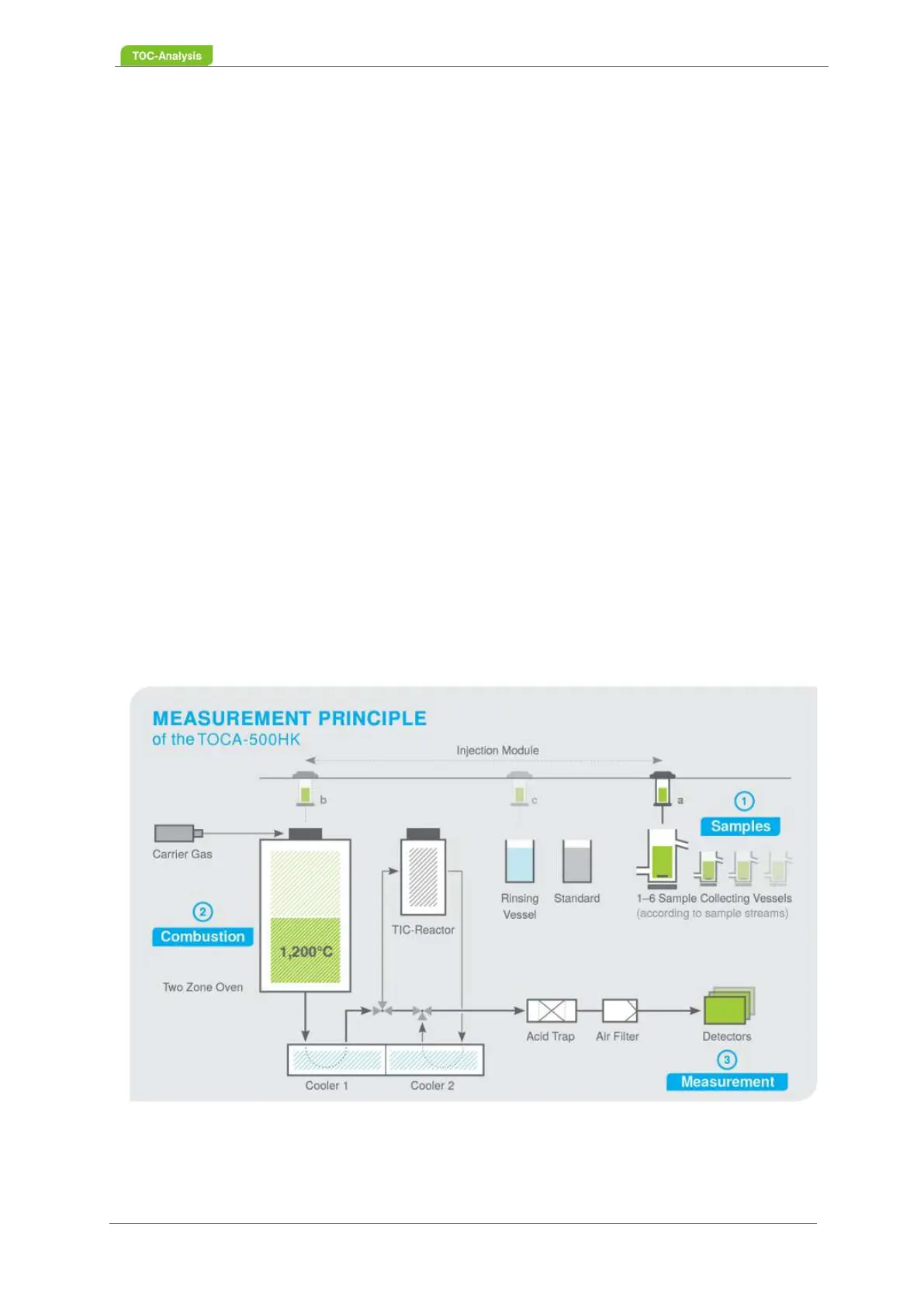
In the ceramic furnace without catalyst the carbon compounds are reliably oxydized at a combustion
temperature of 1,200°C. This high temperature method does not require a filtration. The NDIR detector
(Non-Dispersive Infrared) detects the CO
2
contents of the sample. If required, the samples can be ho-
mogenised and be measured with all particles contained within, allowing for measurement of the TRUE
TOC.
2.3 High Temperature Method vs. Wet Chemical Method
High temperature methods (as well as wet chemical methods, such as the UV persulphate method) are
used to determine the TOC. The advantages of the high temperature method compared to the wet chem-
ical UV persulphate method is described in the European Norm EN 1484:1997:
“Devices which determine the TOC with the UV persulphate method are not appropriate for media
containing suspended and turbided solids”.
Furthermore, Wei reports in the “Proceedings of the Water Quality Technology Conference (1998, Paper
2-E2)“ that the UV persulphate method can show TOC values between 30 and 50% lower than with the
high temperature method, while the values measured can have a 23% higher variance. It is for these
reasons that the high temperature method is the more common method in waste water analysis. For this
reason, it is also used in the QuickTOC
®
ultra
.
2.4 The Measurement Principle of the TOC-Difference Method
Fig. 2: Measurement Principle of the TOC-Difference Method


 To Next Page