FSLG-HETCOR
User Manual Version 002 BRUKER BIOSPIN 121 (327)
Setting up FSLG HETCOR 8.2
1. This experiment requires a probe of 4 mm spinner size or smaller. One can run
it on a 7 mm probe, but the results will not be very convincing.
2. Start from a data set with well adjusted cross polarization and proton decou-
pling at fairly high RF-fields. Unlike standard multiple pulse decoupling, which
only works well at very high RF-fields, FSLG requires only moderately high RF
fields. Decent performance is achieved at 80-100 kHz proton field. At lower
magnetic fields (200-300 MHz proton frequency) lower RF-fields are adequate,
RF fields of 100 kHz and higher perform better at higher magnetic fields (500
MHz and up).
3. Insert a suitable test sample, spin at a suitable speed. We recommend
13
C la-
beled tyrosine hydrochloride, since it has a wide spread (2.5-12ppm) of proton
shifts, a short proton T
1
, a well resolved
13
C-spectrum with quite many lines,
and it is readily available. The unlabeled sample can also be used, but re
-
quires a few more scans (8-32).
4. Optimize the spin rate such that no overlap occurs between center- and side-
bands (especially with the labeled sample, in order to avoid rotational reso-
nance broadening). Re-optimize decoupling and HH-condition. Check the
proton RF-field via the proton 90° pulse p3. Set pl13 = pl12, set cnst20 to RF-
field in Hz as calculated from p3.
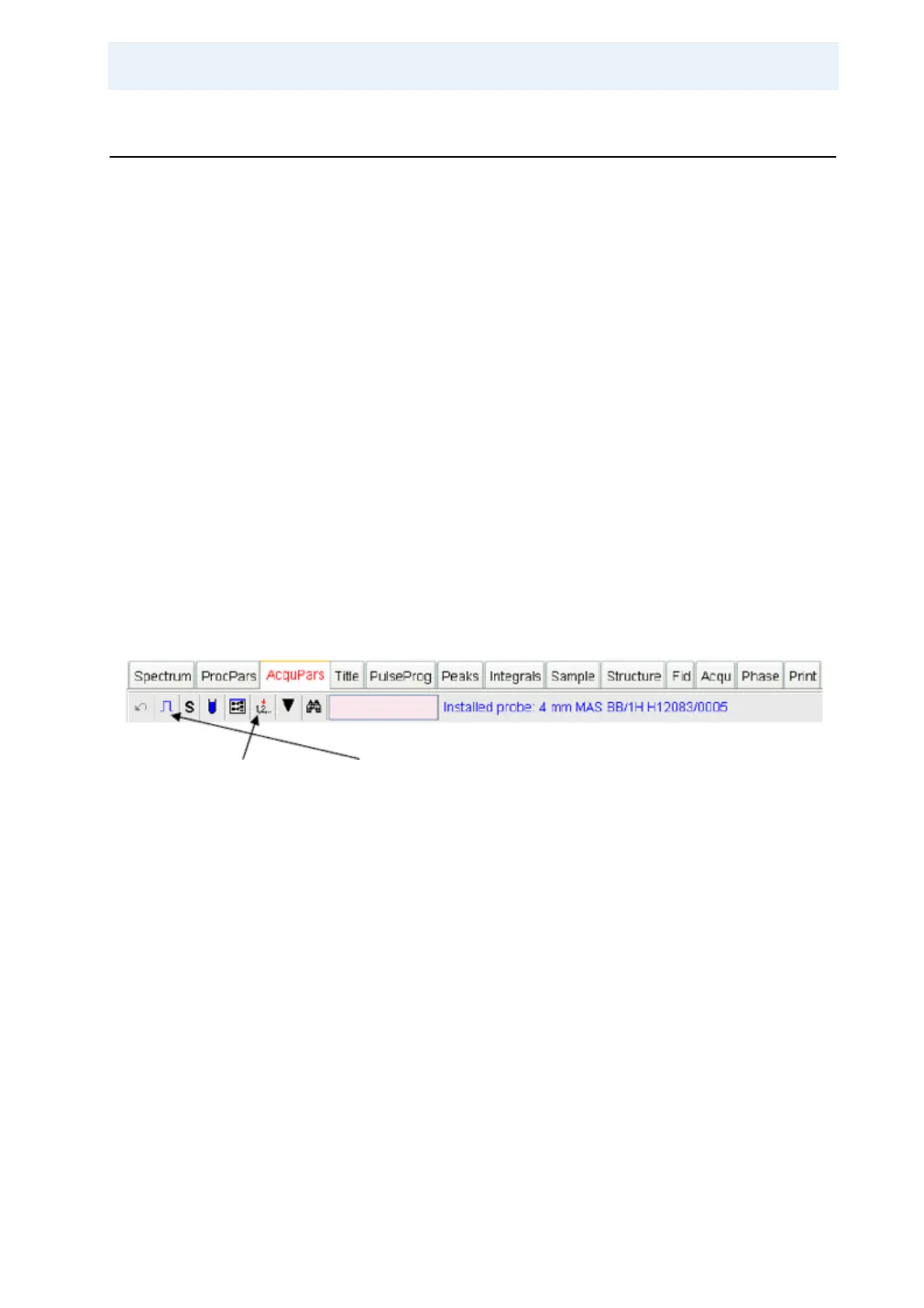
5. Generate a new data set with edc, new. Set pulprog lghetfq and change to a
2D parameter set using the “123” button in eda. Set FnMode to STATES-TPPI.
Type ased or click the pulse symbol in eda.
Figure 8.2. The “12...” icon, and the ased icon in eda.
6. Performing ased will show all parameters which are essential for the acquisi-
tion, not all available parameters. In addition, it performs calculations which are
specified in the pulse program. Note that all parameters which are calculated
are not editable, and will show only, if explicitly used during the main pulse pro
-
gram between ze and exit. In this sequence, the proton chemical shift evolu-
tion is influenced by the RF field (cnst20) under which the shifts evolve and
the type of
homonuclear decoupling sequence (FSLG in this case) which
scales chemical shifts (by about 0.578 in this case). In order to obtain proton
chemical shifts at the standard scale, both parameters are taken into account
and an increment along F1 is calculated which yields correct chemical shifts
for protons. Transfer this increment to IN_F1 in eda (A button in ased). This
will set the sweep width along F1. Note that the time increment here is gener
-
ated by a loop counter, counting the periods of FSLG. The loop counter l3 is
used to multiply this increment. Usually, l3 is set to 2-4 in order to reduce the
F1 sampling width to a reasonable value. Cnst24 is usually set to -1000 - -
2000 in order to move the spectrum away from the center ridge in F1.



 To Next Page