Final Remarks
User Manual Version 002 BRUKER BIOSPIN 167 (327)
Final Remarks 12.3
The REDOR sequence is a powerful tool to measure distances in different spin
systems. But, as seen above, already a small error during the setup procedure will
finally lead to severely stretched distances calculated in the interpretation process
of the measured data. Although the results using S
IMPSON simulations are in a
much better agreement with the expected values, the simulations cannot compen-
sate for the errors introduced by a faulty setup. Additionally it is not always possib-
le to use the simulations for the interpretation of experimental data, e.g. in the
case of multispin systems or amorphous systems it may not possible to get reli-
able input data for the simulations setup.
In any case, in order to be sure of the correct setup of the experiment it is abso-
lutely necessary to proof the experimental setup on a known spin system like the
glycine in order to check the robustness of the overall sequence setup. After this
validation and calibration process the sequence can then be used to determine
distances or M
2
values for unknown samples by using the calibrated experimental
setup. Experiments on unknown samples should be measured as close to the cal-
ibration run as possible to minimize the influence of experimental fluctuations
(pressure changes and consecutive spin rate changes, temperature changes and
consecutive pulse power changes and the like).
Of course a qualitative comparison within a set of samples is always possible with
the same set of experimental parameters without doing a full calibration run.
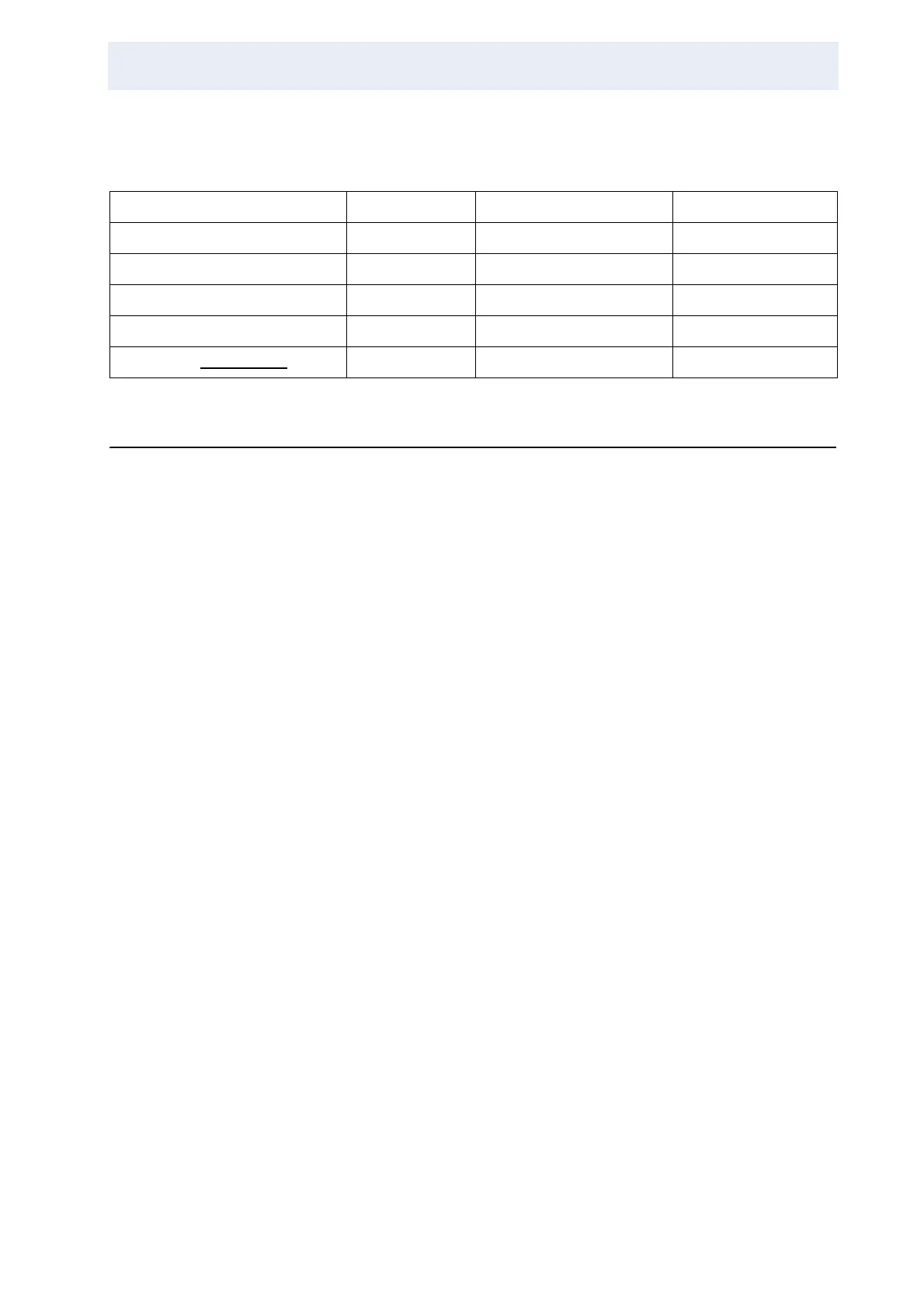
Table 12.2. Results for the M
2
Calculation and the Simulations
Measurement M
2
[s
-2
] Dipolar coupling [Hz] Distance [Å]
experiment 4.4E6 747 1.6
ideal pulses 7.3 / (6.3)E6 964 / (896) 1.47 / (1.5)
10% pulse error 7.3 / (5.7)E6 964 / (850) 1.47 / (1.53)
850 Hz dipolar coupling 5.7 / (5.0) E6 850 / (800) 1.53 / (1.56)
theoretical (reference 9.
) 7.3E6 964 1.47



 To Next Page