238 (327) BRUKER BIOSPIN User Manual Version 002
MQ-MAS: Sensitivity Enhancement
one rotor period and the spinning frequency is increased (and hence the rotor pe-
riod decreased). On “real life” samples the differences between signal intensities
at one rotor period compared to e.g. ¼ rotor periods will be more pronounced than
on a crystalline model compound. Since the spinning frequency is usually deter
-
mined by the spectrum itself, the only degree of freedom is the amplitude of the
sweep. In the example chosen here any of the conditions will provide a good qual
-
ity spectrum, and the condition with the biggest enhancement at the least power is
to be preferred.
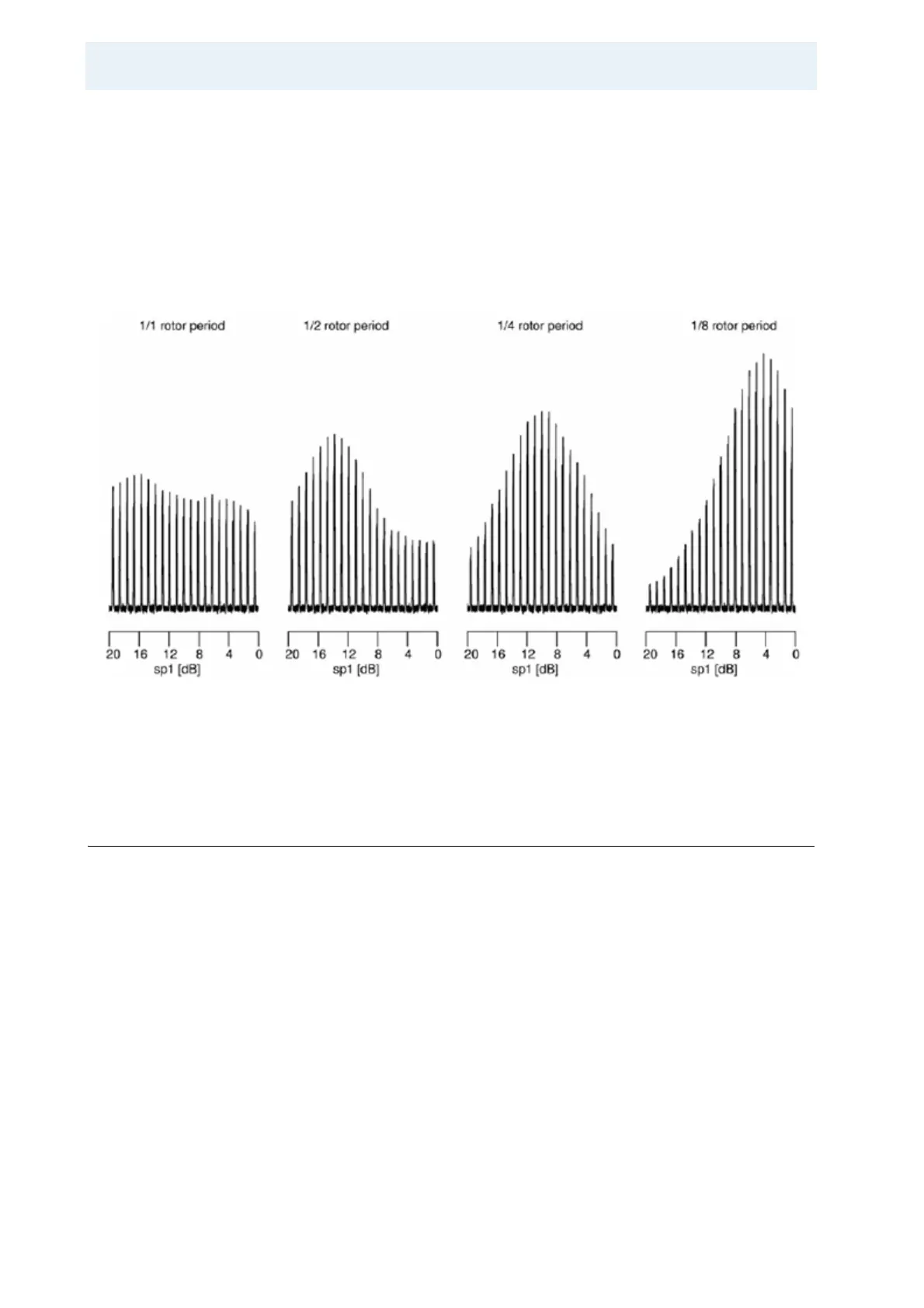
Figure 18.6. Signal Intensities of
87
Rb in RbNO
3
Signal intensities of
87
Rb in RbNO
3
as function of duration and RF field amplitude
for double frequency sweeps.
2D Data Acquisition 18.2.2
After the parameters for the DFS are adjusted the 2D data acquisition can be pre-
pared. In tables 2 and 3 the important parameters are listed for the two pulse se-
quences. Parameters are listed separately for F1 and for the pulse program
relevant parameters which should be set in eda and ased, respectively.
The 3-pulse sequence used in mp3qdfs.av creates a phase modulated data set
and therefore, FnMODE must be QF. However, since a whole echo acquisition is
performed a pure absorption mode spectrum can be obtained. Increments for D10
and D11 must be set correctly so that a standard two-dimensional FT can be ap
-
plied.
Using the 4-pulse sequence mp3qdfsz.av FnMode must be States or States-TPPI,
so that the shearing FT can be performed for processing. However, no shearing is
required in case of nuclei with spin I=3/2 where a split-t
1
experiment can be per-
formed, in which case IN10 must be set correctly.



 To Next Page