76 (327) BRUKER BIOSPIN User Manual Version 002
Basic Setup Procedures
Setting Up for Cross Polarization on Adamantane 4.6
Cross polarization is used to enhance the signals of X-nuclei like
13
C. The strong
proton polarization is transferred (cross polarized) to the X-nuclei coupled to the
protons via strong dipolar couplings. To achieve this, the protons and the X-nuclei
must nutate at the same frequency. This frequency is the RF field applied to both
nuclei at the same time (contact time). If this condition (Hartmann-Hahn-condition)
is met, the transfer of proton magnetization to carbon is optimum. Since the pro
-
ton signal of adamantane is resolved into spinning sidebands even at slow spin
rates, this Hartmann-Hahn condition can be set to match for every proton spinning
sideband. Using a ramp for the proton contact pulse, the Hartmann-Hahn match is
swept over these possible match conditions and becomes insensitive to miss-sets
and different spin rates.
Start from the data set used for observing
13
C under proton decoupling (1.4).
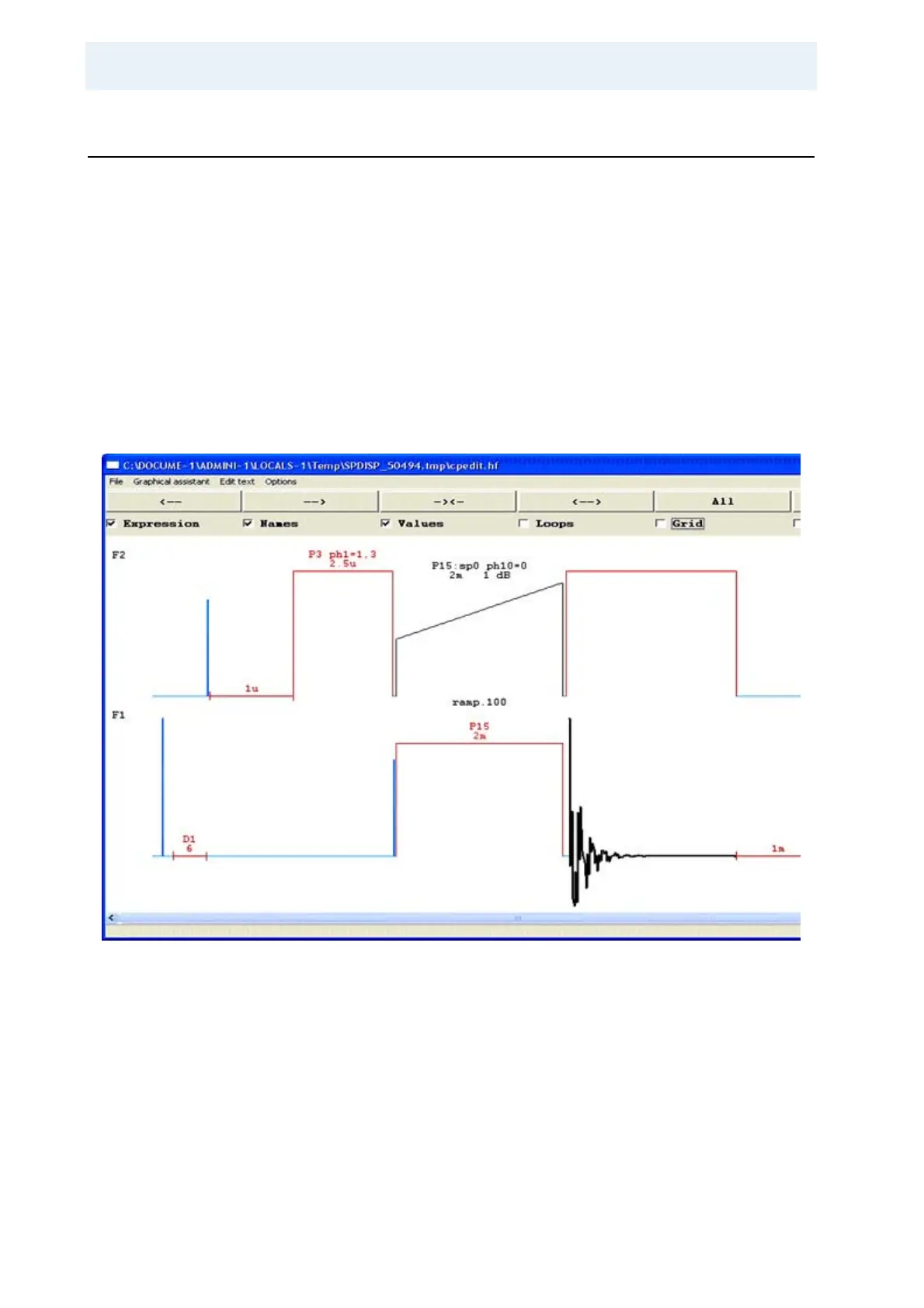
Load the pulse program cp (in eda or typing pulprog cp). The pulse sequence is
depicted in the following figure:
Figure 4.20. A cp Pulse Sequence



 To Next Page