MQ-MAS: Sensitivity Enhancement
User Manual Version 002 BRUKER BIOSPIN 233 (327)
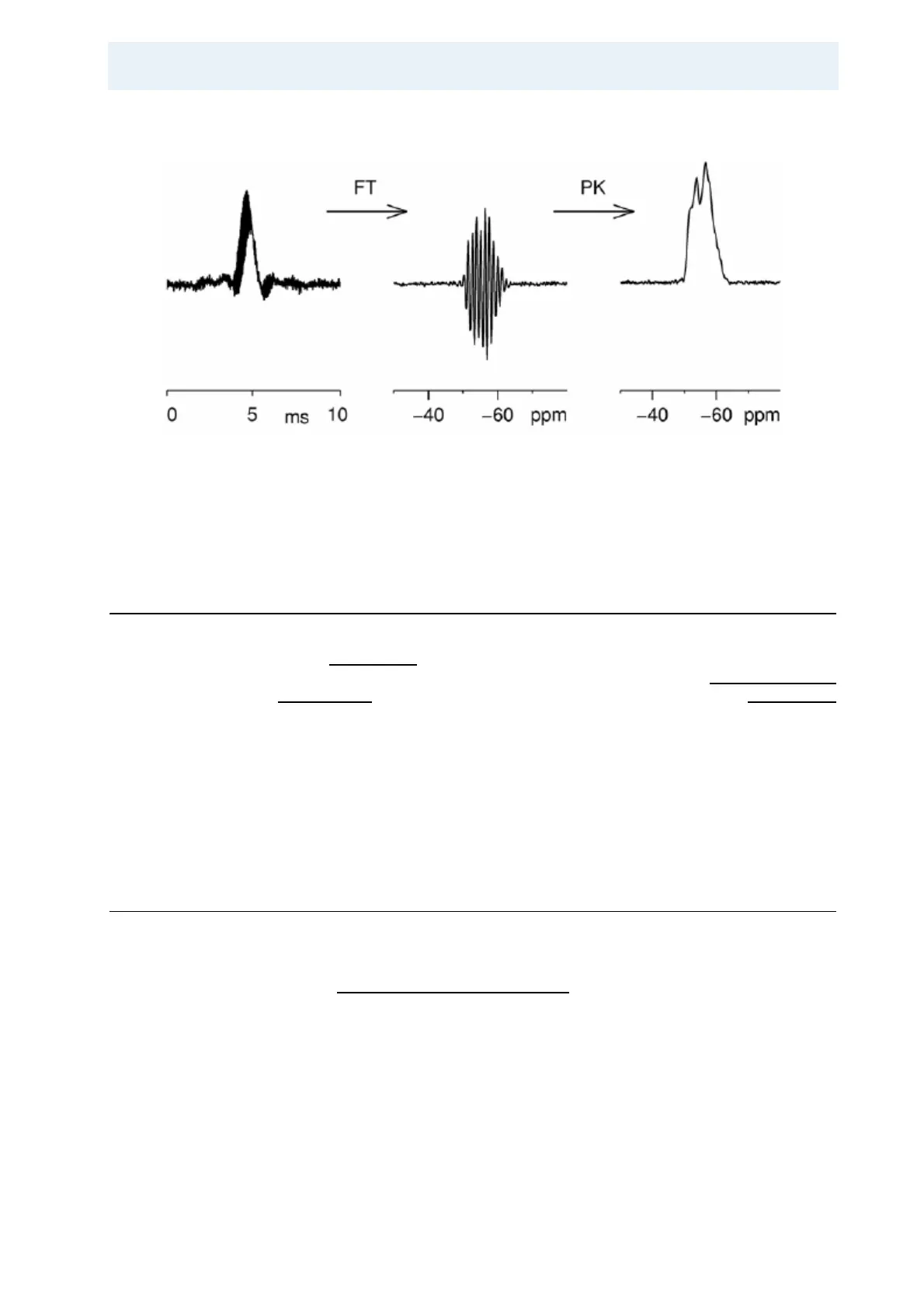
Figure 18.2. Processing of Hahn Echo. Left is the Shifted Echo.
The middle shows the spectrum after FT. On the right is the spectrum with the cor-
rect first order phase correction.
Implementation of DFS into MQMAS Experiments 18.2
Two pulse sequences are available to implement a double frequency sweep
(DFS).
Figure 18.3. shows the 4-pulse sequence with z-filter, mp3qdfsz.av. The
principle of this sequence is already described in the chapter "Basic MQ-MAS"
on page 213, with a CW pulse instead of a DFS for conversion. Figure 18.4.
shows a 3-pulse sequence with a shifted echo acquisition in a split-t
1
experiment,
mp3qdfs.av. In both sequences the same sweep is used. Both sequences start
with an excitation pulse p1 that creates 3Q coherence which is allowed to evolve
during the evolution period D0. The sweep during P2 is used to change (non-ob
-
servable) 3Q coherency to observable SQ coherency. In the 4-pulse sequence
they pass through a z-filter by a sequence of CT selective 90°-90° pulses P3-D4-
P3. In the 3-pulse sequence a delay D6 is introduced so that the obtained signal
can first dephase and then be refocused with a 180° CT selective pulse.
Optimization of the Double Frequency Sweep (DFS) 18.2.1
At this point it is assumed that the pulses p1, P3, and P4 together with their corre-
sponding power levels PL11 and PL21 are already calibrated as described in the
chapter
"Basic MQ-MAS" on page 213. Starting from this set-up a data set
should be created into which either of the two DFS pulse programs is loaded.



 To Next Page