78 (327) BRUKER BIOSPIN User Manual Version 002
Basic Setup Procedures
The wiggles besides the signals stem from truncation of the FID after 50 msec ac-
quisition time.
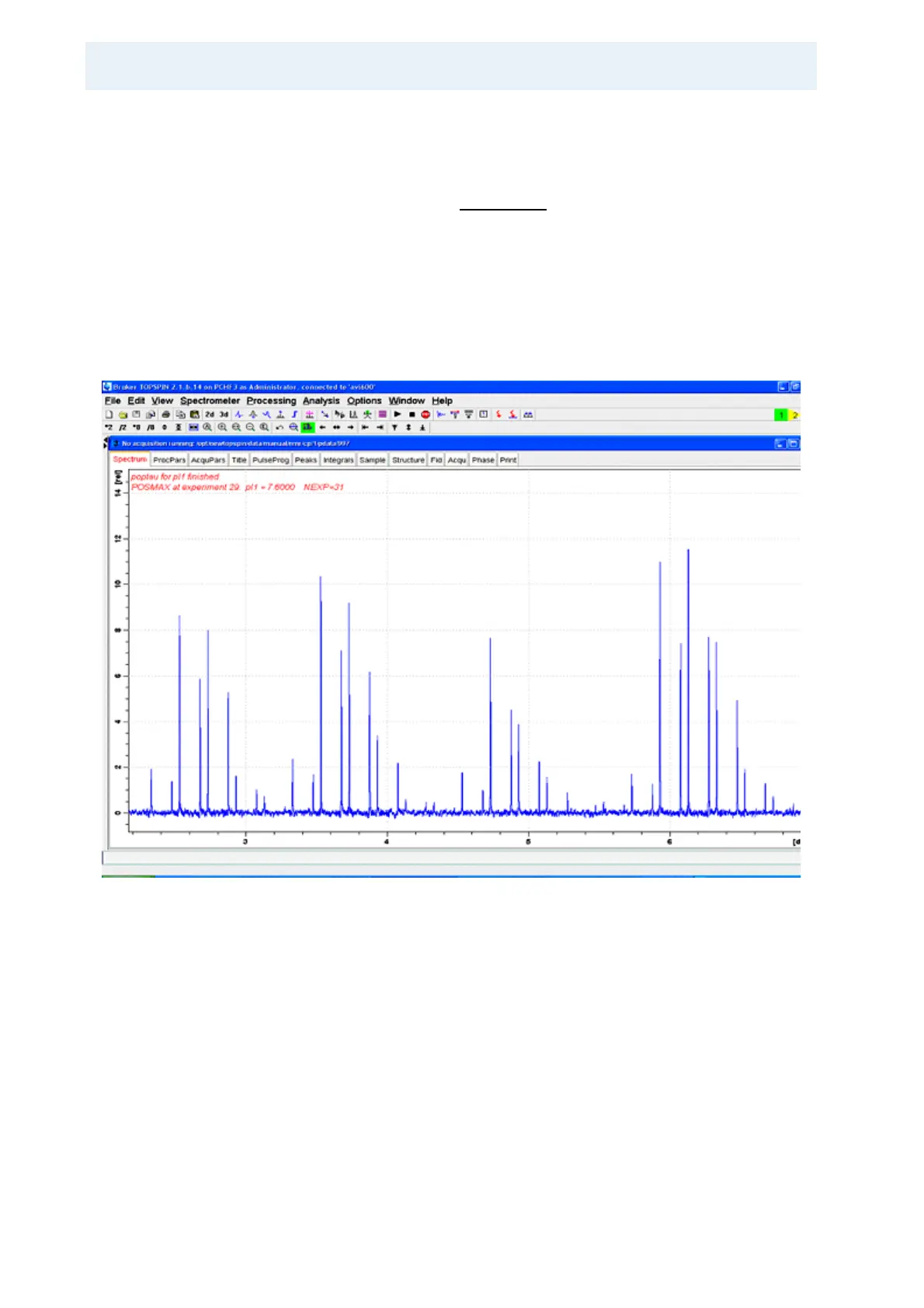
To exemplify the existence of several HH-conditions on a spinning adamantane
samples, another HH profile (
Figure 4.22.) is shown where a square proton con-
tact pulse is used. There are several maxima corresponding to matches on the
sideband orders n+2, n+2, n+1, n+0, and n-1. The largest intensity is seen for n+/
-1, the intensities are very sensitive to the RF-level which is varied in 0.2 dB steps.
Using a ramp makes the experiment much more stable and more quantitative.
Problems may arise if the proton T
1ρ
is short, since usually longer contact times
must be employed. It makes therefore sense to use a flatter ramp (70-100%) and
optimize for the spin rate which is used.
Figure 4.22. Hartmann-Hahn Optimization Profile Using a Square Proton Contact
Pulse
The sideband order 0 at 4.8 dB gives a rather small intensity. A ramp sweeping
over 3.5-6.5 dB would cover both most efficient HH conditions. Note that increas
-
ing the spin rate would shift all maxima except the one at 4.8 dB further out.



 To Next Page